Asbestos Abatement in Wichita: The 10-Working-Day Window, the Floor Tile Trap, and What KDHE Actually Wants on Your Notification
Asbestos abatement Wichita: a Kansas-licensed practitioner walks through the federal NESHAP threshold, KDHE notification chain, Sedgwick County wrecking permit, and the floor tile decision that turns a Day 1 renovation into a Day 3 RACM project.
It is a Monday in May. A facility owner in northeast Wichita decides the second-floor administrative wing of a 1978 office-and-shop building has to be reskinned before a tenant moves in on July 15. The drawings show new carpet over the existing 9x9 vinyl composition tile, a chiller swap on the mechanical mezzanine, and replacement of about 180 linear feet of pipe insulation in the chase between the boiler room and the AHUs. The GC pulls up the calendar, blocks the trades, and asks the property manager when the floor crew can start.
The honest answer is: not for at least 10 working days, and only after a KDHE-certified inspection of the existing materials, a Kansas-licensed asbestos contractor on contract, a written notification filed with the Kansas Department of Health and Environment, and a path to the Sedgwick County wrecking permit that does not move until the abatement chain is documented. The question is not whether asbestos abatement Wichita rules apply to this job. The question is whether the schedule survives the discovery that they do.
This is what asbestos abatement Wichita actually looks like in 2026 — the regulatory geometry, the cost shape, the decision points that turn a routine renovation into a regulated project, and the way a competent Kansas-licensed crew structures the work so the owner does not lose the calendar to a single oversight.
What Triggers Asbestos Abatement Wichita Rules in the First Place
The federal floor sits at 40 CFR Part 61 Subpart M, the National Emission Standard for Hazardous Air Pollutants for asbestos. The applicability test is quantitative: a renovation or demolition triggers NESHAP-prescribed work practices, notifications, and disposal requirements when the project will disturb at least 260 linear feet of regulated asbestos-containing material (RACM) on pipes, 160 square feet of RACM on other facility components, or 35 cubic feet of RACM off facility components where prior measurement was not possible (40 CFR 61.145(a)(1)). Below those thresholds, the wet-method, no-visible-emissions, and disposal rules still attach to whatever asbestos is disturbed, and a demolition still requires the owner to notify the agency — but the prescriptive removal sequencing does not apply.
Kansas implements the federal rule under KAR 28-50, enforced by KDHE. Two pieces of the Kansas implementation matter on every Wichita job. First, the business entity performing the work has to hold an active Kansas asbestos abatement contractor license, and the supervisor and crew have to hold valid Class I or Class II worker certificates (KAR 28-50-5). Second, the licensee or property owner has to submit a written project notification to KDHE at least 10 working days before the project starts (KAR 28-50-8) — the same 10-working-day floor as the federal NESHAP at 40 CFR 61.145(b). The fee structure runs a baseline charge plus, for projects at or above the 260 lf / 160 sf threshold, an additional 0.5% of contract value capped at $2,500.
On top of those two layers, Wichita and unincorporated Sedgwick County run demolition and wrecking permits through the Metropolitan Area Building and Construction Department (MABCD). MABCD does not operate an independent asbestos program. It enforces the federal and Kansas chain as a precondition of issuing the wrecking permit — meaning the GC cannot pull the permit until the KDHE notification is on file and the abatement is either complete or scheduled.
The compressed version: any demolition or any renovation that crosses the RACM threshold in Wichita triggers three notification and authorization paths at once, all anchored on the same 10-working-day window.
The 10-Working-Day Window Is the Schedule
Treat the 10-working-day notification window as a hard floor on every Wichita commercial project that has any chance of disturbing RACM. The clock does not start when the contract is signed. It starts when KDHE accepts a properly completed notification — which requires that the survey is done, the contractor and supervisor are named, the removal methodology is described, the transport route is mapped, and the receiving landfill is identified. A project that has not yet been surveyed is a project that has not yet started its 10-working-day clock.
This is why competent abatement scheduling in Wichita runs in three phases. Phase one is the survey — a KDHE-certified asbestos building inspector quantifies the RACM by location and material type, and that quantification feeds the notification. Phase two is the notification window — 10 working days, during which the contractor mobilizes containment materials, decon equipment, and crew credentials, and the GC coordinates trades around the abated area. Phase three is the work itself — wet-method removal under HEPA-filtered negative-pressure containment, daily air monitoring, and packaging for permitted disposal.
The owner who tries to compress phases one and two into a weekend loses every time. There is no expedited NESHAP path for commercial work in Kansas. There is no fee schedule that buys around the 10 working days. The only way to protect the schedule is to put the survey on the critical path 12 to 14 working days before mobilization — which is also when the GC and the abatement contractor should be confirming the disposal facility, the manifest, and the post-job air-clearance protocol.
What Asbestos Abatement Costs in Wichita
The honest answer to “what does it cost?” is that the project shape — not the keyword search — sets the number. A defensible budget for a Wichita commercial abatement project has five components, in this order:
- The pre-project survey. A KDHE-certified inspector quantifies RACM by location, samples and submits bulk samples to an accredited lab for PLM analysis, and produces the documented inventory that drives the notification. Survey scope scales with building size and material complexity.
- The KDHE notification fee. Baseline fee plus the 0.5% of contract value (capped at $2,500) when the project crosses the 260 lf / 160 sf threshold. Predictable line item.
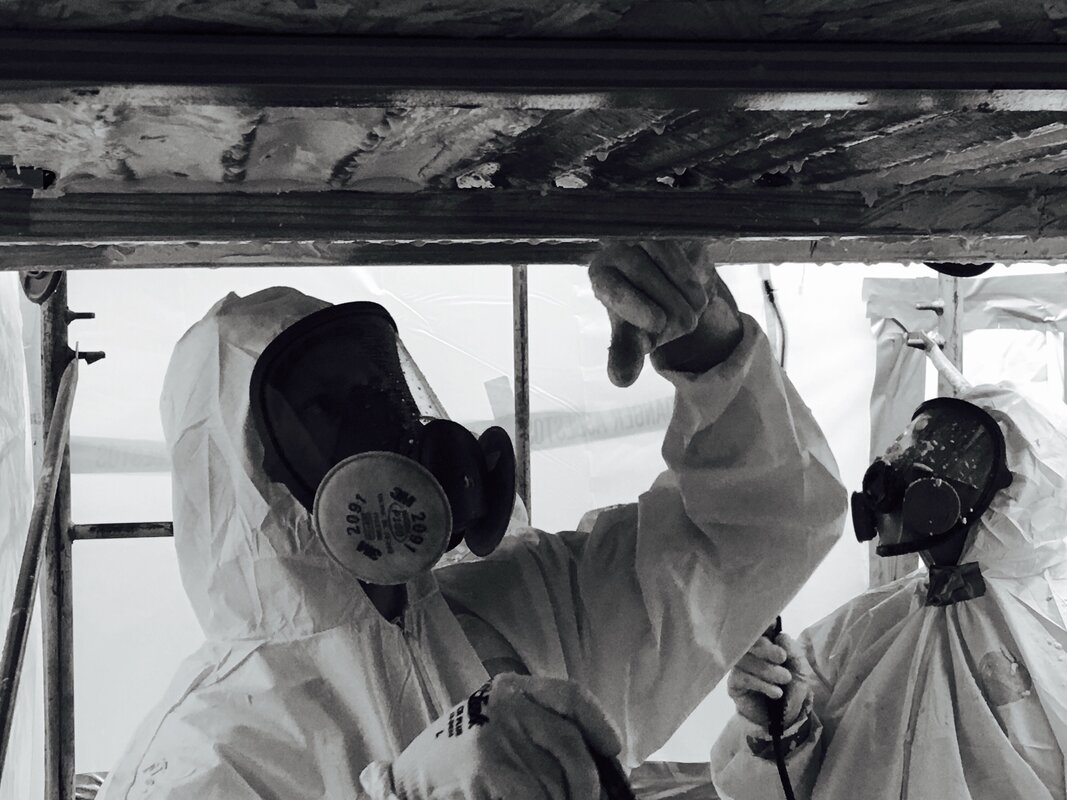
- The abatement labor and containment. Crew hours under full OSHA construction asbestos protections (29 CFR 1926.1101) — exposure assessment, regulated area posting, full Tyvek and respirator program, decon airlocks, HEPA-filtered negative-pressure containment, and supervisor presence throughout. This is the largest single line item on most projects and the one most affected by methodology choice.
- Disposal — packaging, transport, tipping. RACM goes to a Subtitle D landfill permitted to receive asbestos. In the Wichita area the standard pathway is Plumb Thicket Landfill in Bel Aire, operated by Waste Connections, which accepts asbestos as a permitted special waste. The waste shipment record is retained for at least two years (40 CFR 61.150(d)).
- Air clearance and final documentation. Visual inspection plus aggressive air sampling against the 0.01 f/cc clearance threshold before containment teardown, plus the final close-out package that the GC needs for the MABCD wrecking permit and the owner needs for transaction-due-diligence purposes later.
The cost framing iSi uses with Wichita buyers is anchored in this structure rather than in a unit price quoted out of context. A property owner who is told “asbestos abatement is $X per square foot” without a survey is being given a number that has nothing to drive it.
What does drive the number — and where most surprises live — is the methodology decision on Day 1.
How Floor Tile Removal Differs From Pipe Insulation (the Decision That Sets the Project)
Here is the place where most Wichita renovations go sideways. Vinyl asbestos floor tile and the underlying black asphaltic mastic are classified as Category I non-friable asbestos-containing material under 40 CFR 61.141. Category I non-friable ACM is not automatically RACM. It becomes RACM only when it has become friable in service, or when it will be sanded, ground, cut, or abraded during removal.
That definition is the floor tile trap, and it cuts both ways.
On the conservative side, the trap is the contractor who reflexively calls every floor tile removal a full NESHAP abatement project. That over-scopes the work, inflates the cost, and treats the regulatory definition as a marketing tool rather than as the technical line it actually is. A pre-1980 9x9 vinyl asbestos tile in good condition, removed intact by hand with floor scrapers and a heat gun and no power tools, can in some narrow cases be disposed of as non-RACM construction debris — provided the disposal facility accepts it and the documentation supports the non-friable status throughout the chain.
On the aggressive side, the trap is the opposite — the GC or owner who assumes “it’s just floor tile” and schedules a mechanical removal crew with ride-on shotblasters, dry scrapers, or chemical strippers. The moment that equipment touches the tile, the material is being abraded, and Category I non-friable ACM becomes RACM. Now the project requires the full NESHAP chain — 10-working-day notification, KDHE-licensed crew, containment, wet removal, RACM disposal — and the property owner has just discovered on Day 3 that the schedule is gone and the budget is wrong.
The honest practitioner answer to a Wichita owner asking “do we have to abate this floor tile?” is: it depends on the removal method we propose, and we would rather walk through that decision with you on Day 1 than discover it on Day 3. The owner who hears that answer is getting an accurate one. The owner who hears “yes, all floor tile is a NESHAP abatement project” or “no, floor tile is never regulated” is getting a sales pitch.
Pipe insulation does not carry the same ambiguity. Thermal system insulation — magnesia, calcium silicate, asbestos cement — is friable by definition in most service conditions and is treated as RACM on the front end of the project. Containment, wet-method removal, double 6-mil poly bagging, OSHA asbestos warning labels, manifested disposal. The 180 linear feet of pipe insulation in the example at the top of this post is RACM from Day 1 and drives a full notification by itself if it crosses the 260 linear feet threshold across the building scope.
How to Evaluate an Asbestos Contractor in Kansas
Five verifiable checks separate the licensed Kansas operator from the unlicensed regional roamer:
- Active KDHE business-entity license. Cross-check the contractor against the current KDHE Licensed Asbestos Abatement Contractors list. A contractor not on the published list cannot legally perform the work in Kansas.
- Supervisor and crew certifications. Class I worker certificate for supervisors and any worker handling friable RACM, Class II for non-friable work, both issued under KAR 28-50-5. Ask for current certificates by name. Inspector training runs 24 hours, worker training 32 hours, contractor-supervisor training 40 hours.
- Insurance coverage that matches the work. General liability, pollution liability, workers compensation, and umbrella coverage at the limits the property owner’s risk-transfer language requires. A property owner accepting a certificate of insurance without reading the pollution coverage is taking the risk back onto the building.
- A documented notification history with KDHE. Contractors who actually work in Kansas have a paper trail of notifications. Contractors who do not are usually contractors who do not actually work in Kansas.
- A named, written disposal pathway. The contractor should be able to state on Day 1 where the RACM goes, how it gets there, and who signs the manifest. “We’ll figure that out” is a red flag.
Where Wichita RACM Actually Ends Up
The disposal pathway is part of the regulated chain, not an afterthought. RACM packaged in two layers of 6-mil leak-tight poly, labeled with the OSHA/EPA asbestos warning, and tracked on a waste shipment record moves by manifested transport to a Subtitle D landfill that holds a state permit to receive asbestos. In the Wichita area the standard pathway runs to Plumb Thicket Landfill in Bel Aire (operated by Waste Connections), which accepts asbestos as a permitted special waste alongside non-hazardous contaminated soils. KDHE requires that special waste — including friable and non-friable asbestos materials — be permitted at the receiving facility.
The shipment record stays in the contractor’s project file for at least two years (40 CFR 61.150(d)). The receiving landfill signs the manifest. The originating party retains the signed copy as evidence the RACM made it to a permitted destination. This documentation is what closes the loop on the MABCD wrecking permit and what protects the property owner in any future environmental due-diligence event — a Phase I ESA on a future sale, a refinance, a tenant lease that asks for asbestos history.
What the Penalty Math Looks Like in 2026
The 2025 federal civil penalty inflation adjustment moved the Clean Air Act §113(b) maximum civil penalty from $117,468 to $121,275 per day per violation (40 CFR 19.4; 90 FR 1373). That is the highest figure in program history and the statutory ceiling for NESHAP violations in EPA Region 7, which covers Kansas. CAA §113(d) administrative penalties cap at $37,500 per day with a $295,000 ceiling, but EPA and DOJ can lift the ceiling when warranted.
The pattern in Region 7 is consistent: NESHAP enforcement actions are typically prosecuted as multi-day, multi-count, and the contractor and the property owner can both be named. KDHE retains parallel state-level authority including civil penalties and license suspension.
The OSHA exposure under 29 CFR 1926.1101 hits the worker-protection side: $16,550 per serious citation and up to $165,514 per willful or repeat citation (29 CFR 1903.15). On an asbestos job, exposure assessment, regulated-area posting, respirator selection, decontamination procedures, and medical surveillance each map to a separate citable standard. A single inspection can produce multiple stacked OSHA citations on top of the EPA/KDHE NESHAP action.
The point is not to lead with fear. The point is that the math on doing it right — survey, notification, licensed crew, containment, disposal — is small compared to the math on getting caught doing it wrong. A single willful OSHA violation costs $165,514. A correctly scoped and surveyed industrial hygiene assessment that catches an asbestos exposure issue before the inspector does is a fraction of that. The return on the phone call is high.
What iSi Does on a Wichita Asbestos Project
iSi runs Kansas-licensed asbestos abatement crews out of Wichita, with same-day quote turnaround on most commercial projects and an integrated EHS scope that covers the pre-project survey, the KDHE notification, the abatement, the OSHA exposure assessment under 29 CFR 1926.1101, the manifested disposal pathway, and the final close-out documentation the GC needs for the MABCD wrecking permit. We hold the business-entity license, the supervisor and crew certifications, and the insurance coverage the work requires. When the project shape includes floor tile, mastic, pipe insulation, transite, fireproofing, or roofing — or all of them on the same building — we walk the owner through the methodology decisions on Day 1, before the schedule and the budget are committed. The 10-working-day window is something we plan around, not something we let surprise the project.
If you have a Wichita commercial renovation or demolition on the calendar this quarter that may disturb asbestos-containing materials, the next step is a brief site walk and survey scope. That is the call that protects the schedule.
Sources
- 40 CFR Part 61 Subpart M — National Emission Standard for Asbestos (eCFR) — verified 2026-05-19
- 40 CFR 61.141 — Definitions (eCFR) — verified 2026-05-19
- 40 CFR 61.145 — Standard for demolition and renovation (eCFR) — verified 2026-05-19
- 40 CFR 19.4 — Statutory civil monetary penalties as adjusted for inflation (eCFR) — verified 2026-05-19
- 90 FR 1373 — 2025 Civil Monetary Penalty Inflation Adjustment (Federal Register) — verified 2026-05-19
- 29 CFR 1926.1101 — OSHA Construction Asbestos Standard (eCFR) — verified 2026-05-19
- 29 CFR 1903.15 — OSHA Civil Penalty Amounts (eCFR) — verified 2026-05-19
- OSHA 2025 Annual Penalty Adjustment Memo — verified 2026-05-19
- KDHE — State of Kansas Asbestos Regulations and Statutes (PDF) — verified 2026-05-19
- KDHE — Licensed Asbestos Abatement Contractors (PDF) — verified 2026-05-19
- KAR 28-50 — Kansas Asbestos Control Regulations — verified 2026-05-19
- KAR 28-50-5 — Asbestos Worker Certification — verified 2026-05-19
- KAR 28-50-8 — Asbestos Project Notification Requirements — verified 2026-05-19
- Sedgwick County MABCD — Permits — verified 2026-05-19
- Plumb Thicket Landfill — Waste Connections — verified 2026-05-19
- EPA Overview of the Asbestos NESHAP — verified 2026-05-19