Atmospheric Tank Vacuum Relief: Why the Engineering Matters More Than the Headlines
What pulp, chemical, and manufacturing operators need to verify on every atmospheric storage tank — API 653 currency, API 2000 venting capacity, and P/V valve condition.
The news coverage of the Nippon Dynawave incident in Longview, Washington has used the word “explosion” almost interchangeably with “implosion.” Those are opposite events. The engineering distinction is the entire story, and it is the reason every operator running atmospheric aboveground storage tanks should look at their inspection records this week — not next quarter.
On May 26, 2026, a 900,000-gallon atmospheric tank containing white liquor at the Nippon Dynawave Packaging mill collapsed inward, killing at least eight workers. The U.S. Chemical Safety and Hazard Investigation Board (CSB) opened a formal investigation within days (CSB — Nippon Dynawave investigation opening). The mechanism — implosion, not explosion — points to a vacuum event the venting system could not relieve fast enough. The cause has not been determined. The physics of why it could happen at all is not in dispute, and that is what plant managers, EHS directors, and process engineers should be focused on right now.
This post walks the engineering, then walks the four questions every operator with atmospheric tanks should be able to answer Monday morning.
What “Atmospheric” Actually Means in API 650
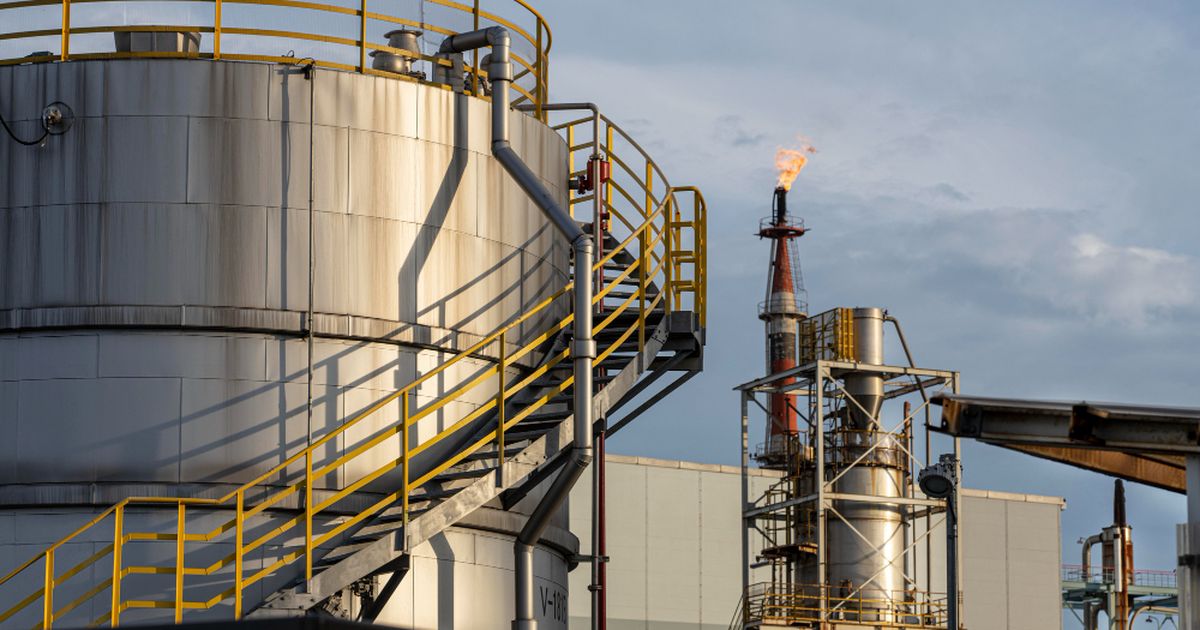
An atmospheric storage tank is not a pressure vessel. It is engineered for almost no pressure differential at all. The API 650 standard — the design and construction baseline for new welded aboveground storage tanks — typically allows internal design pressure under 1.0 psig and vacuum capability of roughly 1 ounce per square inch, which is about one inch of water column (API 650 External Pressure Design Appendix, EPA-hosted reference). API 650 Annex F allows upgraded designs to handle internal pressures up to 2.5 psig, but that is a deliberate engineering choice that must be specified up front and verified throughout the tank’s life (Eng-Tips — API 650 Vacuum Rating discussion).
Those numbers sound small until they are multiplied by surface area. A 0.5 psi internal vacuum on a 60-foot-diameter tank shell produces more than 200,000 pounds of force pulling the wall inward. The tank does not need a dramatic pressure event to fail. It needs the venting system to lag the rate at which the internal pressure drops below atmospheric — for any reason, including liquid withdrawal, thermal contraction as a hot product cools, steam coil condensation, or sudden vapor collapse.
The venting system is the only thing standing between normal operations and a catastrophic vacuum event. That system is governed by API 2000.
What API 2000 Actually Requires
API 2000 specifies how to size the venting capacity on atmospheric and low-pressure storage tanks for both pressure and vacuum conditions. The standard requires that venting capacity be calculated against the worst-case combination of:
- Maximum liquid withdrawal rate — how fast product leaves the tank during normal operations.
- Maximum thermal contraction rate — how fast vapor inside the tank contracts when ambient temperature drops or hot liquid cools.
- Maximum steam coil condensation rate — for tanks that use internal steam coils for heating (white liquor tanks do), how much volume the steam coil can pull when it condenses.
- Maximum emergency venting demand — what happens during a fire or other upset condition.
API 653, the in-service inspection and reconstruction standard, ties back to this directly. Section 9.12.1.1 of the 2020 edition specifies that any roof repair affecting venting must preserve normal and emergency venting capacity in line with API 650 Section 5.8.5 — which in turn requires verification against API 2000 (API 653 — Tank Inspection, Repair, Alteration, and Reconstruction reference).
The hard truth: API 2000 venting capacity verification is the step most operators skip. Most “compliant” tanks have a documented API 653 external inspection within the five-year window. Far fewer have a current API 2000 calculation that reflects the tank’s actual operating regime — particularly when the process has changed since the original design. A tank designed and vented for one withdrawal rate, one heating duty, one product, and one ambient condition can be under-vented after a process modification that nobody flagged for tank design review.
Counter-Signal: OSHA Does Not Cover This for Most Tanks
This part is worth saying directly because it is uncomfortable.
OSHA’s standard for pulp, paper, and paperboard mills — 29 CFR 1910.261 — addresses tank entry, hot work, chemical hazards, and respiratory protection (OSHA — Pulp, Paper, and Paperboard Mills standard). It does not establish a structural integrity inspection standard for atmospheric process tanks. For non-petroleum process tanks at chemical plants, food plants, and water treatment facilities, the OSHA regulatory floor on tank integrity is effectively the General Duty Clause. EPA’s SPCC rule under 40 CFR 112 covers aboveground oil storage but does not address structural integrity for non-petroleum tanks.
The practitioner standard — API 653 inspection intervals combined with API 2000 venting verification — is the only defensible baseline for most atmospheric process tanks. And it is voluntary.
A facility that follows API 653 and API 2000 on every atmospheric tank, regardless of whether a regulator requires it, can defend its program in litigation, in insurance underwriting, and in the CSB investigation that follows any incident. A facility that points to OSHA compliance as evidence of tank integrity will not survive any of those three reviews.
The Four Questions for Monday Morning
If you operate atmospheric aboveground storage tanks larger than 5,000 gallons — and most pulp mills, refineries, chemical plants, food manufacturers, and water treatment facilities operate at least a handful — these four questions tell you whether you are exposed.
1. Is the most recent API 653 inspection within five years for every atmospheric tank?
API 653 specifies external visual inspection on a five-year interval, with ultrasonic shell thickness verification, and out-of-service internal inspection on a 10-to-20-year cycle (API 653 standard description). Many states adopt this as a floor for regulated petroleum tanks. For non-regulated process tanks, the five-year interval is the practitioner standard regardless of whether a regulator requires it.
The question to answer: pull the most recent inspection report for every atmospheric tank above 5,000 gallons and verify the date. If any tank is past due — or has no documented inspection — that is the first finding.
2. Has the venting system been verified against API 2000 in the last five years?
This is the question most operators cannot answer cleanly. The venting calculation should reflect current operating conditions, not the conditions at the time of original tank construction. If anything has changed — withdrawal rates, steam coil capacity, nitrogen blanketing, product chemistry, ambient temperature swings, anything — the calculation needs to be redone.
A tank passing its API 653 external visual with a missing or stale API 2000 verification is not actually in compliance with the spirit of the standard. It is in compliance with the part that is easy to document.
3. Are the pressure/vacuum (P/V) valves and vacuum breakers on a documented inspection schedule?
P/V valves are the most common single failure mode for vacuum-induced tank collapse. They stick. They foul. They get coated in deposits from polymerizing liquids, condensing caustics, and product carryover. A stuck P/V valve looks identical to a working P/V valve from the outside.
Inspection interval should match API 2000 guidance and the manufacturer’s recommendation, with annual minimum for service-critical valves and more frequent intervals for caustic, polymer-forming, or fouling-prone liquids. White liquor service is exactly the kind of duty that warrants tightened intervals. If the answer to “when was this P/V valve last bench-tested” is a shrug, that is the second finding.
4. Is there a written procedure governing withdrawal rates and steam coil operation that prevents vacuum events?
A vacuum event does not require equipment failure. It requires operations that pull volume faster than venting can replace it. The procedural controls — maximum withdrawal rates, sequencing of steam coil shutdown, monitoring during product transfers, requirement for vent path verification before unusual operations — are management-of-change territory, not maintenance territory.
If a process change in the last five years modified the rate at which liquid leaves the tank, the rate at which steam coils condense, or anything affecting vapor space dynamics, that change should have triggered a tank design review. If it did not, there is a procedural gap that the next CSB investigation will find.
What Is Actually at Stake After Longview
The CSB does not issue citations. It issues recommendations — and historically, those recommendations have driven API standard revisions, OSHA enforcement priority shifts, and the post-incident inspection-program changes that propagate across peer facilities (CSB — Nippon Dynawave investigation announcement). Based on past tank-failure investigations, the Longview recommendations will likely arrive in 18 to 24 months and will likely touch API 650, API 653, and API 2000.
The smarter operational decision is to anticipate the recommendations rather than wait for them. Inspection program updates that get ahead of the likely findings — atmospheric tank inventory review, API 2000 reverification across the population, tightened P/V valve intervals on caustic and process service, formal management-of-change procedures covering tank operations — cost less when they are planned than when they are reactive to a compressed CSB recommendation timeline.
The other dimension worth stating directly: civil liability after a multi-fatality incident dwarfs regulatory enforcement. Historically, eight-to-nine-figure settlements follow multi-fatality industrial events, and insurance underwriting decisions made in the post-incident attention window persist for the life of the policy. The conversation about tank integrity is increasingly a conversation the CFO and General Counsel need to see, not just the EHS director.
The Buyer Self-Qualification Test
The clean version of this article reduces to four questions a plant manager should be able to answer on a Monday morning whiteboard:
- Do we have an atmospheric tank inventory list with size, service, and last inspection date?
- Is every tank above 5,000 gallons within its API 653 inspection interval?
- Has every tank’s venting system been verified against API 2000 within the last five years, reflecting current operating conditions?
- Are P/V valves and vacuum breakers on documented inspection intervals appropriate to the service?
If those questions do not have crisp, sourced answers, the facility is exposed — not by regulatory standard, but by the standard a CSB investigator, an insurance underwriter, or a plaintiffs’ attorney will apply.
How iSi Works This With Clients
iSi’s atmospheric tank integrity audits walk the inventory, score every tank against the four questions, and produce a defensible record of the verification — both for the operating site and for the CFO, GC, or insurance carrier who may need to see it. For multi-site manufacturers, the same audit gets standardized across facilities and rolled up. Variability across sites in atmospheric tank inspection rigor is the leading indicator of a coming incident, and the rollup is what surfaces it.
For clients on an EHS COOP retainer, this kind of inventory review is the work the embedded iSi team handles between regulatory events — not a separate project, not a separate proposal cycle. For sites without a retainer, a one-time tank integrity audit is the entry point. Either way, the deliverable is the same: a sourced, defensible record of where every atmospheric tank stands against API 653, API 2000, and the procedural controls the next investigation will look for.
If your atmospheric tank records cannot answer the four questions, that is the conversation to have. Call iSi at (316) 264-7050 or use the Compliance Gap Checker to scope a tank integrity audit for your site.
Sources
- CSB — Investigation opening at Nippon Dynawave Longview: https://www.csb.gov/us-chemical-safety-board-opens-investigation-into-fatal-chemical-tank-implosion-at-nippon-dynawave-paper-mill-in-washington/ (verified 2026-05-30)
- OPB — Longview paper mill chemical tank death toll: https://www.opb.org/article/2026/05/27/longview-paper-mill-chemical-tank-death-toll/ (verified 2026-05-30)
- API 653 — Aboveground Storage Tank Inspector certification (standard description): https://www.api.org/products-and-services/individual-certification-programs/certifications/api653 (verified 2026-05-30)
- API 653 Body of Knowledge (March 2026): https://www.api.org/-/media/Files/Certification/ICP/ICP-Certification-Programs/653/2026%20files/March%202026_653_BOK_final.pdf (verified 2026-05-30)
- API 653 — Tank Inspection, Repair, Alteration, and Reconstruction (publication reference): https://www.api.org/~/media/files/publications/whats%20new/653_e5%20pa.pdf (verified 2026-05-30)
- API 650 External Pressure Design Appendix (EPA-hosted reference): https://archive.epa.gov/emergencies/content/fss/web/pdf/lieb_04.pdf (verified 2026-05-30)
- OSHA — Pulp, Paper, and Paperboard Mills (29 CFR 1910.261): https://www.osha.gov/laws-regs/regulations/standardnumber/1910/1910.261 (verified 2026-05-30)
- OSHA — Pulp, Paper, and Paperboard Mills standards index: https://www.osha.gov/pulp-paper/standards (verified 2026-05-30)
- Eng-Tips — API 650 Vacuum Rating discussion (engineering reference): https://www.eng-tips.com/threads/typical-api-650-tank-vacuum-rating-for-oil-storage.433514/ (verified 2026-05-30)
- Regulation: 29 CFR 1910.261 (OSHA pulp/paper standard)
- Regulation: 29 CFR 1910.119 (OSHA Process Safety Management)
- Regulation: 40 CFR 112 (EPA SPCC)