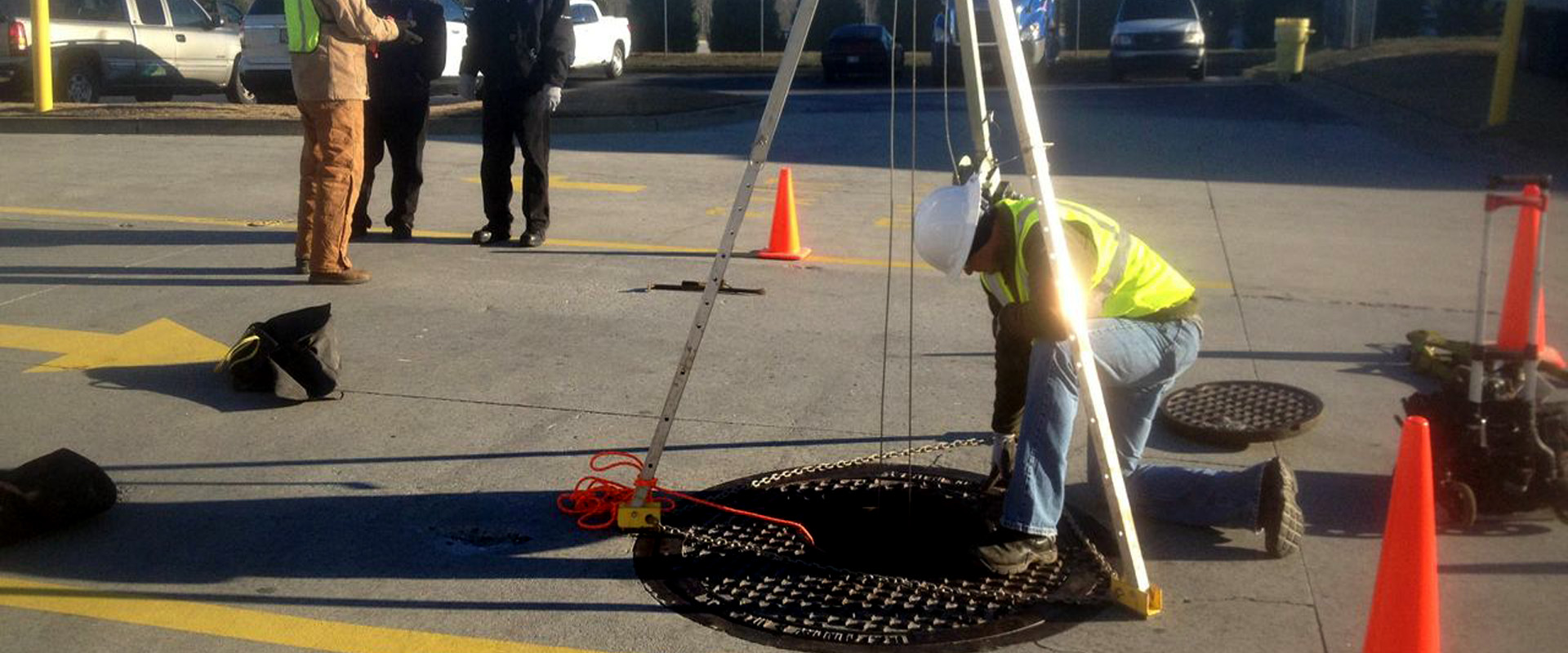
Your Benzene Meter Cleared OSHA for Thirty Years. It Does Not Clear USCG Today.
A field PID with a 0.1 ppm benzene LOQ has 5x the LOQ of the USCG 0.02 ppm tank-entry ceiling. Here is what a defensible Marine Chemist's Certificate now requires.
The first thing a US Coast Guard marine inspector now looks for on a Marine Chemist’s Certificate is a specific benzene concentration value and the limit of quantitation the instrument used to produce it. “Benzene: ND” with no LOQ stated is not a defensible certificate after April 7, 2025. The Marine Chemist Qualification Board (MCQB memo, April 7, 2025; reinforced June 27, 2025) directed every Certified Marine Chemist in the country to document a measured benzene test result on the certificate when the space has carried benzene or benzene-containing cargo — and to do so against the USCG-adopted 0.02 ppm ceiling that took effect June 25, 2025. The piece of monitoring equipment that satisfied OSHA’s 1 ppm permissible exposure limit for the last thirty years is, for that certificate, often the wrong instrument.
That gap — between a regulatory ceiling expressed in parts-per-billion and an instrument with a limit of quantitation expressed in parts-per-million — is the entire story of this article. It is not theoretical. It is on every tank-vessel entry, every confined-space entry on a barge that previously carried gasoline, and every refinery vessel that ever held benzene-containing feedstock. And it does not get resolved by buying a more sensitive meter. It gets resolved by understanding which regulatory regime governs which entrant and documenting the LOQ against the right ceiling.
The Math: A Field PID at 0.1 ppm LOQ Cannot Demonstrate a 0.02 ppm Ceiling
A typical field photoionization detector (PID) running a 10.6 eV lamp calibrated against isobutylene reports a benzene-specific response factor of roughly 0.53. That response factor, combined with humidity and co-VOC interference in a real tank atmosphere, puts the practical limit of quantitation for benzene on most field PIDs somewhere between 1 ppb and 100 ppb depending on conditions (photoionization detector instrumentation reference). The commonly documented field LOQ for benzene on a general-purpose VOC PID sits around 0.1 ppm — 100 ppb.
The USCG-adopted ceiling for tank entry by Coast Guard personnel is 0.02 ppm — 20 ppb (Marine Chemist Association USCG benzene policy). That is a five-to-one mismatch. A meter that reports “below detection limit” is reporting “below 100 ppb” — which is a number five times higher than the ceiling it is being asked to demonstrate compliance against. The certificate that says “ND” on the benzene line is, in plain terms, silent about whether the space is actually compliant. A USCG inspector who knows the policy reads that certificate as silent — not as clean.
Research-grade GC instruments with preconcentration trapping can reach roughly 0.20 ppb for benzene (sub-ppb BTEX with preconcentration GC, PMC), but that equipment is not in a field bag on a barge. The practical defensible workflow is a confirmatory laboratory sample using NIOSH Method 1501 — a coconut-shell charcoal sorbent tube, carbon-disulfide desorption, and gas chromatography with flame ionization detection (GC-FID) — run by a qualified laboratory with sufficient sample volume and analytical sensitivity to push the reporting limit well below 0.02 ppm. OSHA Method 1005, by contrast, was designed around the 1 ppm OSHA PEL as the instrument target. It is appropriate for OSHA-compliance demonstration. It is the wrong method for USCG 0.02 ppm certification work.
Three Regulatory Ceilings, One Tank, Different Workers
Benzene tank entry monitoring is now governed by three exposure-limit regimes that do not agree with each other. An IH plan that does not name each one and the worker category it governs is not defensible.
The legally enforceable federal floor is OSHA’s 29 CFR 1910.1028. The benzene permissible exposure limit is 1 ppm as an 8-hour time-weighted average, the short-term exposure limit is 5 ppm over 15 minutes, and the action level is 0.5 ppm as an 8-hour TWA. That standard has been in place since 1987 and was unchanged through 2026 enforcement. The maritime parallel is 46 CFR Part 197 Subpart C, which applies the identical 1 ppm TWA / 5 ppm STEL / 0.5 ppm action-level framework on Coast Guard inspected tank ships and barges carrying benzene-containing cargo. The scope trigger is a vessel carrying at least 0.5 percent benzene by volume in bulk as cargo — a threshold that pulls in far more product streams than most plant managers realize when they read the cargo manifest.
In January 2024, ACGIH lowered its threshold limit value for benzene from 0.5 ppm to 0.02 ppm — a twenty-five-fold reduction — and eliminated the STEL entirely (ACGIH benzene TLV reduction). ACGIH cited human epidemiology pointing to bone-marrow toxicity, myelodysplastic syndrome, acute myeloid leukemia, and chromosomal damage at exposures previously considered safe. ACGIH TLVs are consensus recommendations, not regulatory ceilings. They become enforceable through two routes: state-plan adoption (which has not happened in federal-OSHA states; more on that below), and policy adoption by an inspecting authority. The Coast Guard took the second route on June 25, 2025 — adopting 0.02 ppm as the ceiling its own personnel will not cross when entering a benzene-affected confined space.
The downstream effect is jurisdictional. A petrochemical operator with a refinery in Tulsa, a terminal on the Houston Ship Channel, and a barge fleet on the Mississippi River has three different controlling benzene ceilings operating at the same time. The refinery operates under federal OSHA — 1 ppm PEL, 0.5 ppm action level. The terminal vessel operations fall under 46 CFR Part 197 Subpart C — same 1 ppm PEL. The barge cargo-tank entries that USCG personnel may board for inspection fall under the 0.02 ppm USCG policy. The highest-risk certificate work is the marine vessel side, and the IH program needs to know which limit governs which worker on which entry.
What Changed on the Marine Chemist’s Certificate
The operational change that took effect April 7, 2025 is narrower than the trade press has reported and more demanding than most operators realize. The Marine Chemist Qualification Board directed that every Certified Marine Chemist must document a specific benzene concentration test result on the Marine Chemist’s Certificate — not a TPH reading, not a total-VOC reading, not a “benzene: ND” notation — whenever the space being certified has carried benzene or benzene-containing product (MCA documentation guidance). The certificate must show the value and the limit of quantitation that produced it. A measured value of “<0.02 ppm” is acceptable; a reported LOQ that itself sits above 0.02 ppm makes the value statement non-defensible.
That requirement applies to certificates issued under NFPA 306, Standard for the Control of Gas Hazards on Vessels — which is the standard every Certified Marine Chemist works under. The 110-or-so CMCs in the U.S. Marine Chemist Association directory are all subject to it. The certificates they have been writing the same way for twenty-five years now read differently.
For the EHS or industrial hygiene lead at a facility that ships, receives, or transfers benzene-containing cargo, the operational translation is direct. Confirm that the CMC issuing your certificates is documenting an actual measured benzene concentration. Confirm that the LOQ stated alongside it is at or below 0.02 ppm. If the certificate reads “benzene: ND” with no LOQ — that certificate will not survive a USCG inspector’s review, and the cost of having that conversation at the dock with a hold on the vessel is not a number anyone budgets for.
The Counter-Signal: OSHA Did Not Lower the PEL — and Is Not Going To
The story circulating in the trade press is that “ACGIH dropped benzene to 20 ppb, OSHA is next.” That story is wrong on the facts and worth correcting directly, because EHS programs that plan capital purchases or training revisions on the assumption of federal harmonization will spend on the wrong things.
OSHA’s actual rulemaking activity on benzene in 2025 was deregulatory. The Notice of Proposed Rulemaking published on July 1, 2025 (90 FR 27893; comment extension Aug 20, 2025) proposed to relax certain substance-specific respirator requirements within the existing 29 CFR 1910.1028 benzene standard. It was issued under Executive Order 14192 — the deregulatory framework directing federal agencies to reduce regulatory burden. The NPRM did not propose to lower the PEL toward the ACGIH 0.02 ppm TLV. The comment period closed November 1, 2025. The final rule, when it issues, will go in the direction of less restriction on the existing PEL framework, not toward ACGIH alignment.
The state-plan picture confirms the same pattern. California, Washington, and Oregon have historically signaled willingness to adopt more stringent PELs ahead of federal OSHA. As of mid-2026, none of those state plans had moved the benzene PEL below the federal 1 ppm. In iSi’s primary service region — Kansas, Oklahoma, Missouri, Nebraska, Texas, and Colorado — every state operates under federal OSHA without a state-plan PEL deviation on benzene. The 1 ppm PEL applies as written. The 0.5 ppm action level applies as written. None of those states are moving toward 0.02 ppm in the planning horizon, and no announced rulemaking suggests otherwise (OSHA Annotated Table Z-1).
The implication for the multi-site EHS director is uncomfortable but clean. The gap between ACGIH at 20 ppb and OSHA at 1,000 ppb is unlikely to narrow in the federal direction over the planning horizon. The USCG 0.02 ppm policy applies to maritime entries regardless of whether OSHA ever moves. Multi-site programs that have one foot on land under OSHA and one foot in marine operations under USCG are operating against two ceilings that differ by a factor of fifty — and that is not going to resolve into a single number on its own. The IH plan has to name each ceiling, each worker category, each entry scenario, and document the controlling limit on each one.
Where the Citations Actually Land
The single most useful piece of intelligence about benzene enforcement is that most citations are not exposure-exceedance findings. They are recordkeeping and procedural findings. The CFR Subpart Z benzene standard contains more than thirty paragraph-level citation hooks — exposure monitoring intervals, regulated-area signage, medical-surveillance triggers, employee notification within 15 days of monitoring results, respiratory protection program elements, hazard communication, and 30-year recordkeeping under 29 CFR 1910.1020. A single OSHA inspection at a benzene-handling facility can produce multiple citation lines drawn from those paragraphs without anyone ever measuring an over-the-PEL exposure.
The penalty math is unforgiving. Under the FY2026 carryover schedule of the Federal Civil Penalties Inflation Adjustment Act (40 CFR 19.4), a willful or repeat violation carries up to $165,514 per instance. A serious or other-than-serious violation carries up to $16,550 per instance. The 2025 inflation multiplier of 1.02598 (Federal Register, January 2025) carries forward into FY2026 absent a new adjustment (OSHA 2025 trade release). An inspection that produces, say, four serious citations on documentation paragraphs plus one willful citation on a regulated-area or medical-surveillance failure is sitting at $231,714 in penalty exposure before anyone discusses what was actually in the air.
A facility-level IH assessment that catches those documentation gaps before the inspector does costs roughly $4,050. That is a 41:1 return on a phone call — and the math holds whether the underlying air result is 0.5 ppm benzene or 0.005 ppm.
The USCG side does not generate dollar penalties the same way OSHA does. It generates operational holds. A non-defensible Marine Chemist’s Certificate produces a delayed vessel, a delayed cargo transfer, a delayed inspection sign-off — and the demurrage and holding costs on a stalled tank vessel are not numbers most EHS budgets recognize until they land in finance. The certificate is the choke point. The certificate is what now has to specify benzene to 0.02 ppm with the LOQ stated.
What an IH Program Actually Has to Document Now
A facility that has any chance of triggering this gap can self-qualify with three questions. Has any vessel, tank, drum, or confined space at this site previously contained material at 0.5 percent benzene or higher by volume? Do entrants on any of those spaces include USCG personnel, marine inspectors, or workers covered by 46 CFR Part 197 Subpart C? Does the monitoring equipment in use have a documented LOQ below 0.02 ppm benzene? If either of the first two answers is yes and the third is no, there is a defensibility gap that the IH program has to close.
The compliance steps follow directly from the gap.
Identify the controlling exposure limit by job category for every entry. USCG personnel on a benzene-cargo vessel are governed by the 0.02 ppm USCG policy. Civilian workers under federal OSHA are governed by the 1 ppm TWA and 0.5 ppm action level. Civilian workers on a vessel under 46 CFR Part 197 are governed by the same 1 ppm framework. Many entry events involve multiple worker categories with different controlling limits simultaneously. The IH plan must document each one.
Verify the LOQ of every monitoring device against the controlling limit. A device with an LOQ of 0.5 ppm is fine for the OSHA action level. The same device is non-defensible for the USCG 0.02 ppm ceiling. The IH report should explicitly state the device’s documented LOQ alongside the result — not on a separate calibration record, but on the same line as the value. For certificates issued under NFPA 306, the same rule applies.
Document the calibration gas, calibration date, lamp energy, and correction factors used. For a field PID, the response factor for benzene against an isobutylene calibration cylinder is roughly 0.53 at a 10.6 eV lamp — meaning a PID reading of 0.04 ppm isobutylene-equivalent is roughly 0.021 ppm benzene at face value. That math is fragile in the presence of toluene, xylene, or alkene VOCs in the same atmosphere. The defensible practice is to take a confirmatory NIOSH 1501 laboratory sample whenever the certifying limit is the 0.02 ppm USCG ceiling. Field instrumentation is the screening tool; the laboratory result is the documentation.
Use the right method for the right ceiling. OSHA Method 1005 targets 1 ppm and is appropriate for OSHA PEL demonstration. NIOSH Method 1501 — charcoal tube, CS₂ desorption, GC-FID — can reach LOQs well below 0.02 ppm when run by a qualified laboratory at appropriate sample volumes. Field PIDs calibrated against isobutylene are not appropriate for 0.02 ppm certification work as the sole instrument of record.
For benzene cargo vessel operations under 46 CFR Part 197 Subpart C, monitor at least one person in each type of operation involving handling or potential exposure — cargo transfer, connection and disconnection, tank gauging and sampling, gas-freeing, venting, cleaning. Monitoring covers the full duration of the operation or 8 hours, whichever is less (46 CFR 197.505; 46 CFR Part 197 Subpart C Appendix A).
For the workplace side, continue compliance with the unchanged 1 ppm PEL framework — 30+ days at the action level triggers medical surveillance, 10+ days at the PEL triggers medical surveillance regardless of action-level frequency, semi-annual air monitoring, 15-day employee notification of monitoring results, regulated areas, the full 29 CFR 1910.1028 paragraph hierarchy. The lowered ACGIH TLV does not move the floor on any of that (OSHA benzene exposure evaluation).
Where iSi Helps
iSi Environmental’s industrial hygiene practice is built for exactly this kind of gap. Same-day IH response when a tank or vessel entry is on a hold. Benzene exposure assessments with NIOSH 1501 laboratory confirmation when a field PID is not the right instrument of record. Multi-site EHS COOP retainer support across the 40 states where iSi operates — one team, one retainer, programmatic monitoring across refining, petrochemical, terminal, and marine-touching footprints. iSi’s COOP retainer starts at $15,000 per year — typically $115,000 to $180,000 less than a single fully-loaded EHS hire, with a national team in 40 states included. When a refinery in Tulsa, a terminal in Houston, and a barge operation on the Mississippi all need different controlling benzene limits documented on the same plan, that is the work the retainer is built to handle.
The IH equipment that cleared OSHA for thirty years did not become wrong. The ceiling moved underneath it for one specific category of entry. The defensible response is to name the gap, document the LOQ against the controlling limit, and put a confirmatory laboratory sample alongside the field reading whenever the 0.02 ppm USCG ceiling is in scope. That is the conversation we are happy to have on a call — before the certificate is the one having it with an inspector.
Sources
- 29 CFR 1910.1028 — Benzene (OSHA) (verified 2026-05-26)
- eCFR: 29 CFR 1910.1028 — Benzene (verified 2026-05-26)
- 46 CFR Part 197 Subpart C — Benzene (USCG, eCFR) (verified 2026-05-26)
- 46 CFR 197.505 — Definitions (Cornell LII) (verified 2026-05-26)
- 46 CFR Appendix A to Subpart C of Part 197 — Substance Safety Data Sheet, Benzene (verified 2026-05-26)
- Federal Register: Benzene — OSHA NPRM (90 FR 27893, July 1, 2025) (verified 2026-05-26)
- Federal Register: Benzene — OSHA comment extension (Aug 20, 2025) (verified 2026-05-26)
- Marine Chemist Association: USCG Benzene TLV Policy (June 2025) (verified 2026-05-26)
- Marine Chemist Qualification Board Memo — Benzene TLV and USCG (April 7, 2025) (verified 2026-05-26)
- MCQB Memo — USCG Benzene Policy (June 27, 2025) (verified 2026-05-26)
- Marine Chemist Association: Documentation of Benzene Test Result on the MC Certificate (verified 2026-05-26)
- NFPA 306 — Standard for the Control of Gas Hazards on Vessels (verified 2026-05-26)
- OSHA Method 1005 — Benzene Sampling and Analysis (verified 2026-05-26)
- NIOSH NMAM Method 1501 — Aromatic Hydrocarbons (verified 2026-05-26)
- OSHA Annotated Table Z-1 — Permissible Exposure Limits (verified 2026-05-26)
- OSHA Benzene — Evaluating Exposure (verified 2026-05-26)
- ACGIH Reduces Threshold Limit Value for Benzene — Gradient summary (verified 2026-05-26)
- OSHA: 2025 Annual Adjustments to Civil Penalties (trade release, January 14, 2025) (verified 2026-05-26)
- 40 CFR 19.4 — Statutory Civil Monetary Penalties, Adjusted for Inflation (verified 2026-05-26)
- Federal Register: Federal Civil Penalties Inflation Adjustment Act Annual Adjustments for 2025 (verified 2026-05-26)
- Compact GC with preconcentration — sub-ppb BTEX detection (PMC) (verified 2026-05-26)
- Wikipedia: Photoionization detector — instrumentation reference (verified 2026-05-26)