Commercial Mold Remediation in Kansas: What Is Required and What Is Not
A water loss in a Kansas commercial building raises one question above all others: what has to happen before people can use the space again. The answer is not a regulatory number, because no federal mold standard exists.
A chilled water line fails over a Friday night in a Wichita office building. By Monday the carpet is dark across 400 square feet, the drywall is swollen at the base, and three people want to know when the floor reopens. The first instinct is to go find the legal threshold.
There is no legal threshold. No federal mold standard exists. OSHA has no mold standard and no permissible exposure limit for mold or mold spores. Kansas licenses no mold assessors and no mold remediation contractors. Commercial mold remediation in a Kansas building runs on four things instead: a statutory duty clause, a set of worker-protection standards that apply to the work rather than to the mold, the asbestos rules if the building is old enough, and the contract you signed.
That absence is uncomfortable, and it is also the single most useful fact a facility manager can have. Once you stop looking for a number to clear, you can start writing a scope that defines what done means.
Is there a federal mold standard or a legal limit for mold in a commercial building?
No. EPA states that “Standards or Threshold Limit Values (TLVs) for airborne concentrations of mold, or mold spores, have not been set,” and that “Currently, there are no EPA regulations or standards for airborne mold contaminants” (EPA, Mold Testing or Sampling). OSHA has no mold standard either. Any vendor quoting a legal mold limit is describing something that does not exist.
EPA goes one step further and closes the loophole most marketing copy walks through. Because no federal limit exists, sampling “cannot be used to check a building’s compliance with Federal mold standards.” A lab report cannot establish compliance with a rule that was never written.
What is the difference between a mold assessment and mold remediation?
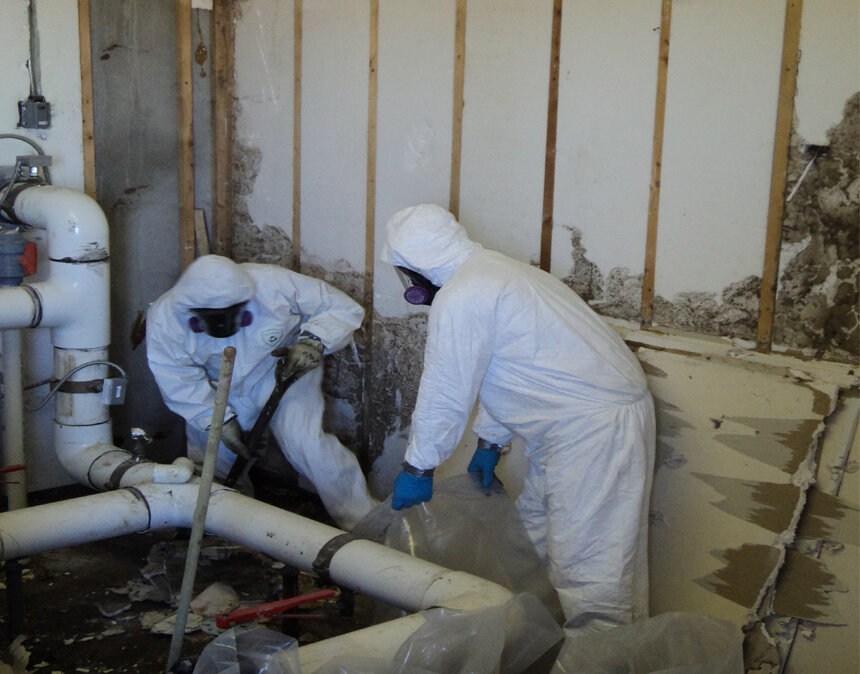
Assessment locates the moisture source, measures the affected area, and produces a written protocol that sets the containment level and the criteria for finishing. Remediation executes that protocol. EPA’s guidance tells building owners to “Select a remediation manager for medium or large jobs (or small jobs requiring more than one person)” whose “highest priority must be to protect the health and safety of the building occupants and remediators” (EPA 402-K-01-001, Chapter 3).
These are two purchases with two deliverables. The assessment deliverable is a document. The remediation deliverable is a cleaned building and a disposal record. Buying them as one line item from one firm collapses the only independent check the job has.
Does Kansas license mold assessors or mold remediation contractors?
No. KDHE’s Environmental Licensing and Permitting listing covers air permitting, hazardous waste, household hazardous waste, lead licensing and certification, public water supply, remediation licensing, solid waste, water permitting, and water well contractors (KDHE). Mold appears nowhere on it.
The program that sounds like it should apply does not. KDHE’s “Remediation Licensing and Permitting” page covers storage tank registrations, dry cleaner registration, and underground storage tank operator and contractor licenses (KDHE). Mold does not appear there either. Kansas licenses the people who work on lead and leaves mold work open to anyone with a van.
KDHE does get involved in mold complaints, and its role is epidemiological. When mold concerns surfaced at Fort Hays State University, the agency’s Bureau of Epidemiology and Public Health Informatics opened an investigation in collaboration with the Ellis County Health Department and published a report in July 2024 (KDHE investigation report). The output was findings and recommendations. No notice of violation, because there is no Kansas mold regulation to violate.
If Kansas does not license mold contractors, what actually applies?
Section 5(a)(1) of the OSH Act, 29 U.S.C. 654(a)(1), requires each employer to “furnish to each of his employees employment and a place of employment which are free from recognized hazards that are causing or are likely to cause death or serious physical harm to his employees” (OSH Act Section 5). That duty clause is the only route by which a mold condition itself becomes an OSHA matter, and we have written separately about how General Duty Clause citations get built.
Below the duty clause sit standards that apply to the remediation work no matter what the contaminant is. Respiratory protection at 29 CFR 1910.134. PPE and the hazard assessment at 29 CFR 1910.132. Hazard communication at 29 CFR 1910.1200, which covers every biocide, antimicrobial and detergent the crew brings through the door. Permit-required confined spaces at 29 CFR 1910.146 when the work enters a crawlspace, pit, duct or tank that meets the definition. The mold is incidental to all four. The citable paragraphs are not.
Should the same company do my mold assessment and the remediation?
Kansas does not prohibit it. Florida does. Under Fla. Stat. 468.8419(1)(d), a licensed mold assessor may not perform remediation on a structure it assessed “within the last 12 months,” and under (2)(d) a remediator may not perform assessment on a structure it remediated in that window, excluding a Division I certified contractor classified under 489.105(3) (Fla. Stat. 468.8419).
Florida wrote that rule because the conflict is obvious to anyone who has read a protocol: the firm that defines the scope also gets paid for the scope, and the firm that certifies the finish is the firm being certified. The conflict exists in Kansas identically. Nothing in Kansas law stops it, so the separation has to come from how you contract.
At what size does mold contamination require containment?
No size requires containment by law. EPA guidance sets three tiers, and all three are guidance. Under 10 square feet, EPA’s Table 2 lists containment as “None required” and minimum PPE as an “N-95 respirator, gloves, and goggles” (EPA 402-K-01-001, Chapter 5). Between 10 and 100 square feet, “Limited containment is generally recommended.” Above that, “Full containment is recommended for the cleanup of mold-contaminated surface areas greater than 100 ft2.”
Limited containment, in EPA’s guidance, is a single layer of 6-mil fire-retardant polyethylene with vents, doors, chases and risers sealed. Full containment adds a second layer and a decontamination chamber or airlock. In either case EPA states that “The containment area must be maintained under negative pressure relative to surrounding areas,” with exhaust routed outdoors through a HEPA-filtered or ducted fan.
EPA also gives the cheapest field check in the business. If the sheeting “flutters or billows outward, containment has been lost” and has to be corrected before work continues. Anyone standing in the corridor can see that.
One caution on the tiers. OSHA’s guidance bulletin uses a different set, with Level I at 10 square feet or less, Level II from 10 to 30, Level III from 30 to 100, and Level IV above 100 contiguous square feet (OSHA SHIB 03-10-10). EPA has no 30 square foot tier at all. Two federal agencies published two different breakdowns of the same decision, which tells you how much weight either set carries as a requirement. Both are advisory. OSHA’s bulletin says so in its own text: it “is not a standard or regulation, and it creates no new legal obligations.”
What respiratory protection does OSHA require for mold remediation workers?
Once an employer requires respirator use, 29 CFR 1910.134 applies in full and the mold stops mattering. The employer needs a written program with worksite-specific procedures and a trained administrator under (c). A medical evaluation has to come first: paragraph (e)(1) requires the employer to “provide a medical evaluation to determine the employee’s ability to use a respirator, before the employee is fit tested or required to use the respirator in the workplace.”
Then fit testing under (f), on the same make, model, style and size the employee will wear. Then training under (k), which must “recur annually, and more often if necessary.” Respirators, training and medical evaluations are all provided at no cost to the employee under (c)(4). If your in-house maintenance team is being handed half-face respirators for a wet drywall tear-out, every one of those obligations attached the moment you handed them over. Our post on respirator selection and pressure drop covers the selection side in more detail.
The small detail both agencies bother to call out is eye protection. EPA states that “Safety glasses or goggles with open vent holes are not acceptable” for this work, and OSHA’s bulletin says the same thing in slightly different words.
Which OSHA standards apply when there is no mold standard?
Four, in practice. Respiratory protection at 29 CFR 1910.134. PPE at 29 CFR 1910.132, where paragraph (d)(1) requires a workplace hazard assessment, (d)(1)(iii) requires PPE that “properly fits each affected employee,” and (d)(2) requires the employer to verify the assessment “through a written certification” naming the workplace, the certifier and the dates. Hazard communication at 29 CFR 1910.1200, with the written program under (e), safety data sheets under (g), and employee information and training under (h). Permit-required confined spaces at 29 CFR 1910.146 where the geometry qualifies.
OSHA’s own mold bulletin names 1910.134 and 1910.1200 directly and reminds employers that they “must comply with hazard-specific safety and health standards and regulations promulgated by OSHA.” The agency never needed a mold standard to have something to cite.
How long after a water leak do I have before it becomes a mold remediation project?
EPA builds its water-damage response table around acting “within 24-48 hours,” and then draws the line explicitly: “If mold growth has occurred or materials have been wet for more than 48 hours, consult Table 2 guidelines” (EPA 402-K-01-001, Chapter 4). Table 2 is the remediation planning table. Past that window the job changes character.
Two caveats in the same guidance are worth carrying into any insurance conversation. EPA warns that “Even if materials are dried within 48 hours, mold growth may have occurred,” and also that “mold growth will not always occur after 48 hours; this is only a guideline.” The window is a planning tool, not a verdict.
The whole table assumes clean water, and EPA says so: “These guidelines are for damage caused by clean water.” If the source might be sewage or chemically contaminated, EPA notes that “Personal Protective Equipment and containment are required by OSHA,” and gives one instruction that gets ignored on half the losses we see: “Do not use fans before determining that the water is clean or sanitary.” Running air movers on a sewer backup distributes the problem through the building.
Some materials come out regardless of how fast you move. EPA’s table tells you to discard and replace ceiling tiles, cellulose insulation and fiberglass insulation. Drying in place can work for wallboard when there is no obvious swelling and the seams are intact.
What does clearance testing before re-occupancy consist of, and who sets the pass criteria?
You do, in the contract. EPA lists five criteria for judging whether remediation worked: the moisture problem completely fixed, mold removal complete with no “visible mold, mold-damaged materials and moldy odors,” indoor fungal types and concentrations similar to outdoors if sampling was done, a revisit shortly afterward showing no recurrence, and occupants able to use the space “without health complaints or physical symptoms.”
Then EPA says the thing no proposal ever quotes: “Ultimately, this is a judgment call; there is no easy answer.”
That is the federal government’s complete position on post-remediation verification, and it is guidance rather than a rule. There is no pass line to hit, which means the pass line has to be written into the scope of work before anyone mobilizes. Who samples, what the comparison basis is, what happens on a failed result, and who authorizes re-occupancy are all contract terms. We cover the sampling methodology and how to read the results in a companion post on mold air testing in commercial buildings.
ANSI/IICRC S520, the Standard for Professional Mold Remediation now in its 2024 Fourth Edition, is the document the industry works to and the one insurers and consultants reference. It is a private procedural standard published by the IICRC, and it is copyrighted. It carries real weight as the standard of care in a dispute, and no agency enforces it. A scope written against it is defensible. A scope written against nothing is an argument waiting to happen.
Does mold remediation in an older building trigger asbestos requirements?
Yes, as soon as materials get disturbed. EPA’s asbestos NESHAP at 40 CFR 61.145(a) requires the owner or operator, “prior to the commencement of the demolition or renovation, [to] thoroughly inspect the affected facility or part of the facility where the demolition or renovation operation will occur for the presence of asbestos, including Category I and Category II nonfriable ACM” (eCFR).
Pulling mold-damaged drywall, plaster, ceiling tile, pipe insulation or resilient flooring out of a pre-1980 building is a renovation under that rule. The thresholds that pull the job into the full notification and work-practice requirements are 260 linear feet of regulated asbestos-containing material on pipes, 160 square feet on other facility components, or 35 cubic feet where the area could not be measured. OSHA’s construction asbestos standard at 29 CFR 1926.1101 attaches on the worker-protection side.
This is the part of a mold project that carries real enforcement exposure, because the asbestos thresholds are regulation where the mold tiers are guidance. Our guide to asbestos abatement covers that side of the work.
Can OSHA cite my facility over mold if there is no mold standard?
Only through the General Duty Clause, and OSHA’s Field Operations Manual sets four elements the agency has to establish: the employer failed to keep the workplace free of a hazard employees were exposed to, the hazard was recognized, it was causing or was likely to cause death or serious physical harm, and “There was a feasible and useful method to correct the hazard” (OSHA FOM, CPL 02-00-163, Chapter 4). The same chapter restricts the tool: “The general duty clause shall be used only where there is no standard that applies to the particular hazard.”
With no recognized-hazard threshold for mold to point at, elements two and three are both contestable. Which is why the citations that land on mold jobs are almost never about mold. They are respirators without medical evaluations, PPE hazard assessments with no written certification, biocides with no safety data sheets, and wet drywall pulled out of a 1968 building with no asbestos inspection on file.
What the federal agencies say about mold testing
One counter-signal belongs in any honest version of this discussion. CDC’s position on mold testing is one sentence long: “CDC does not recommend mold testing” (CDC, About Mold). EPA is close to it for the ordinary case, stating that “In most cases, if visible mold growth is present, sampling is unnecessary.” OSHA’s guidance adds that “Sampling for mold, mold spores, mycotoxins, and other bioaerosols are not part of a routine building evaluation,” and that “Testing for mold is expensive, and there should be a clear reason for doing so.”
So three federal agencies say the sampling step that a lot of remediation proposals treat as automatic is usually unnecessary. That cuts against our own service line, and it is still the right starting position. Sample when there is a defined question a sample can answer, such as whether a cleaned area is ready for re-occupancy or where hidden growth is feeding a complaint. Skip it when the mold is visible and the answer is already on the wall.
The health literature counsels similar restraint. The Institute of Medicine’s 2004 report Damp Indoor Spaces and Health found sufficient evidence of an association between damp indoor environments and upper respiratory tract symptoms, cough, wheeze, and asthma symptoms in sensitized asthmatic people, along with hypersensitivity pneumonitis in susceptible people (National Academies Press, 2004). For several other outcomes, including airflow obstruction in otherwise healthy people and mucous membrane irritation syndrome, the committee found inadequate or insufficient evidence to determine whether an association exists. Those conclusions are stated at the level of association throughout, which is a considerable distance from the claims that drive most toxic mold litigation.
Where these jobs go wrong
The pattern in Kansas commercial losses is consistent enough to predict. The water source gets repaired last instead of first, so the remediation is performed into an active leak and the mold returns within a season. The affected area never gets measured, so the containment level is whatever the crew felt like building. Nobody writes down when the water started, which makes the 48-hour question unanswerable in the insurance file. And the firm that wrote the protocol is the firm that declares the job finished.
None of those is a regulatory failure, because there is no regulation to fail. All four are scope failures, and all four are fixable with a document written before mobilization.
Getting the sequence right
The order that holds up is: fix the water, date the event, measure the area, get an independent written protocol, set containment against the measurement, screen for asbestos before anything gets demolished, and define the re-occupancy criteria in the contract rather than at the end of the job.
iSi’s mold remediation group and our industrial hygiene team handle that sequence as two separate scopes on purpose, so the assessment and the clearance criteria are not written by the crew doing the removal. iSi has run mold, IAQ and lead projects for Kansas facilities for two decades, including the occasional indoor air quality problem nobody saw coming. If you are holding a wet building and a reopening date, the protocol is the thing to buy first.
Sources
- EPA, Mold Remediation in Schools and Commercial Buildings, EPA 402-K-01-001: Chapter 3, Investigating, Evaluating and Remediating (verified 2026-10-13)
- EPA, same guide, Chapter 4, Table 1: Water Damage, Cleanup and Mold Prevention (verified 2026-10-13)
- EPA, same guide, Chapter 5, Table 2: Mold Remediation Guidelines (verified 2026-10-13)
- EPA, Mold Testing or Sampling (verified 2026-10-13)
- OSHA, A Brief Guide to Mold in the Workplace, SHIB 03-10-10 (verified 2026-10-13)
- OSHA, Preventing Mold-Related Problems in the Indoor Workplace, OSHA 3304-04N (verified 2026-10-13)
- OSH Act Section 5, Duties, 29 U.S.C. 654: osha.gov (verified 2026-10-13)
- OSHA Field Operations Manual, CPL 02-00-163, Chapter 4, Violations (verified 2026-10-13)
- 29 CFR 1910.134, Respiratory protection: eCFR (verified 2026-10-13)
- 29 CFR 1910.132, Personal protective equipment: eCFR (verified 2026-10-13)
- 29 CFR 1910.1200, Hazard communication: eCFR (verified 2026-10-13)
- 40 CFR 61.145, Standard for demolition and renovation: eCFR (verified 2026-10-13)
- KDHE, Environmental Licensing and Permitting (verified 2026-10-13)
- KDHE, Remediation Licensing and Permitting (verified 2026-10-13)
- KDHE, Investigation of Mold Concerns at Fort Hays University, July 2024 (verified 2026-10-13)
- Florida Statutes 468.8419, Prohibitions; penalties: flsenate.gov (verified 2026-10-13)
- Texas Department of Licensing and Regulation, Mold Assessors and Remediators at a Glance (verified 2026-10-13)
- CDC, About Mold (verified 2026-10-13)
- Institute of Medicine, Damp Indoor Spaces and Health, National Academies Press, 2004: NCBI Bookshelf (verified 2026-10-13)
- ANSI/IICRC S520, Standard for Professional Mold Remediation, Fourth Edition 2024: IICRC (verified 2026-10-13)