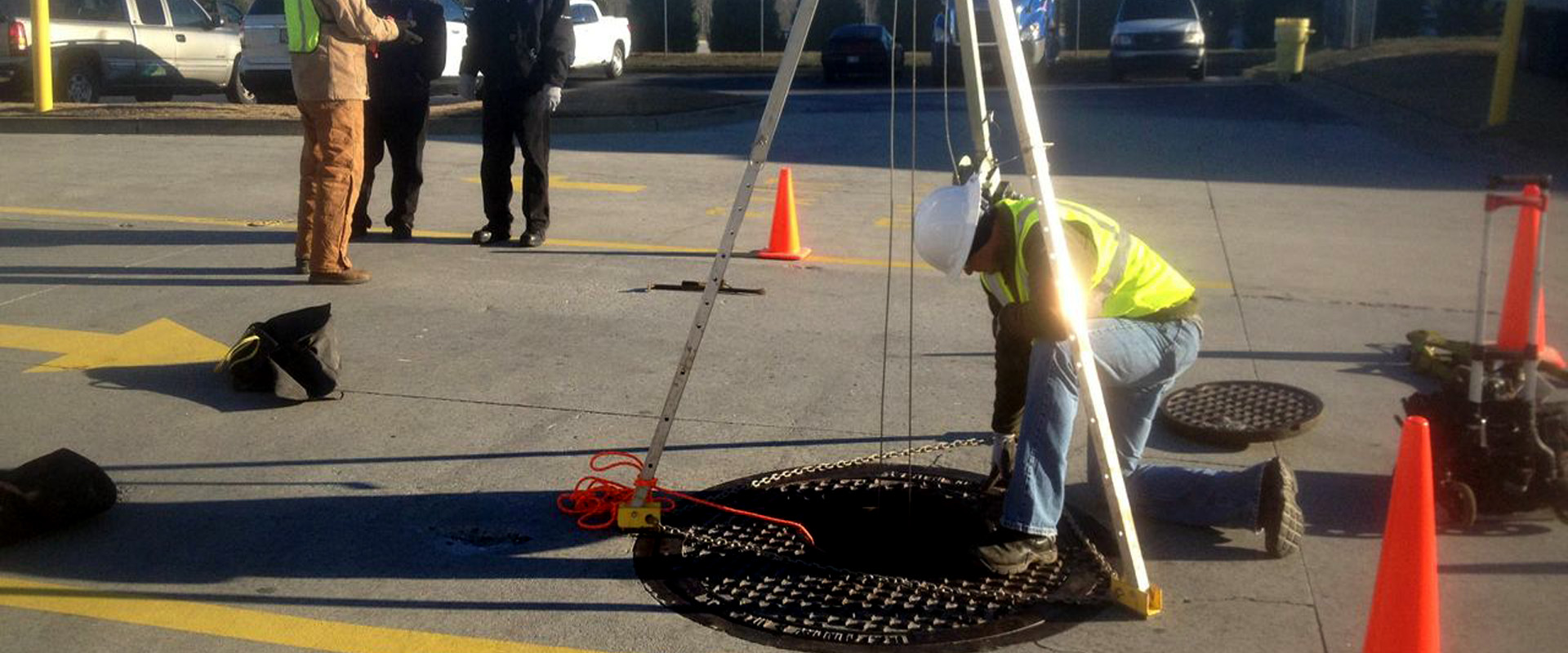
Cleaning a Tank, Pit or Wet Well: Which OSHA Standard Applies, What Your Plant Still Owes, and When to Hire It Out
Cleaning an in-service tank, pit or wet well is maintenance under 29 CFR 1910.146. What the host owes at (c)(8), what the crew owes back, and how to vet rescue.
The entry that kills people in a tank, a pit or a wet well is usually not the entry on the schedule. It is the second one. And the second one happens because somebody who was never going to climb into that space is suddenly standing at the opening watching a coworker stop moving.
On August 20, 2025, a pipe came apart in a manure handling system at a Weld County, Colorado dairy and released manure water and hydrogen sulfide into a pump room. Two workers went in to stop the flow and were overcome. Four more went in after them. All six died. On February 24, 2026, OSHA cited three employers in a single action, a combined $246,609, for failing to protect employees from atmospheric hazards, no written hazard communication program, and no training on detecting hazardous gases (OSHA news release, February 24, 2026).
That was not a scheduled cleaning job, which is exactly why it belongs at the top of a post about one. Nobody in that pump room had a permit, a tested atmosphere, an attendant posted outside, or a retrieval line rigged. It is the single most complete refutation available of the sentence that gets plants into trouble: our guys know that tank.
You probably have a tank, a pit, a silo, a sump or a wet well that has to be emptied and cleaned, and you are deciding whether your own people do it or you hire a crew. You have budgeted for the sludge removal. Have you budgeted for the attendant who stands outside the manway doing nothing else for an entire shift, and for the rescue service you are required to have personally evaluated before anyone goes in?
Where workers actually die in these spaces, and what the federal trend really shows
Between 2011 and 2018, BLS counted 1,030 U.S. confined space fatalities. Where the space type was recorded, tank, bin and vat interiors led with 205 deaths, silos and grain bins took 107, sewers, manholes and storm drains 61, and manure pits 18. Inhalation of a harmful substance killed 126, engulfment 98, and cleaners of vehicles and equipment made the occupational top ten with 28 deaths (BLS CFOI fact sheet, confined spaces 2011-2018).
Those 1,030 deaths rose from 120 in 2011 to a 2017 peak of 166, and BLS has published no confined space fact sheet covering any year after 2018, so no federal series shows improvement (BLS Census of Fatal Occupational Injuries, 2024). The measured trend went up, and then the measurement stopped.
Does OSHA 1910.146 or 1926 Subpart AA apply to a tank cleaning contractor?
1910.146. OSHA’s April 12, 1996 letter holds that “refurbishing of existing equipment and space is considered maintenance,” naming tank relining, and that contractors doing maintenance for a host must comply with 1910.146. Subpart AA takes over only when cleaning is a step inside construction, alteration or repair, per 1910.12(b) and FAQ Q4.
29 CFR 1910.146(a) applies to general industry and by its own terms does not reach agriculture, construction or shipyard employment. 29 CFR 1926.1201(a) applies to “employees engaged in construction activities at a worksite with one or more confined spaces,” and its note names tanks, bins, pits, silos, sewers and lift stations among its example spaces. So both standards describe your tank. The question is what the crew is doing in it.
The dividing line is 29 CFR 1910.12(b): “Construction work means work for construction, alteration, and/or repair, including painting and decorating.” OSHA applied that line to confined space work in its April 12, 1996 letter to BMW Constructors. Reconfiguration or substantially new equipment is usually construction; refurbishing existing equipment and space is maintenance. OSHA’s named maintenance examples are tank relining, furnace refractory replacement and manhole repointing. The construction FAQ restates the same test at Q4 and Q41 (Confined Spaces in Construction FAQ).
So: routine cleaning of an existing, in-service tank, pit, vessel, silo, sump or wet well is maintenance, governed by 1910.146, with the cleaning crew standing in the shoes of an outside employer performing maintenance for a host. If OSHA treats relining the tank as maintenance, cleaning the same tank is maintenance several steps before that. The job crosses into 1926 Subpart AA only when the cleaning is a step inside a construction, alteration or repair project: cleaning that prepares a vessel for structural repair, replacement, installation, upgrade, demolition or decommissioning, or cleaning done by a construction trade under a controlling contractor.
One honest limit. OSHA has issued no interpretation letter that addresses tank, pit or vessel cleaning by name; the 1996 letter reaches cleaning by analogy to relining and manhole repointing, and the 2006 letter addresses erecting new tanks, not cleaning them (OSHA interpretation, July 10, 2006). The answer above is the right answer. It is not a ruling on cleaning.
One counterintuitive consequence: plants that let the work get characterized as construction usually assume they are buying a tighter rulebook, and on the information exchange the opposite is true. Under 1910.146(c)(8) the host owes the contractor five affirmative duties directly; under 1926.1203(h)(1) the host hands over information only “if it has it,” owes it to the controlling contractor rather than the entering crew, and need not perform a separate assessment (FAQ Q50). A thinner exchange and a longer chain between you and the person in the tank, even though Subpart AA is stricter elsewhere, notably the competent-person evaluation at 1926.1203(a) and continuous monitoring.
Do I need a confined space permit to clean a tank?
Almost always yes once cleaning begins. 29 CFR 1910.146(b) makes a space permit-required on any one of four triggers, and cleaning typically creates three: hazardous atmosphere above 10% LFL or over a PEL, engulfment potential in sludge, and a recognized serious hazard. An empty tank can be non-permit; a tank being cleaned rarely is.
The full definitions sit at 1910.146(b): three conjunctive tests make a confined space, any one of four characteristics makes it permit-required, and oxygen outside the 19.5 to 23.5 percent band is a hazardous atmosphere on its own.
The important thing is what the work does to the classification. The hazard in a cleaning job is created by the work, not discovered by it. An empty, dry, isolated tank can genuinely be a non-permit space. Put a solvent, a pressure washer or a shovel into a sludge layer and three of the four permit triggers can appear in the same minute. OSHA’s own storage tank work-activity page lists sludge removal, hydrocarbon vapor, H2S, inerting and hot work among the hazards of tank cleaning (OSHA storage tanks eTool, major work activities). The classification you did last quarter on an idle vessel is not the classification that governs the day a crew starts scraping it.
For what a written program and permit must contain, the 14 elements at 1910.146(d), the 15 permit fields at (f) and the role duties at (h) through (j), see the confined space program requirements post. This post does not restate them.
Can forced-air ventilation alone make a cleaning entry a non-permit entry?
No. The note to 29 CFR 1910.146(c)(7) states that forced-air ventilation does not count as eliminating a hazard, so it cannot support reclassification. (c)(5) alternate procedures are available only where atmosphere is the ONLY hazard and documented monitoring shows ventilation alone keeps the space safe. Solvent, sludge or hot work defeats both.
Both off-ramps close the moment cleaning starts. A job that introduces a solvent, disturbs an engulfment medium, or adds a hot work step fails (c)(5) on the “only hazard” clause and (c)(7) on the “eliminated” clause. You cannot ventilate your way out of the permit. For sizing the ventilation you do owe, including nameplate derate, duct loss and purge time, see the confined space ventilation calculation post.
Can I reclassify my parts-cleaning tank as a non-permit space?
Sometimes. OSHA’s May 8, 2012 letter allowed reclassifying 40-to-72-inch-deep parts-cleaning tanks under (c)(7) where the external fill valve was closed and locked out under 1910.147, eliminating the engulfment source rather than merely controlling it, with the dated and signed certification required at (c)(7)(iii). Two cautions. OSHA marks the May 8, 2012 letter as archived and possibly no longer reflecting current policy. And it does not help you on a cleaning job, because the reclassification depended on there being nothing left in the tank to hurt anybody.
Why is sludge in the bottom of a tank more dangerous than an empty tank?
Disturbed sludge off-gasses. H2S carries a 20 ppm ceiling and 50 ppm 10-minute peak under 29 CFR 1910.1000 Table Z-2, an IDLH of 100 ppm, collapse within 5 minutes above 500 ppm, and death in one or two breaths above 700 ppm. Sludge is also an engulfment medium under 1910.146(b).
Those thresholds are closer together than people expect, and every number above is government-published (OSHA Occupational Chemical Database, hydrogen sulfide; OSHA FATAL Facts No. 18). A sludge layer that reads clean at the manway can release several hundred ppm at the shovel. For how to monitor it rather than why it matters, see the H2S monitoring requirements post.
What happens to oxygen levels when you purge a tank with nitrogen before cleaning?
They drop below survivable, with no warning. OSHA TIB 02-05-30 documents 8 to 10 percent oxygen causing unconsciousness too fast for self-rescue, 6 to 8 percent fatal in under 6 minutes, 4 to 6 percent coma in under 40 seconds, and notes “Nitrogen cannot be detected by human senses.” 1910.146(b) sets 19.5 percent as the floor.
This is the hazard that kills experienced people, because inerting a vessel before cleaning is a sound process decision that creates a fatal atmosphere as a byproduct. The gas that makes the tank safe from ignition makes it lethal to breathe, and it gives the entrant no cue: no odor, no irritation, no warning before the lights go out (OSHA Technical Information Bulletin 02-05-30). The permit floor of 19.5 percent oxygen is not a comfort margin. It is the number below which you have no reliable warning system but an instrument.
Is a sump, wet well or lift station a confined space?
Yes if it meets all three tests at 1910.146(b): bodily enterable, restricted entry or exit, not designed for continuous occupancy. The Subpart AA scope note at 1926.1201(a) names lift stations, sludge gates, sewers and pits explicitly. BLS recorded 61 deaths in sewers, manholes and storm drains from 2011 to 2018.
Below-grade water structures are the most commonly misclassified spaces in a plant, because the grating lifts off easily and the ladder is permanent, which feels like unrestricted access. A fixed ladder down a vertical shaft is restricted egress, and a wet well is not designed for continuous occupancy. These spaces also trigger the retrieval requirement almost automatically: a mechanical retrieval device is mandatory for vertical permit spaces more than 5 feet deep under 1910.146(k)(3), which describes nearly every sump, wet well, pit and silo entry in industry.
What does my plant have to do before a contractor cleans a confined space, and what do I get back afterward?
Five host duties at 1910.146(c)(8), including the post-job debrief at (c)(8)(v) on the program followed and hazards confronted or created. Three contractor duties at (c)(9). On construction work the same exchange routes through the controlling contractor at 1926.1203(h)(1) through (h)(5).
A purchase order does not move this. Write the duties side by side (29 CFR 1910.146):
| What the host owes the cleaning crew, (c)(8) | What the crew owes back, (c)(9) |
|---|---|
| (i) Inform the contractor that the workplace contains permit spaces and that entry is allowed only under a compliant permit program | (i) Obtain any available information on permit space hazards and entry operations from the host |
| (ii) Apprise the contractor of “the elements, including the hazards identified” and the host’s experience with the space that make it a permit space | (ii) Coordinate entry operations with the host |
| (iii) Apprise the contractor of any precautions or procedures the host has implemented to protect employees in or near the space | (iii) Inform the host of the permit space program the contractor will follow, and of any hazard confronted or created, during entry or through the (c)(8)(v) debrief |
| (iv) Coordinate entry operations when both host and contractor personnel will work in or near the space | |
| (v) Debrief the contractor at the conclusion of entry operations on the program followed and on any hazards confronted or created |
First, (c)(8)(ii) is unanswerable if you have not evaluated the space, which 1910.146(c)(1) already requires you to do. A plant that bids out a cleaning job without knowing whether the space is permit-required has nothing to apprise anyone of. Second, (c)(8)(v) is the duty that gets skipped: the debrief is where you learn the crew found 300 ppm of H2S under the sludge layer, and skipping it is both a citable omission and the reason the same surprise repeats on the next cycle.
On construction work the exchange reroutes rather than disappearing. 1926.1203(h) sends the host’s information to the controlling contractor, who collects it and pushes it to every entering entity, with a debrief chain running back up to the host at (h)(5).
Who is responsible if a cleaning contractor’s worker is hurt in my tank?
Both employers, on separate duties. 29 CFR 1910.146(c)(8) obligates the host to apprise, coordinate and debrief; (c)(9) obligates the contractor to obtain, coordinate and disclose its program. In the February 24, 2026 Weld County, Colorado case OSHA cited the site owner $132,406, one contractor $99,306 and a second $14,897.
Hiring the work out does not move the exposure. It changes which employer gets cited first and leaves you holding (c)(8), plus the host-side items nobody else can perform: signage under (c)(2), and isolation of host-side energy and fill sources. Isolation under 1910.146(b) means blanking, blinding, double block and bleed, lockout of all energy sources, and disconnecting mechanical linkages. Those are your valves, your pumps, your mixers and your lockout program, not the contractor’s. Settle in writing who isolates what before the bid, not at the manway. If the labor is coming through a staffing agency rather than a cleaning contractor, the liability analysis shifts again; see the staffing agency confined space liability post.
What should a confined space cleaning contractor provide before entry?
Under 1910.146(c)(9)(iii) the contractor must inform the host of the permit program it will follow. Demand that in writing, plus the (k)(1) rescue-service evaluation record, the (k)(2)(iv) 12-month practice record, calibration records for the four-gas instrument, and the (k)(3) retrieval rig for spaces over 5 feet deep.
Add to that list the resume of the person who will sign the permit as entry supervisor, the training records for the named entrants and the named attendant, and written confirmation that the attendant will do nothing else during the entry. An attendant is not a spare laborer and cannot be the person running the vacuum truck. 1910.146(k)(4) also requires that safety data sheets or equivalent exposure information travel to the treating medical facility, decided in advance. Fold it into your contractor prequalification requirements package.
How do I vet a confined space rescue service before I hire the cleaning crew?
Use 1910.146 Appendix F as the checklist. It states that relying on a 911 call at the time of the emergency “would not comply with paragraph (k)(1).” Confirm standby presence for IDLH atmospheres, retrieval through portals of 24 inches or less, elevated rescue above 4 feet, IDLH atmospheric testing, and a written plan per space type.
OSHA wrote you a vendor questionnaire and called it Appendix F. It is non-mandatory, free, government-published, and almost never used by the people it would help most.
The mandatory part sits at 1910.146(k)(1), and it requires the employer who designates a rescue service to evaluate it, not merely to name it: timely response for the hazards identified, proficiency with the tasks and equipment the spaces at issue demand, hazard briefings, and access to the spaces to plan and practice. Appendix F then supplies the criteria: standby rescuers for IDLH or fast-developing atmospheres, retrieval through a portal of 24 inches or less, elevated rescue at 4 feet or more above grade, rope capability at 5 feet or more of depth, IDLH atmospheric testing, and a written plan for each type of space. If the cleaning contractor uses its own people, (k)(2) adds entrant-level proficiency, current first aid and CPR coverage, and a simulated rescue in an actual or representative permit space at least once every 12 months. Ask for that practice record, and whether the practice space matched the real portal size and elevation.
Why an evaluated rescue capability is the argument, and why the number everyone quotes is wrong
You have read that more than 60 percent of confined space deaths are would-be rescuers. That figure comes from NIOSH Alert 86-110, published in January 1986, and it rests on 16 deaths (NIOSH Alert 86-110). The larger NIOSH dataset supersedes it: publication 94-103, covering 109 confined space deaths between December 1983 and September 1993, records rescue as the reason for entry in 39 of 109, or 36 percent, with only 4 of the 39 being emergency responders (NIOSH 94-103, Worker Deaths in Confined Spaces).
Thirty-six percent is the honest number, and it is a far stronger argument than the inflated one. Roughly a third of the people who die in these spaces went in after somebody else, and nearly all of them were untrained coworkers rather than trained rescuers. The person Appendix F is protecting is not the entrant. It is the maintenance supervisor standing at the opening with no respirator and no reason to believe the air will kill him in two breaths. Six people in that Weld County pump room is what 36 percent looks like on one afternoon.
What does OSHA actually cite a cleaning job for, and what does it cost?
In four 2026 cases OSHA cited missing permit programs, no atmospheric evaluation, no permit, untrained entrants, and absent emergency response. Proposed penalties ran $60,242 to $264,380 per employer. The 2026 maximums are $16,550 serious and $165,514 willful or repeat, unchanged because the 2026 inflation adjustment was cancelled.
The citation pattern is the same in all four, which is what makes it useful as a self-audit.
| Case | What happened | Citations | Proposed penalty |
|---|---|---|---|
| PCE Petroleum Contractors Enterprises Inc., Lake Worth FL, petroleum tank services contractor. News release March 3, 2026, incident July 2025 | Worker fatally exposed to benzene and toluene in a fuel storage tank | 12 serious: no written entry program; entrants not informed of hazards or symptoms of exposure; entry without atmospheric evaluation or a permit; no respiratory or hazard communication program | $60,242, contested before OSHRC |
| Construction Labor Services Inc., Mobile AL. News release February 17, 2026, incident August 11, 2025 | Three sewer-line workers overcome by sewer gas in a manhole; one self-rescued, two died | 16 serious: no entry program, procedures, training or emergency response plan; no method for determining acceptable entry conditions | $257,707 |
| Prospect Ranch LLC, Fiske Inc. and HD Builders LLC, Weld County CO. News release February 24, 2026, incident August 20, 2025 | Manure system pipe released H2S into a pump room; two workers overcome, four more entered, six dead | Serious, across three employers: failure to protect from atmospheric hazards; no written hazard communication program; no training on detecting hazardous gases; no H2S detection training | $132,406 plus $99,306 plus $14,897, a combined $246,609 |
| A Texas truck-parts distributor. News release July 15, 2026, inspection opened January 7, 2026 | Employee asphyxiated while inspecting a tanker trailer | 16 serious plus 3 other-than-serious: no confined space program; missing respiratory protection program elements; electrical hazards | $264,380 |
Three of those four were contractors, not hosts. That is the pattern worth reading twice if you are about to hire one.
A six-figure proposal is not a single bad act: a missing program, atmospheric evaluation, permit, training and emergency plan is five items. The 2026 statutory ceilings are $16,550 per serious violation and $165,514 per willful or repeat violation (OSHA memo, 2026 annual adjustments to civil penalties, May 21, 2026). Those are the 2025 amounts carried forward after the 2026 inflation adjustment was cancelled (Federal Register document 2026-10456; OMB M-26-11). All four cases were first-instance and none willful. For the penalty schedule and contest mechanics, see the program requirements post.
Clean it in-house or hire it out: the comparison nobody runs
The reader is not deciding whether to clean the tank. He is deciding who climbs in.
In-house. You own the whole list: the 14-element written program at 1910.146(d), a calibrated instrument used in the (d)(5)(iii) order, an entry supervisor, an attendant who does nothing else, trained entrants per (h) through (j), a retrieval system with a mechanical device for anything over 5 feet vertical per (k)(3), an evaluated rescue service under (k)(1) or an in-house team meeting (k)(2), and a respiratory protection program under 1910.134 if air-purifying respirators are not adequate, which in a sludge tank they usually are not.
Price that list before assuming in-house is the cheap option. The visible cost is wages: a supervisor, an attendant who does nothing else, and entrants, for every shift the space is open. The buildable part is cheaper than most plants expect, because it is bought once: iSi’s EHS consulting engagements that stand up exactly this apparatus, the written program, space inventory, permit forms and initial training, carry a median price of $3,990 across more than a thousand priced projects. The line that breaks most in-house cases is the standing cost that never stops: the (k)(2) rescue capability with its equipment, certifications and documented 12-month practice evolution, and the instrument whose readings are only as good as the calibration-gas and bump-test records behind them.
Hire it out. You get the contractor’s price, which is the only number you currently have, plus every host duty that does not transfer: the (c)(1) evaluation, (c)(2) signage, all five (c)(8) items including the (c)(8)(v) debrief, and host-side isolation and lockout of host-side energy and fill sources.
iSi sells this scope, and the honest range is wide because the space class drives it: across iSi’s priced cleaning-service work, contracts have run from $255 at the small sump and pit end to $144,794 for bulk scopes, with a median of $12,485. For plants that hire another crew, the host-side package iSi supplies around it, the (c)(1) evaluation, the (c)(8) information package, third-party monitoring, the Appendix F rescue evaluation and the debrief record, prices like iSi’s industrial hygiene work, median $4,050.
Do nothing differently. OSHA values a prevented confined space fatality at $8.7 million and a prevented injury at $62,000, in its own final economic analysis for the construction confined space rule (80 FR 25367). That is the federal government’s own number for one death. The four 2026 enforcement actions above produced proposed penalties of $60,242, $246,609 across three employers, $257,707 and $264,380, all of them first-instance and none of them willful.
And the penalty is not the expensive part. A failed entry also buys the rescue callout, the stoppage, and the inspection response that follows, which typically runs $25,000 to $75,000 in legal, consulting and downtime costs before any citation is paid. Set the columns side by side: the prevention apparatus is four figures, the proposed penalties above start at $60,242, and the federal government’s own value on the fatality is $8.7 million. The cheapest number on this page is the one you spend first.
The honest answer. Hire it out when the entry is occasional, when the atmosphere is unknown or variable, when the space is more than 5 feet vertical, or when you do not have a rescue capability you could document today. Keep it in-house when entries are frequent and predictable enough that an annual rescue practice and a standing attendant pool are genuinely sustainable, and when the space can be isolated and reclassified under (c)(7) with a signed certification. The answer the data kills is the third one, the one that says our guys know that tank.
A cleaning job is a task. A permit space is a program. Buying the task does not buy the program, and 1910.146(c)(8) is the proof, because every one of those five host duties survives the purchase order.
Does my state have its own rules on this?
Not in this region. Kansas, Oklahoma, Texas, Missouri, Nebraska and Colorado operate no OSHA-approved State Plan of any type, so federal OSHA enforces 1910.146 and 1926 Subpart AA directly in all six (OSHA State Plans). One consequence worth knowing: state and local government employees in all six of these states are not covered by federal OSHA at all, which matters directly to a municipal wastewater department cleaning its own wet wells.
What to do before the next entry
- Evaluate and inventory the spaces under 1910.146(c)(1) before you solicit a bid, so you have something to put in the (c)(8)(ii) package.
- Build the (c)(8) handover as a written document, all five items, and issue it before the crew mobilizes rather than at the manway.
- Decide and record, in writing, who isolates which valve, pump, mixer and energy source, and under whose lockout program.
- Ask the contractor for its program disclosure under (c)(9)(iii), the (k)(1) rescue-service evaluation record, the (k)(2)(iv) practice record, instrument calibration records, and the retrieval rig specification for the depth involved.
- Run Appendix F as a questionnaire against whatever rescue service is named, and reject any answer that resolves to calling 911.
- Schedule the (c)(8)(v) debrief as a line item on the job, with a form, and keep the record.
iSi sits on both sides of that comparison, which is the point of hiring it. iSi performs the cleaning entry itself: crews that empty and clean tanks, pits, vessels, silos, sumps and wet wells under a written permit program, with the tested atmosphere, the dedicated attendant, the retrieval rig and the evaluated rescue coverage priced into the job instead of left on your side of the manway. And around any entry, iSi’s or another crew’s, the same team builds the host-side package this post has been describing: the (c)(1) space inventory and hazard evaluation, the written program and permit forms, third-party monitoring and the documentation that proves acceptable entry conditions existed, the Appendix F rescue evaluation, training, the (c)(8) handover, and the debrief record that closes the file. If a tank, pit or wet well on your site needs to be cleaned and you are not certain your (c)(8) package would survive an inspector reading it, send iSi the space list. You will have a fixed price the same day, not in 7 to 14 business days.
Sources
All URLs verified 2026-11-23.
Regulations
- 29 CFR 1910.146, Permit-required confined spaces (eCFR): https://www.ecfr.gov/current/title-29/subtitle-B/chapter-XVII/part-1910/subpart-J/section-1910.146
- 29 CFR 1910.12, Construction work: https://www.osha.gov/laws-regs/regulations/standardnumber/1910/1910.12
- 29 CFR 1926 Subpart AA, Confined Spaces in Construction (eCFR): https://www.ecfr.gov/current/title-29/subtitle-B/chapter-XVII/part-1926/subpart-AA
- 29 CFR 1926.1203, General requirements: https://www.osha.gov/laws-regs/regulations/standardnumber/1926/1926.1203
Federal Register and OMB
- Confined Spaces in Construction, Final Rule, 80 FR 25366 (May 4, 2015), economic analysis at 25367: https://www.federalregister.gov/documents/2015/05/04/2015-08843/confined-spaces-in-construction
- DOL Federal Civil Penalties Inflation Adjustment Act annual adjustments for 2026, document 2026-10456, effective May 27, 2026 (2026 adjustment cancelled): https://www.federalregister.gov/documents/2026/05/27/2026-10456/department-of-labor-federal-civil-penalties-inflation-adjustment-act-annual-adjustments-for-2026
- OMB Memorandum M-26-11, Cancellation of Penalty Inflation Adjustments for 2026 (April 17, 2026): https://www.whitehouse.gov/wp-content/uploads/2026/04/M-26-11-Cancellation-of-Penalty-Inflation-Adjustments-for-2026-Regarding-the-Federal-Civil-Penalties-Inflation-Adjustment-Act-Improvements-Act-of-2015.pdf
OSHA letters of interpretation
- Maintenance versus construction, tank relining example (April 12, 1996, to BMW Constructors): https://www.osha.gov/laws-regs/standardinterpretations/1996-04-12
- Construction of aboveground storage tanks and confined space (July 10, 2006, to Pasadena Tank Corporation): https://www.osha.gov/laws-regs/standardinterpretations/2006-07-10
- Controlling confined space hazards in deep tanks for parts cleaning (May 8, 2012, to Superior Powder Coating). OSHA marks this letter ARCHIVED and possibly no longer reflecting current policy: https://www.osha.gov/laws-regs/standardinterpretations/2012-05-08
- Permit-required confined space, pass-through piping and isolation under (d)(3)(iii) (January 3, 2025): https://www.osha.gov/laws-regs/standardinterpretations/2025-01-03
OSHA guidance, directives and topic pages
- Major work activities for tank cleaning operations, storage tanks eTool: https://www.osha.gov/storage-tanks/work-activities
- Confined Spaces in Construction, Frequently Asked Questions (Q4, Q41, Q49, Q50, Q57): https://www.osha.gov/confined-spaces-construction/faq
- 2026 annual adjustments to OSHA civil penalties, memo dated May 21, 2026: https://www.osha.gov/memos/2026-05-21/2026-annual-adjustments-osha-civil-penalties
- OSHA State Plans: https://www.osha.gov/stateplans
- Hydrogen sulfide, OSHA Occupational Chemical Database (PELs, Table Z-2, IDLH): https://www.osha.gov/chemicaldata/652
- OSHA FATAL Facts No. 18, hydrogen sulfide release: https://www.osha.gov/sites/default/files/publications/OSHA4204.pdf
- OSHA Technical Information Bulletin TIB 02-05-30, exposure to hazards associated with temporary enclosures: https://www.osha.gov/sites/default/files/publications/TIB20020530.pdf
OSHA enforcement news releases
- PCE Petroleum Contractors Enterprises Inc., Lake Worth FL (March 3, 2026): https://www.osha.gov/news/newsreleases/atlanta/20260303
- Construction Labor Services Inc., Mobile AL (February 17, 2026): https://www.osha.gov/news/newsreleases/atlanta/20260217
- Prospect Ranch LLC, Fiske Inc., HD Builders LLC, Weld County CO (February 24, 2026): https://www.osha.gov/news/newsreleases/denver/20260224
- OSHA citations following a Texas tanker trailer asphyxiation (July 15, 2026): https://www.dol.gov/newsroom/releases/osha/osha20260715
BLS and NIOSH
- Fatal occupational injuries involving confined spaces, 2011-2018, BLS IIF fact sheet: https://www.bls.gov/iif/factsheets/fatal-occupational-injuries-confined-spaces-2011-19.htm
- Census of Fatal Occupational Injuries Summary, 2024, released February 19, 2026: https://www.bls.gov/news.release/cfoi.nr0.htm
- NIOSH Alert, Request for Assistance in Preventing Occupational Fatalities in Confined Spaces, DHHS (NIOSH) 86-110, January 1986: https://archive.cdc.gov/www_cdc_gov/niosh/docs/86-110/default.html
- NIOSH, Worker Deaths in Confined Spaces, DHHS (NIOSH) 94-103, January 1994: https://stacks.cdc.gov/view/cdc/6382/cdc_6382_DS1.pdf