Confined Space Program Requirements for Fleet Maintenance: What the FleetPride Tanker Trailer Citations Demand
OSHA's $264,380 proposed FleetPride citation shows what a confined space program for fleet maintenance and tanker entry requires under 29 CFR 1910.146.
The worker was not welding inside the tank. He was not cleaning it. He was inspecting a tanker trailer — one of the most routine tasks in fleet maintenance — when he asphyxiated at FleetPride Inc.’s Corpus Christi, Texas facility on January 7, 2026. Yesterday, July 15, OSHA issued the citations: 16 serious and 3 other-than-serious violations carrying $264,380 in proposed penalties, headlined by a failure to implement a confined space program (OSHA News Release 26-875-DAL, July 15, 2026). FleetPride now has 15 business days to comply, request an informal conference, or contest the citations before the OSH Review Commission — the penalty is proposed, not final.
For every fleet maintenance shop, tank trailer repair facility, wash rack, and bulk carrier with an in-house garage, the case answers a question most operations have never formally asked: what does OSHA actually require before an employee opens a manway and puts any part of their body inside a tanker barrel? The governing standard is 29 CFR 1910.146, the permit-required confined space rule for general industry, and the FleetPride case is not novel law — it is the standard applied to a workplace category that persistently under-programs for it. Minnesota OSHA made the same point two years earlier, assessing $621,600 against Wayne Transports, Inc. after a March 2024 worker fatality inside a tanker — 10 serious violations of 1910.146 spanning essentially every program element (Minnesota DLI news release). Wayne Transports has contested those citations. Between 2011 and 2018, more than 1,030 U.S. workers died in confined-space incidents (BLS data, cited by Minnesota DLI).
Here are the twelve questions every fleet maintenance operation should be able to answer today — with the regulatory citations behind each one.
Is a tanker trailer a confined space under OSHA rules?
Yes. A cargo tank barrel is large enough to enter, has limited manway openings, and is not designed for continuous occupancy — the three-part confined space definition at 29 CFR 1910.146(b). Residual vapors or oxygen displacement usually make it permit-required, as OSHA’s July 2026 FleetPride citations ($264,380 proposed) illustrate (Release 26-875-DAL).
Apply the three-part test to what actually rolls through a fleet shop and the conclusion is hard to avoid. A tanker barrel, a frac tank, a vacuum truck tank — each is bodily enterable, each restricts entry and exit to one or two manways, and none is built for someone to work inside continuously. That makes each one a confined space before anyone asks what it last hauled. The second question — permit-required or not — turns on the hazards: residual product vapors, inerting gases, or plain oxygen displacement in a vessel that has been sealed. Ownership is irrelevant. A customer’s trailer sitting in your bay for inspection is your confined space problem the moment your employee is the one entering it.
What must a confined space program include under 29 CFR 1910.146?
A written permit-space program covering hazard evaluation before entry, atmospheric testing, unauthorized-entry prevention, an entry permit system, a trained attendant outside the space, entrant/attendant/supervisor training and certification, and rescue arrangements evaluated in advance (29 CFR 1910.146(c)–(k)). Minnesota OSHA’s Wayne Transports citations listed failures in ten of these elements (MN DLI).
The Wayne Transports citation list — unauthorized-entry prevention, hazard evaluation, pre-entry testing, attendants, permits, training, certification, rescue evaluation, and retrieval systems — reads as a de facto checklist of the standard, which is exactly how a fleet maintenance manager should use it. Those citations are contested, but the program elements they map to are not in dispute; they are the text of the rule. Note what a program is not: a binder with a policy statement in it. Each element is an operational practice that has to function on the day of entry — a calibrated meter someone actually uses, an attendant who actually stands post, a permit someone actually signs and cancels.
Do fleet maintenance shops need a written confined space program?
Yes, if employees enter tanker barrels or similar spaces for inspection, repair, or cleaning. OSHA cited FleetPride — a parts distributor, not a chemical plant — for failure to implement a confined space program after a fatal tanker inspection (Release 26-875-DAL, July 15, 2026). The alternative is a documented no-entry policy with enforced manway controls (1910.146(c)(3)).
The trigger is the task, not the industry code. Heavy-duty truck dealerships and service networks, tank trailer repair and testing facilities (including R-stamp shops), tank wash operations, bulk carriers with in-house maintenance, agricultural and fuel co-ops, food-grade tanker operations — any of these has a permit-space program obligation the moment an employee’s head crosses a manway plane. Employers with no written program, no entry permits, and no calibrated gas meter are in the FleetPride posture right now. Shops that staff these tasks with temporary or contract labor carry an additional layer of joint-employer exposure — we broke down how OSHA cites both the staffing agency and the host employer after a confined-space fatality in our analysis of the Converse, Texas staffing-agency citations.
What happened in the FleetPride tanker trailer fatality case?
A worker asphyxiated on January 7, 2026 while inspecting a tanker trailer at FleetPride’s Corpus Christi, TX facility. On July 15, 2026, OSHA proposed $264,380 in penalties for 16 serious and 3 other-than-serious violations, including no confined space program and respiratory protection deficiencies (OSHA Release 26-875-DAL). Penalties are proposed; FleetPride has a 15-business-day contest window.
The timeline matters for anyone benchmarking their own exposure. The inspection opened the day of the fatality and ran to citation in just over six months. The citation package went beyond the confined space program itself — OSHA also cited deficiencies in the respiratory protection program and electrical safety, which is the standard pattern in fatality cases: the investigation starts at the incident and works outward through every program it touches. FleetPride’s three options within the 15-business-day window — comply, request an informal conference with the area director, or contest before the OSH Review Commission — are the same three every cited employer gets. Until that window closes, $264,380 is a proposed figure, and it should be described that way.
What atmospheric testing is required before entering a tanker?
Test with a calibrated instrument before entry, in this order: oxygen, then flammable gases and vapors, then potential toxic contaminants (29 CFR 1910.146(d)(5)). Acceptable oxygen is 19.5–23.5%. Conditions must be re-tested or continuously monitored during entry, and any entrant may request re-verification.
The sequence is not stylistic — oxygen comes first because combustible-gas sensors read unreliably in oxygen-deficient air, so a flammables reading taken before an oxygen reading can be false comfort. The instrument has to be calibrated to the manufacturer’s schedule, and the results belong on the entry permit where the entry supervisor verifies them before authorizing entry. Testing once at the manway and calling it done also fails the standard for a tanker: atmospheres stratify, and a barrel that reads acceptable at the opening can be oxygen-deficient at the far head. The entrant’s right to observe testing and request re-verification is written into the rule — a shop culture where asking for a re-test is treated as slowing the job down is a shop culture the standard was written against.
What oxygen level makes a tank atmosphere dangerous?
Below 19.5% oxygen is oxygen-deficient; above 23.5% is oxygen-enriched and a fire and explosion hazard (29 CFR 1910.146(b)). Asphyxiation in nominally “empty” tankers — the FleetPride fatality mode — typically involves oxygen displacement with no warning odor (Release 26-875-DAL).
“Empty” is the most dangerous word in tanker maintenance. A barrel that hauled nothing hazardous can still have been purged or blanketed with an inert gas, and a sealed vessel can go oxygen-deficient through oxidation alone. Displaced-oxygen atmospheres give the body nothing to detect — no smell, no visible haze, no irritation — which is why the standard requires a meter rather than judgment. The 19.5–23.5% band is the definition of acceptable entry conditions, not a target; a reading outside it means the space stays sealed until ventilation or purging brings it back and the meter proves it.
Can an employee look inside or inspect a tanker without a full permit entry?
Breaking the plane of the manway with any body part is entry under 1910.146(b). Inspection-only tasks qualify for alternate procedures (1910.146(c)(5), ventilation-only) or reclassification ((c)(7)) only with documented monitoring data proving hazards are controlled or eliminated — a certification, not a judgment call.
This is the exact gap the FleetPride case exposes: “just inspecting” is not an exemption category anywhere in the standard. Leaning in for a look with a flashlight is an entry. The rule does offer two legitimate reduced-burden paths for low-hazard work — entry under forced-air ventilation alone under (c)(5), and reclassification to non-permit status under (c)(7) — but both require documented atmospheric data and a written certification before they apply, and (c)(5) still requires testing and continuous ventilation during the work. The ventilation path also has real engineering math behind it — blower sizing, duct derating, purge times — which we cover in our breakdown of confined space ventilation CFM and purge calculations under 1910.146. Shops that treat (c)(5) as a paperwork shortcut rather than a calculated procedure are running permit entries without permits.
What are OSHA penalties for confined space violations in 2026?
Maximums per violation in 2026: $16,550 for serious and other-than-serious, $165,514 for willful or repeat, with an $11,823 minimum for willful (OSHA penalties page; OSHA memo, May 21, 2026). Real cases stack violations: FleetPride drew $264,380 in proposed penalties across 19 federal citations; Minnesota OSHA assessed Wayne Transports $621,600 for one tanker fatality (contested).
The per-violation maximum understates real exposure because fatality cases are never one citation. FleetPride’s 19 citations and Wayne Transports’ 10 show how a single incident multiplies across program elements — every missing permit, every untrained entrant, every unevaluated rescue arrangement is its own line item.
Inspections are down. That is exactly the wrong reason to relax.
Here is the counter-signal worth reading closely. FleetPride drew zero willful or repeat classifications — 16 serious violations averaging roughly $16.5K each — despite a fatality and a complete program absence. Federal classification practice remains conservative in 2026, which means $264,380 is closer to the floor of fatality-case exposure than the ceiling: the willful maximum is $165,514 per violation (OSHA penalties page). At the same time, overall federal OSHA enforcement volume is down materially in 2025–2026 — roughly 20–42% depending on the measure. Neither fact helps a fleet shop, because programmed inspection sweeps are not what produces these cases. The fatality itself opens the investigation, with priority attention regardless of the agency’s inspection budget. “OSHA will never come” is a bet about random inspection odds; confined space enforcement does not run on random inspection odds. It runs on the incident — and Minnesota’s $621,600 assessment shows state plans are not settling these cases leniently either (MN DLI).
What rescue requirements apply to tanker entry?
Employers must evaluate prospective rescuers’ capability and availability before entry — not dial 911 after a collapse — and provide retrieval systems enabling non-entry rescue unless infeasible (29 CFR 1910.146(k)). Failure to evaluate local emergency services was among Wayne Transports’ cited violations (MN DLI).
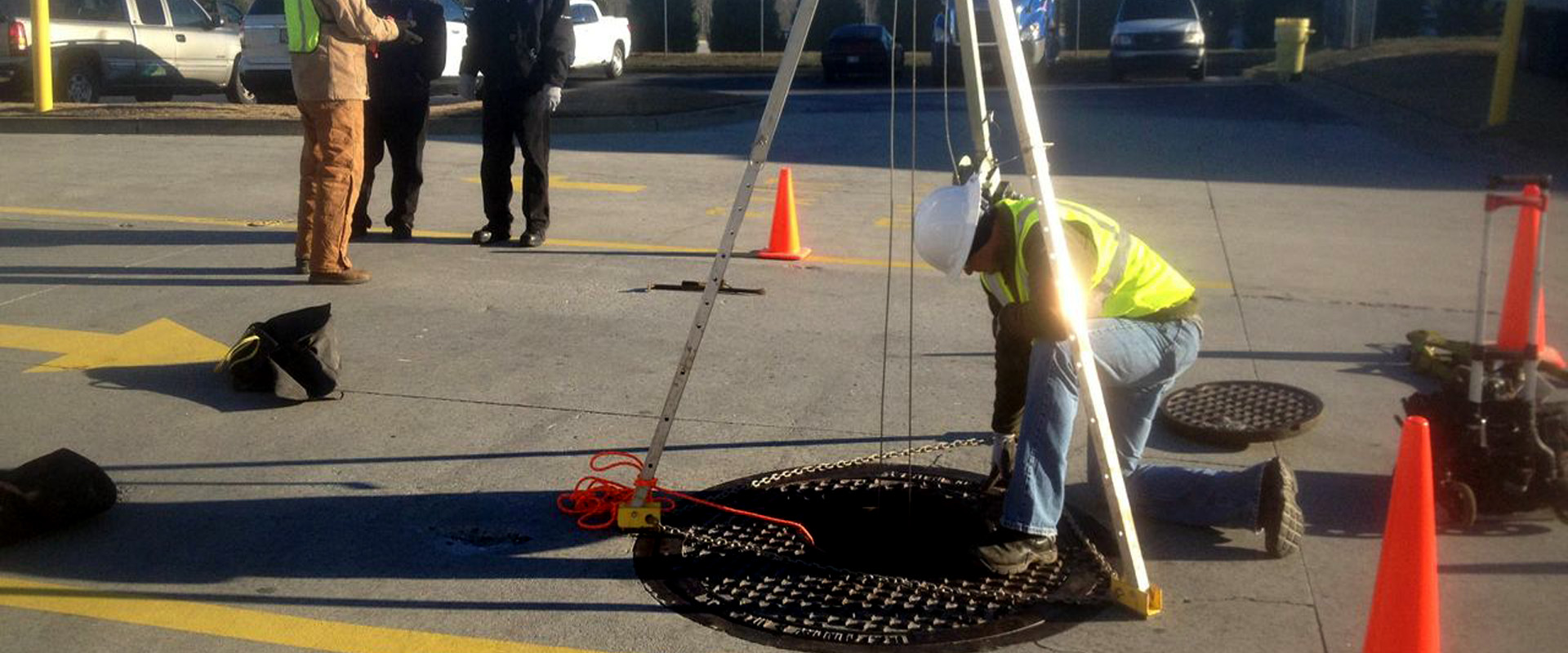
The rescue requirement is where most informal programs collapse under scrutiny. Listing the fire department on the permit is not an evaluation — the standard requires assessing, before entry, whether that service can actually reach and extract an entrant from your specific space in time, with confined-space rescue capability, and whether it is available at the hour your crew enters. For tanker work, non-entry retrieval means a harness on the entrant and a retrieval line to a tripod or davit-and-winch at the manway, rigged before entry, unless the equipment would increase overall risk. In an oxygen-deficient atmosphere the timeline is minutes, and would-be rescuers entering unprotected is a documented multiplier in confined-space fatality counts.
Do state OSHA plans enforce confined space rules differently than federal OSHA?
State plans enforce at least equivalent standards and can hit harder: Minnesota OSHA assessed $621,600 against Wayne Transports for a tanker fatality — more than double FleetPride’s $264,380 federal proposal — plus state-specific items like the joint labor-management safety committee requirement (MN DLI). Texas has no state plan; federal OSHA enforced at FleetPride.
For a fleet network running terminals across state lines, jurisdiction is a program-design input. Texas, Oklahoma, Nebraska, Missouri (private sector), and Kansas private-sector workplaces are federal OSHA territory — 1910.146 applies as written. Minnesota and Iowa run state plans: Iowa enforces an adopted-identical 1910.146, while Minnesota layers on requirements such as the joint labor-management safety committee that appeared in the Wayne Transports citation list. The practical rule for multi-state operations: write one program to the strictest applicable plan and run it everywhere. Maintaining a separate, lighter program for federal-jurisdiction terminals saves nothing and guarantees the wrong version is in someone’s hands eventually.
What training do workers need before confined space entry?
Training is required before first assignment, before duty changes, when hazards change, and when performance shows deficiencies — with written certification carrying the employee’s name, trainer’s signature, and date, completed before entry (29 CFR 1910.146(g)). Wayne Transports was cited both for inadequate training and for failure to certify it (MN DLI).
Fleet shops fail this element two ways. The first is the obvious one: no training at all, because tanker entry was never recognized as confined-space work. The second is quieter: a technician trained as an attendant gets pulled to enter, or a service writer gets sent to “take a quick look” — a duty change that retriggers the training requirement before that person crosses a manway. The certification requirement is not paperwork for its own sake; it is the mechanism that forces the employer to know, by name and date, who is qualified for which role. Wayne Transports’ dual citation — for the training and separately for the certification — shows enforcement treats them as distinct obligations.
Does a no-entry policy eliminate confined space obligations for a fleet shop?
No — it narrows them. Employers who decide employees will not enter permit spaces must still identify and inventory the spaces, post danger signs or otherwise inform employees, and take effective measures to prevent entry (29 CFR 1910.146(c)(3)). If a customer’s tanker arrives with an open manway, “we didn’t plan to enter” is not a defense once an employee does.
A genuine no-entry posture is a legitimate and often smart choice for a parts or service operation that can send tank-interior work to a specialized facility. But it has to be built, not declared: a written policy, a space inventory that covers customer equipment passing through the shop, signage, physical manway control, and enforcement when someone shortcuts it. The evaluation duty at (c)(1) applies to every general-industry employer regardless of entry intentions — you cannot decide not to enter spaces you never identified. The no-entry decision fails on the day it is tested: one employee, one open manway, one flashlight, and the employer is retroactively running an unauthorized permit entry with no program behind it.
Where a fleet maintenance shop should start — this week
The FleetPride and Wayne Transports citation lists, read together, are a self-audit. Five steps, in order:
- Inventory every space — tanker barrels, frac tanks, vacuum truck tanks, pits, wash bays’ vessels, and customer equipment that moves through the shop (1910.146(c)(1)).
- Make the entry decision explicitly — permit-space program, or documented no-entry policy with manway controls (c)(3). Not deciding is deciding to have neither.
- Write the program to the standard’s elements — hazard evaluation, testing, permits, attendants, training, rescue (c)–(k) — against the strictest state plan in your footprint.
- Put a calibrated four-gas meter and trained people behind it — testing in the required order, results on the permit, before every entry.
- Solve rescue before the first permit is issued — evaluated rescuers, retrieval equipment at the manway, non-entry rescue as the default.
The cost asymmetry is not close. A single willful OSHA violation runs up to $165,514 (OSHA penalties page); FleetPride’s proposed penalty of $264,380 came from serious classifications alone. An iSi industrial hygiene assessment that finds the gap before an incident does costs $4,050 — a 41:1 return on a phone call against one willful citation, before counting what the incident itself costs.
iSi’s safety consulting team builds confined space programs for fleet maintenance and tanker operations that hold up on the day of entry — space inventories, written programs, permit systems, atmospheric testing procedures, training, and rescue evaluations — across 40 states, written once to the strictest applicable plan. If tankers move through your shop and your program is a binder nobody has opened, start with our safety consulting team or call (316) 264-7050.
Sources
- OSHA News Release 26-875-DAL — US Department of Labor cites big rig parts distributer for confined space, safety hazards after worker fatality at Corpus Christi facility (July 15, 2026) (verified 2026-07-16)
- 29 CFR 1910.146 — Permit-required confined spaces (eCFR current text) (verified 2026-07-16)
- OSHA Penalties page — 2026 maximum penalty amounts ($16,550 serious / $165,514 willful-repeat) (verified 2026-07-16)
- OSHA Memo — 2026 Annual Adjustments to OSHA Civil Penalties (May 21, 2026) (verified 2026-07-16)
- Minnesota DLI — Minnesota OSHA issues citations to Wayne Transports, Inc. after worker died in confined space ($621,600; August 28, 2024) (verified 2026-07-16)
- OSHA Confined Spaces topic page (verified 2026-07-16)