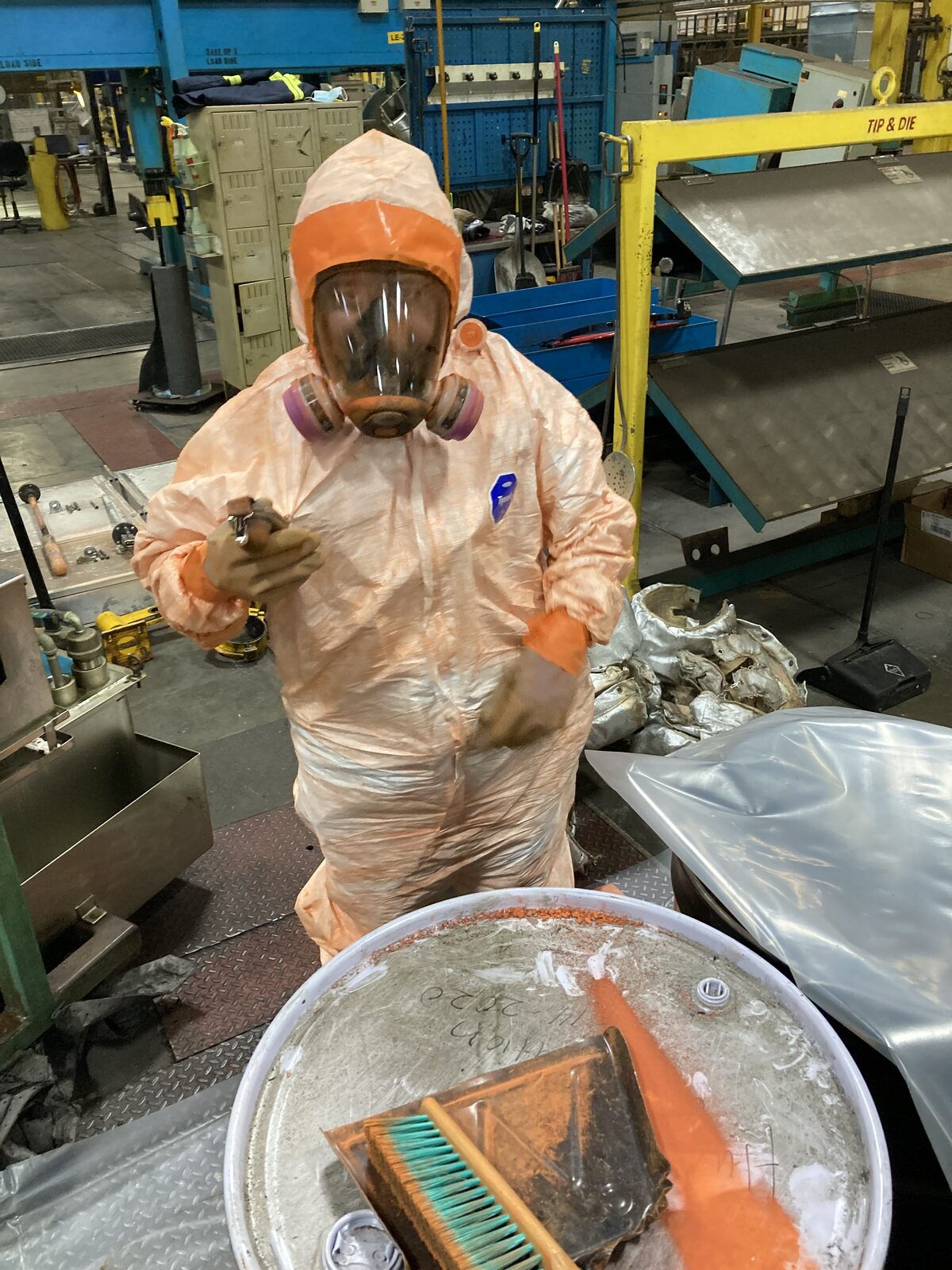
Creosote Exposure Limits and Workplace PPE: The OSHA Hazard Assessment That Has to Come First
OSHA regulates creosote as coal tar pitch volatiles: 0.2 mg/m³ PEL. Why a written hazard assessment under 1910.132(d) must come before any PPE selection.
Picture a consulting field crew that visits a former wood-treating site every week to collect creosote interface-probe samples. They wear disposable nitrile gloves — because nitrile is what’s in the truck — and nothing for the inhalation route. Nobody has ever run an exposure assessment at the site. Nobody has characterized what those staff breathe or touch against any occupational exposure limit. When you ask why there’s no respirator in the program, the honest answer is that nobody knows whether one is needed.
That is the real gap in most creosote PPE programs, and it is not a gear problem. It is a sequence problem. OSHA’s PPE standard, 29 CFR 1910.132(d), requires the employer to assess the workplace for hazards before selecting protective equipment — and to certify that assessment in writing. You can’t pick a respirator you never proved you needed. You also can’t rule one out. The crew in nitrile gloves didn’t choose the wrong PPE; they skipped the step that determines what the right PPE is.
This post walks through what actually governs creosote exposure in the workplace — the enforceable limits, the carcinogen classifications, the glove question, the respirator triggers — and why every one of those answers routes back through the same written hazard assessment.
What Does 29 CFR 1910.132(d) Require?
Three things, in order: assess the workplace for hazards before selecting PPE, select PPE matched to the hazards identified, and certify the assessment in writing. The certification under 1910.132(d)(2) must identify the workplace evaluated, the person certifying, the date(s), and the document itself as a certification of hazard assessment.
The order matters as much as the content. The standard’s structure is assessment first, selection second — PPE must protect against hazards “identified in the assessment,” which means an assessment that never happened cannot support any PPE selection, including the decision to wear nothing but gloves. One scope note worth knowing: under 1910.132(g), the (d) assessment-and-certification duty attaches to eye and face protection (1910.133), head (1910.135), foot (1910.136), hand protection (1910.138), and personal fall protection systems (1910.140). Respiratory protection runs under its own standard, 1910.134, with its own program requirements. But the practical dependency is unavoidable: the hazard assessment, backed by exposure data, is what determines whether 1910.134 gets triggered at all. OSHA’s non-mandatory guidelines at 1910 Subpart I Appendix B lay out the walk-through-and-analyze process.
What Is the OSHA Exposure Limit for Creosote?
0.2 mg/m³, measured as the benzene-soluble fraction, averaged over an 8-hour shift (29 CFR 1910.1000, Table Z-1). Creosote carries no exposure limit of its own — it is regulated as a coal tar pitch volatile (CTPV), a category defined at 29 CFR 1910.1002 to include wood-distillation residues.
This is the number that confuses people searching OSHA’s index for “creosote.” The regulation at 1910.1002 defines coal tar pitch volatiles as “the fused polycyclic hydrocarbons which volatilize from the distillation residues of coal, petroleum (excluding asphalt), wood, and other organic matter” — and NIOSH states plainly that it considers coal tar, coal tar pitch, and creosote to be coal tar products (NIOSH Pocket Guide, CAS 65996-93-2).
One caution from the field: the 0.2 mg/m³ PEL is a 1971-vintage number, adopted from the ACGIH TLVs of that era and never modernized — OSHA’s 1989 attempt to update hundreds of PELs was vacated in court in 1992, leaving the old figure in force (OSHA Annotated Table Z-1). An air result under the PEL means you are compliant. For a substance IARC calls a probable human carcinogen, it does not automatically mean the exposure is as low as it should be.
Does OSHA Have a Creosote-Specific Standard?
No. OSHA has never issued a substance-specific standard for creosote or CTPV (OSHA CTPV standards page). The enforceable framework is the air-contaminants standard (29 CFR 1910.1000, Table Z-1) plus the PPE hazard-assessment duty at 29 CFR 1910.132(d). The 0.2 mg/m³ CTPV PEL is the governing limit.
There is no creosote chapter to look up the way there is for silica, lead, or benzene — no substance-specific medical surveillance trigger, no creosote-specific action level. That absence cuts both ways. It means fewer prescriptive requirements, and it means the general-duty machinery does the work: overexposures get cited under 1910.1000, PPE-selection failures under 1910.132(d), respirator-program failures under 1910.134. Employers who assume “no specific standard” means “no obligation” have the logic backwards — the obligations are simply distributed across the general standards, and the hazard assessment is where they converge.
Is Creosote a Carcinogen?
Yes. IARC classifies creosotes as Group 2A — probably carcinogenic to humans — while coal-tar pitch itself sits in Group 1, a confirmed human carcinogen (ATSDR Toxicological Profile for Creosote, July 2024). EPA classifies creosote as a probable human carcinogen (EPA creosote page); NIOSH treats CTPV as a potential occupational carcinogen with documented cancer sites in the lung, kidney, and skin (NIOSH Pocket Guide).
Keep the two classifications straight — creosotes are Group 2A; coal-tar pitch is Group 1. They are related coal tar products, not the same material, and conflating them overstates the creosote evidence. What matters for the hazard assessment is that every major authority lands on the same side: this is a carcinogen-class exposure with three documented target organs, one of which — skin — no air pump will ever measure. EPA has kept creosote on the market as a restricted-use pesticide for outdoor industrial applications like railroad ties and utility poles rather than cancelling it, which means occupational creosote exposure is an ongoing, legally sanctioned reality, not a phase-out (EPA wood preservatives overview).
Is Creosote a Dermal Hazard, and Does It Carry a Skin Warning?
Yes. NIOSH lists CTPV exposure routes as inhalation, skin, and/or eye contact, names skin among the cancer sites, and directs employers to prevent skin contact, require daily skin washing, and require daily clothing changes (NIOSH Pocket Guide). Air monitoring alone does not capture the dermal route — glove selection belongs inside the hazard assessment.
This is where the interface-probe crew’s situation gets specific. Their highest-contact route is dermal: handling probes, bailers, and tubing wetted with creosote product week after week. A program that never assessed the dermal hazard has no basis for its glove choice, and a program that only runs air sampling has assessed half the problem. The 1910.132(d) assessment is supposed to walk every route — inhalation, skin, eye — and match a control to each. “Prevent skin contact” is not a suggestion to buy more gloves; it is a performance target the glove selection has to actually meet.
Are Nitrile Gloves Adequate for Creosote?
No government agency publishes a permeation rating for nitrile — or any glove material — against coal tar creosote. NIOSH directs “prevent skin contact,” daily washing, and daily clothing changes (NIOSH Pocket Guide), but sets no glove specification. Verify permeation data against the specific product SDS and document the selection in the hazard assessment.
That answer frustrates people who want a yes or no, and it should — because it exposes how much of routine glove selection is habit rather than assessment. Creosote is a complex aromatic-hydrocarbon mixture, and thin disposable nitrile is generally a weak performer against aromatic mixtures. But “generally weak” is not permeation data, and stating flatly that nitrile fails would be as undocumented as assuming it works. The defensible position under 1910.138 is the one 1910.132(d) already requires: identify the specific product in use, pull its SDS, check manufacturer permeation and breakthrough data for the candidate glove materials against that product’s constituents, select accordingly, and write it down. A crew whose glove choice traces to a documented product-specific evaluation is in a different posture than a crew whose glove choice traces to what the supply closet stocks.
What PPE Is Required for Creosote Work?
29 CFR 1910.132(d) makes the answer conditional: required PPE is whatever the written hazard assessment identifies. Because creosote is an inhalation, skin, and eye hazard (NIOSH Pocket Guide), that typically means chemical-appropriate gloves (1910.138), eye and face protection (1910.133), and — only where exposure data support it — a respirator (1910.134).
There is no universal creosote PPE list, and any vendor or safety catalog offering one is answering a question OSHA says only your assessment can answer. The assessment output for a treatment-plant worker handling hot creosote differs from the output for a field sampler probing a monitoring well, which differs again from a crew installing treated poles. What they share is the sequence: hazard by route, then control by hazard, then certification. OSHA is also explicit that PPE is the last line, not the first — engineering controls such as ventilation, isolation, and automated handling are the preferred methods for controlling CTPV exposure (OSHA CTPV solutions page). An assessment that jumps straight to gear without evaluating controls has skipped a rung on the hierarchy.
When Is a Respirator Required for Creosote or CTPV Exposure?
A respirator is required under 1910.134 when engineering and work-practice controls cannot keep airborne CTPV below the 0.2 mg/m³ PEL (Table Z-1). NIOSH guidance goes further, recommending the most protective respirators at any detectable concentration above its 0.1 mg/m³ REL (cyclohexane-extractable fraction) (NIOSH Pocket Guide). Air sampling data — not assumption — decides the question.
Notice what both triggers have in common: they are exposure numbers. You cannot compare your workplace to 0.2 mg/m³ or 0.1 mg/m³ without measured data, which is why the no-assessment crew cannot answer the respirator question in either direction. Maybe their outdoor interface sampling generates airborne CTPV well below any limit — plausible for short-duration outdoor work. Maybe warm-weather volatilization off recovered product tells a different story. Without data it is a guess, and a respirator program built on a guess fails in one of two directions: unprotected overexposure, or the cost and burden of respirators nobody needed. Keep the NIOSH figures in their lane as you plan: the REL is a recommendation, not an enforceable limit. An employer can sit legally under the OSHA PEL while exceeding the NIOSH REL — a gap the hazard assessment should surface and management should consciously decide about, rather than discover later.
What Triggers the Jump to Supplied-Air Respirators for CTPV?
NIOSH recommends the most protective respirators — APF 10,000 supplied-air respirators or SCBA in positive-pressure mode — at any detectable concentration above its 0.1 mg/m³ REL (cyclohexane-extractable fraction), applying its carcinogen policy (NIOSH Pocket Guide). The revised IDLH for CTPV is 80 mg/m³ (NIOSH IDLH documentation). Both figures are guidance, not enforceable OSHA limits.
This surprises people who expect a graduated cartridge-to-supplied-air ladder. Because NIOSH classifies CTPV as a potential occupational carcinogen, its recommendation skips the ladder: any detectable exposure above the REL puts you at the top of the protection hierarchy in NIOSH’s framework. OSHA enforcement does not mirror that — the enforceable obligation remains keeping exposure under the 0.2 mg/m³ PEL with a compliant 1910.134 program where respirators are used. But for an employer writing an internal policy for a Group 2A carcinogen, the NIOSH position is the conservative benchmark worth weighing deliberately. Either way, the same dependency holds: the jump decision runs on measured concentration data that only an exposure assessment produces.
How Do You Sample for Coal Tar Pitch Volatiles?
OSHA Method 58 and NIOSH Methods 5042, 5506, and 5515 measure CTPV by drawing workplace air through a sampling device and analyzing the benzene-soluble fraction and target polycyclic aromatic hydrocarbons (OSHA exposure-evaluation guidance; OSHA Method 58). Sampling converts a 1910.132(d) hazard assessment from professional opinion into defensible exposure data.
The analytical target — the benzene-soluble fraction — matches the way the PEL is written, which is why a generic dust or VOC screen does not answer the CTPV question. Personal samples worn in the breathing zone during representative tasks, run through one of the referenced methods, are what let you put a number next to the 0.2 mg/m³ PEL and the 0.1 mg/m³ REL and defend the comparison, noting the PEL is benzene-soluble and the NIOSH REL is cyclohexane-extractable, so the two are not directly interchangeable. We cover how the sampling itself works — pump-and-media setups, sample duration strategy, and how results translate to TWAs — in our post on industrial hygiene sampling types and methods, so we won’t restate the mechanics here. The point for this discussion is narrower: for CTPV, the sampling round is not a nice-to-have layered on top of the hazard assessment. It is the assessment’s evidentiary spine.
Do Kansas, Oklahoma, Texas, Missouri, and Nebraska Have Their Own Creosote or PPE Rules?
No. None of the five operates an OSHA-approved State Plan covering private-sector employers, so federal OSHA has direct jurisdiction (OSHA State Plans directory). The 0.2 mg/m³ CTPV PEL and the 1910.132(d) written hazard-assessment duty apply identically across all five states — no state variations to reconcile.
For multi-site operators in this footprint — a tie yard in Oklahoma, a treatment plant in Texas, remediation sites in Kansas and Missouri — that uniformity is operationally useful: one CTPV exposure-assessment protocol and one PPE-certification template work everywhere. Wood preserving itself is a federally recognized exposure sector (SIC 2491, OSHA SIC manual), and OSHA lists wood preserving alongside coking, roofing, road paving, and aluminum smelting among CTPV-exposure industries (OSHA CTPV hazards page). The one caveat: state and local government workers in federal-OSHA states generally fall outside federal coverage — a niche point for public-sector fleets, irrelevant to private employers.
Does the Hazard-Assessment Duty Apply to Small Employers and Consulting Firms?
Yes. 29 CFR 1910.132(d) applies to every covered employer regardless of headcount — including small environmental consulting firms whose own field staff collect the samples. There is no small-employer exemption from the written certification. OSHA’s 2026 penalty policy adjusts penalty reductions for small firms; it does not shrink the underlying duty (2026 OSHA penalty memo).
This lands hardest on consulting firms, and it should. A firm that performs exposure assessments for clients while its own weekly sampling crew works without one has a documented-competence problem an OSHA compliance officer will not miss. The financial frame: 2026 maximum penalties are holding at 2025 levels — up to $16,550 per serious violation and up to $165,514 per willful or repeated violation, with no inflation adjustment this year (OSHA 2026 penalty adjustments). A crew sampling weekly for months without a hazard assessment is not a one-day oversight; it is a continuing pattern, and continuing patterns are how “serious” conversations become “willful” conversations.
The Fix Is a Sequence, Not a Shopping List
Pull the thread back to the crew in the opening scene. Their path to compliance is not “buy respirators” — it may turn out respirators are unnecessary. The path is the sequence the standard has required all along:
- Perform and certify the written hazard assessment under 1910.132(d) — every route (inhalation, dermal, eye), every task, signed and dated.
- Characterize the CTPV air exposure against the 0.2 mg/m³ benzene-soluble PEL with method-appropriate personal sampling.
- Select hand and eye protection from the assessment — glove material verified against the specific product’s SDS permeation data and documented, not defaulted.
- Answer the respirator question from the data, in whichever direction the numbers point, and evaluate engineering and work-practice controls before defaulting to gear.
Every downstream decision — glove material, respirator yes-or-no, cartridge versus supplied air, even whether current practice is already adequate — inherits its legitimacy from steps one and two. Skip them and every choice after is a guess wearing a compliance costume.
This is exactly the work iSi’s industrial hygiene team does: exposure assessments and CTPV air sampling that produce the written, certified hazard assessment your PPE selections have to trace back to. The math favors doing it before an inspector forces the issue — a single willful OSHA violation runs up to $165,514, while an iSi industrial hygiene assessment that catches the gap first costs $4,050. That is a 41:1 return on a phone call. If your crews handle creosote-treated materials or sample creosote-impacted sites and no one can produce the certification 1910.132(d)(2) describes, call (316) 264-7050 and we will scope the assessment this week.
Sources
- 29 CFR 1910.1002 — Coal tar pitch volatiles, definition: https://www.osha.gov/laws-regs/regulations/standardnumber/1910/1910.1002 (verified 2026-07-18)
- 29 CFR 1910.1000 Table Z-1 — CTPV PEL 0.2 mg/m³: https://www.osha.gov/laws-regs/regulations/standardnumber/1910/1910.1000TABLEZ1 (verified 2026-07-18)
- OSHA Annotated Table Z-1 — PEL history and ACGIH/NIOSH comparison: https://www.osha.gov/annotated-pels/table-z-1 (verified 2026-07-18)
- 29 CFR 1910.132 — PPE general requirements; (d) hazard assessment; (d)(2) written certification; (g) scope: https://www.osha.gov/laws-regs/regulations/standardnumber/1910/1910.132 (verified 2026-07-18)
- 29 CFR 1910 Subpart I Appendix B — Non-mandatory hazard assessment guidelines: https://www.osha.gov/laws-regs/regulations/standardnumber/1910/1910SubpartIAppB (verified 2026-07-18)
- OSHA Coal Tar Pitch Volatiles topic pages — hazards, exposure evaluation, solutions, standards: https://www.osha.gov/coal-tar-pitch-volatiles/hazards ; https://www.osha.gov/coal-tar-pitch-volatiles/exposure-evaluation ; https://www.osha.gov/coal-tar-pitch-volatiles/solutions ; https://www.osha.gov/coal-tar-pitch-volatiles/standards (verified 2026-07-18)
- OSHA Method 58 — CTPV sampling and analysis: https://www.osha.gov/sites/default/files/methods/osha-58.pdf (verified 2026-07-18)
- OSHA SIC 2491 — Wood Preserving: https://www.osha.gov/sic-manual/2491 (verified 2026-07-18)
- 2026 Annual Adjustments to OSHA Civil Penalties — amounts held at 2025 levels: https://www.osha.gov/memos/2026-05-21/2026-annual-adjustments-osha-civil-penalties (verified 2026-07-18)
- OSHA State Plans — approved plans directory (KS/OK/TX/MO/NE = federal jurisdiction): https://www.osha.gov/stateplans/approvedstateplans (verified 2026-07-18)
- NIOSH Pocket Guide — Coal tar pitch volatiles (REL, routes, cancer sites, respirator recommendations): https://www.cdc.gov/niosh/npg/npgd0145.html (verified 2026-07-18)
- NIOSH IDLH documentation — CTPV, revised IDLH 80 mg/m³: https://www.cdc.gov/niosh/idlh/65996932.html (verified 2026-07-18)
- ATSDR Toxicological Profile for Creosote (July 2024) — IARC classifications, carcinogenicity: https://www.atsdr.cdc.gov/toxprofiles/tp85.pdf (verified 2026-07-18)
- EPA — Creosote (restricted-use pesticide; registration review): https://www.epa.gov/ingredients-used-pesticide-products/creosote (verified 2026-07-18)
- EPA — Overview of Wood Preservative Chemicals: https://www.epa.gov/ingredients-used-pesticide-products/overview-wood-preservative-chemicals (verified 2026-07-18)