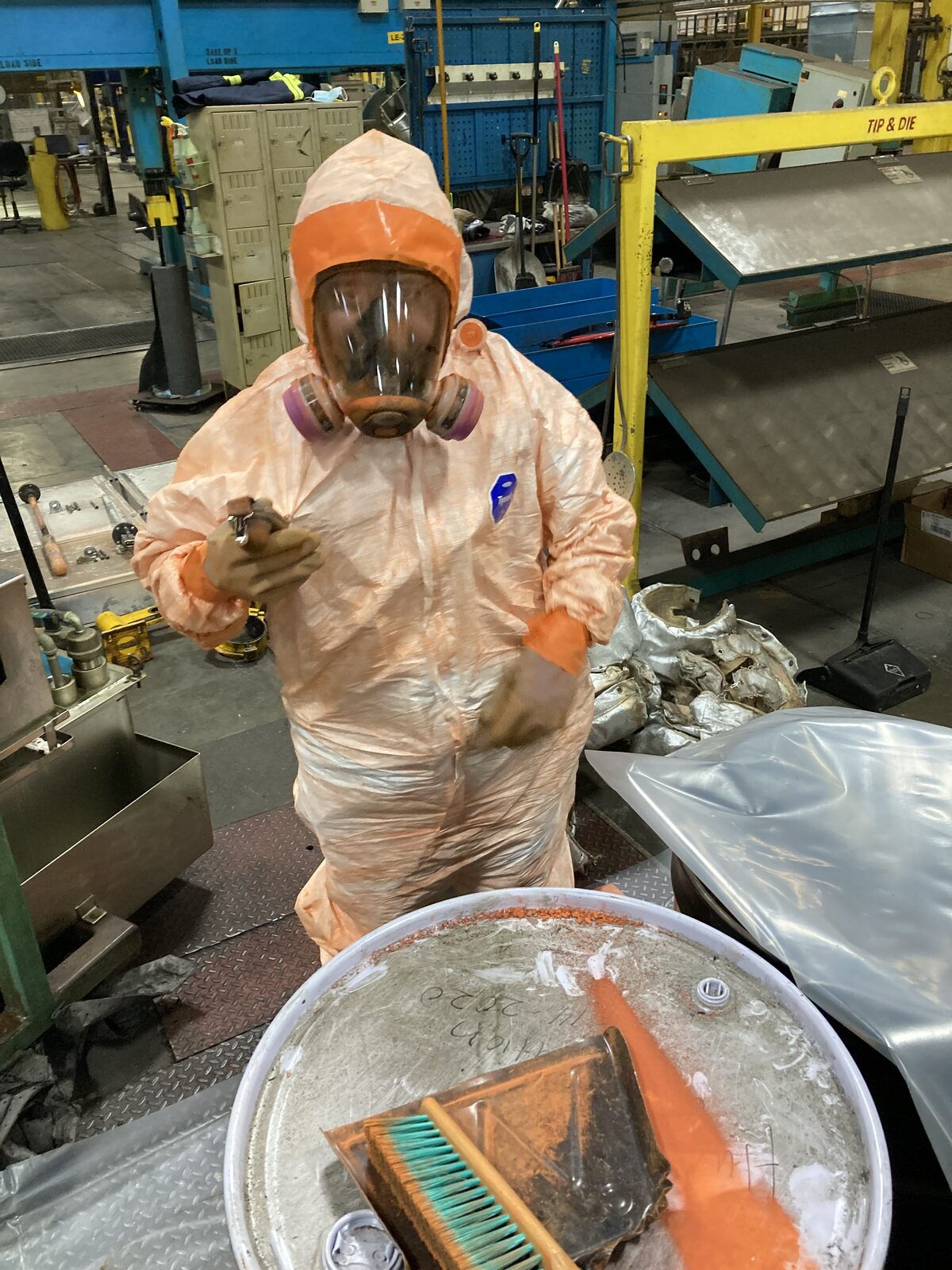
Before You Break Ground on a Remediation Job: The HASP, the SWPPP, and the State Filing Clock That Costs Contractors a Season
Kansas wants your stormwater NOI 60 days out. Nebraska wants 7. What a general contractor needs in hand, HASP included, before a remediation job starts.
A general contractor who wins a remediation job in Kansas and mobilizes on a Texas schedule is 53 days late before the first shovel moves. Kansas asks for the construction stormwater Notice of Intent 60 days ahead of any soil-disturbing activity. Nebraska asks for 7. Missouri wants the land disturbance application in hand 90 days before construction operations begin. None of those clocks appear in the bid documents, and neither does the site-specific health and safety plan OSHA expects to be sitting on the job the day work begins.
Contaminated-site construction puts a contractor inside two federal programs at once. OSHA’s Hazardous Waste Operations and Emergency Response standard attaches because of what is in the ground, and it requires a written plan built for that site and kept there. The Clean Water Act NPDES construction stormwater program attaches because of how much ground gets moved, and it requires a Stormwater Pollution Prevention Plan and a state filing before anything is disturbed. Satisfying one does nothing for the other. Below is what has to be in hand, in the order the clock demands it.
Do I need a HASP to work on a contaminated site?
Yes, if the work falls under 29 CFR 1910.120(a)(1). A site-specific safety and health plan is required by 1910.120(b)(4)(i), it “must be kept on site,” and it must address the safety and health hazards of each phase of site operation. A generic corporate plan with the site name swapped in does not satisfy that. Construction work is covered by the parallel 29 CFR 1926.65.
Paragraph (a)(1) reaches clean-up operations required by a governmental body at uncontrolled hazardous waste sites, RCRA corrective action clean-ups, and voluntary clean-ups at sites a government body recognizes as uncontrolled hazardous waste sites. A state-lead cleanup running under a KDHE consent order sits inside that, and paragraph (a)(2)(ii) closes the door on partial compliance: those operations must comply with all paragraphs of the section except (p) and (q).
The one exit is narrow: the standard applies unless the employer can demonstrate that the operation does not involve employee exposure or the reasonable possibility for exposure to safety or health hazards. On a site that already has an analytical record, that demonstration is usually impossible to make.
What must a site-specific HASP contain under HAZWOPER?
Exactly ten elements, at 1910.120(b)(4)(ii)(A) through (J). There is no eleventh element and none of the ten is optional. Each has to be written for the site in front of you:
- A safety and health risk or hazard analysis for each site task and operation
- Employee training assignments
- Personal protective equipment to be used for each site task
- Medical surveillance requirements
- Frequency and types of air monitoring, personnel monitoring, and environmental sampling, including methods and instrument calibration
- Site control measures
- Decontamination procedures
- An emergency response plan
- Confined space entry procedures
- A spill containment program
The three a recycled corporate plan almost always lacks are the instrument calibration methods, the confined space entry procedures, and the spill containment program. Two obligations travel with the document: (b)(4)(iii) requires pre-entry briefings before any site activity begins, and (b)(4)(iv) requires the site safety and health supervisor to inspect against the plan and correct what is not working.
Does HAZWOPER apply to a general contractor, or only to the cleanup firm?
It applies to any employer whose employees perform covered clean-up operations, and that includes a general contractor. 1910.120(b)(1)(iv) separately requires an employer who retains contractors to inform them of site emergency response procedures and identified fire, explosion, health, or safety hazards, and (b)(1)(v) requires the written program be made available to contractors, subcontractors, employees, employee representatives, OSHA personnel, and other agencies with regulatory authority over the site.
The coverage line has a real edge to it. 1910.120(i) states that employees, contractors, and subcontractors working outside of the operations part of a site are not covered by the standard. A crew paving a lot 400 feet outside the plume boundary is in a different position from a crew trenching through it. Draw that line on the site plan during the bid, because after mobilization it becomes an argument instead of a boundary.
What HAZWOPER training do my crews need, 40 hour or 24 hour?
General site workers need 40 hours of instruction off site plus 3 days of supervised field experience (1910.120(e)(3)(i)). Workers on site only occasionally for a specific limited task, and unlikely to exceed exposure limits, need 24 hours plus 1 day. Moving a 24-hour worker up to general site work takes 16 additional hours and 2 additional days. Everyone takes 8 hours of refresher annually under (e)(8).
Verify the tier before mobilization, for the subs as well as your own people. The bidder pool is thinner than it looks: OSHA’s renewed information collection request for the standard reports 17,211 respondents against 27,186 in the 2023 extension, a 36.7 percent decline (91 FR 25386). Fewer covered employers means fewer crews carrying current training and current medical clearance. Emergency response training under paragraph (q) is a separate track, and clean-up operations are excluded from (p) and (q) by (a)(2)(ii). iSi covered that split in HAZWOPER emergency response plan versus emergency action plan.
What training does a site supervisor need on a HAZWOPER job?
More than the commonly quoted eight hours. 1910.120(e)(4) requires on-site management and supervisors directly responsible for employees engaged in hazardous waste operations to receive 40 hours of initial training and 3 days of supervised field experience, reducible to 24 hours and 1 day in limited circumstances, plus at least 8 additional hours of specialized training at the time of job assignment.
The 8 hours is the add-on. It covers the supervisor-specific material: the employer’s safety and health program, the PPE program, spill containment procedures, and health hazard monitoring techniques. A superintendent holding an 8-hour supervisor card and nothing else is not trained to the standard, which shows up fast when that same person signs the (b)(4)(iv) effectiveness inspections.
When does medical surveillance kick in for remediation workers?
At 30 days or more a year. 1910.120(f)(2) covers employees exposed to hazardous substances at or above the permissible exposure limit or published exposure level, without regard to respirator use, for 30 days or more a year, and employees who wear a respirator for 30 days or more a year. Exams are required prior to assignment and at least every 12 months thereafter under (f)(3)(i).
Respirator use is the trigger most bids miss. A crew in half-face respirators through a summer of excavation crosses the threshold on respirator use alone, whether or not a single sample comes back above a limit. Exams are also required at termination or reassignment when there has been no exam in the last six months, which belongs in the bid rather than in a change order.
What PPE do we use before the site is characterized?
Level B, at minimum. 1910.120(c)(5)(iii) provides that when the preliminary site evaluation does not produce sufficient information to identify the hazards or suspected hazards of the site, an ensemble providing protection equivalent to Level B PPE is the minimum level of protection, with direct-reading instruments used as appropriate to identify IDLH conditions.
Level B is supplied air, and supplied air changes crew size, productivity, and the decontamination setup. Complete the preliminary evaluation with a qualified person before entry so the crew steps down to Level C or D on documented grounds instead of defaulting up on a thin file.
How far in advance do I have to file a construction stormwater NOI in Kansas?
Sixty days. KDHE’s Notice of Intent instructions state: “Submit an NOI no later than 60 days prior to the start of construction activities, i.e., soil disturbing activities” (KDHE NOI Instructions, effective August 1, 2017). Discharge is not authorized until KDHE dates the authorization on the NOI form, assigns the permit numbers, and issues it with the Secretary’s signature.
The SWPPP comes first, because the plan is a supporting document to the application rather than a deliverable that follows it. Enclose the $60 first-year fee required under K.A.R. 28-16-56. A common drainage area serving 10 or more disturbed acres triggers a sedimentation basin. KDHE can also require coverage below the one-acre threshold where the activity carries significant pollution potential, and a contaminated site is close to the paradigm case for that call. If general coverage is denied, an individual permit needs a minimum of 90 more days.
The federal permit mechanics sit in a separate article: what the Construction General Permit is, how coverage works, the inspection cadence, the stabilization deadlines, and the February 16, 2027 expiry are covered in our post on construction stormwater permit and SWPPP requirements. This one stays on the state clocks and the contamination layer.
How do stormwater NOI deadlines differ across Kansas, Missouri, Oklahoma, Nebraska, and Texas?
They differ by more than an order of magnitude. Missouri requires the application be received at least 90 days before construction operations begin, a deadline set by rule at 10 CSR 20-6.200(3)(B)1, not just by agency preference. Kansas is 60 days. Oklahoma’s OKR10 is at least 14 days. Nebraska’s NER210000 and Texas TXR150000 are each 7 days. A contractor who learns the schedule on a Texas job and applies it in Kansas is 53 days late on the day of the pre-construction meeting.
| State | Permit | NOI lead time before soil disturbance | Source |
|---|---|---|---|
| Missouri | MO-RA land disturbance general permit | Application received at least 90 days before construction operations begin (10 CSR 20-6.200(3)(B)1) | MDNR Construction Land Disturbance Permits |
| Kansas | KDHE Kansas Water Pollution Control general permit | 60 days | KDHE NOI Instructions |
| Oklahoma | OKR10 | At least 14 days (OKR10 Part 3.5.A), and authorization to discharge must be received before starting | ODEQ Construction Stormwater |
| Nebraska | NER210000 | At least 7 days before land grading and clearing | NDEE Construction Storm Water |
| Texas | TCEQ TXR150000 | At least 7 days by paper; electronic submittal through STEERS may be filed prior to commencing | TCEQ Stormwater General Permit for Construction |
Oklahoma runs a late-NOI regime rather than a hard bar: filing late is not prohibited, but authorization covers only discharges occurring after coverage is granted, and DEQ reserves the right to enforce against the gap. Oklahoma also requires a new operator assuming operational control to file at least 2 days before doing so, which matters when a responsible party hands a site to a contractor mid-project. Texas charges $325 for a paper NOI, reduced to $225 filed electronically through STEERS. Nebraska’s NER210000 runs through November 20, 2026, so a bid extending past that date should account for a permit transition.
Does the construction stormwater NOI ask about soil or groundwater contamination?
In Kansas, yes, explicitly. Section II.C items 4 and 5 of the KDHE NOI require the applicant to state whether contaminated soils are present on site, whether groundwater contamination exists within 1,000 feet of the site, and whether the work will disturb contaminated soil or pump contaminated groundwater (KDHE NOI Instructions).
A yes answer triggers an attachment. The applicant must describe, on separate paper, the locations and concentrations of the contaminants and the special procedures and erosion and sediment control measures that will eliminate or minimize the potential to discharge them. That is a technical narrative built from the site’s analytical record, not something a project engineer writes the afternoon the form is due. Fill the NOI out as though it were a routine subdivision job and KDHE bounces it, and the 60-day clock restarts on the resubmittal. Two months of float can disappear over an attachment nobody was assigned.
Who holds the stormwater permit on a remediation job, the owner or the contractor?
Either or both. KDHE defines the applicant as the owner or operator with operational control over site construction activities and the day-to-day operational control necessary to ensure compliance, and states plainly that “for a typical commercial construction site, the owner or general contractor is the owner or operator” (KDHE NOI Instructions).
The general contractor does not get to assume the owner filed. Treated water is its own permit and its own owner. At the Wichita 29th and Grove site, a KDHE cleanup running under a consent order with the responsible party, remedy construction waited on separate water permits secured in advance: a Kansas Department of Agriculture permit for groundwater extraction and a KDHE Bureau of Water permit for groundwater injection, issued months apart. On that shape of job the water permits are a pre-construction deliverable in the critical path, and the contract needs to say whose.
Can I move contaminated soil off site without a hazardous waste determination?
No. Under EPA’s contained-in policy, environmental media that contain hazardous waste must be managed as hazardous waste until they no longer contain it, and land disposal restrictions attach at the point of generation (EPA, Guidance for Remediation Waste Management under RCRA Corrective Action). Contaminated soil subject to LDRs must meet the waste-specific standards at 40 CFR 268.40 or the alternative soil treatment standards at 40 CFR 268.49 before land disposal.
Profile the soil before it leaves the site rather than after a landfill rejects the load. The determination drives the disposal facility, the manifesting, and the unit cost, all of which sit on the critical path once excavation starts. RCRA civil penalties run to $93,058 per day of noncompliance under 42 U.S.C. 6928(g), as adjusted effective January 8, 2025, the most recent amendment codified at 40 CFR 19.4.
What can it actually cost to get this wrong?
OSHA serious violations run to $16,550 per violation and willful or repeated violations from $11,823 to $165,514, with the 2025 amounts carried into 2026 (OSHA 2026 Annual Adjustments; OSHA 2025 Annual Adjustments, Table 1). Failure to abate carries $16,550 per day unabated, generally limited to 30 days. Clean Water Act judicial civil penalties reach $68,445 per day per violation under 33 U.S.C. 1319(d).
The 2026 federal penalty figures are the 2025 figures. OMB Memorandum M-26-11, issued April 17, 2026, cancelled the government-wide inflation adjustment because the October and November 2025 lapse in appropriations left the Bureau of Labor Statistics unable to produce the October 2025 CPI-U, and the statute provides no alternative calculation (91 FR 43405). OSHA’s 2026 memo states it will continue using the 2025 penalty levels. Any article published this year claiming penalties went up again is working from a schedule that was never issued.
The Clean Water Act numbers are statutory ceilings, and the gap between the ceiling and what EPA settles for is enormous. The $68,445 per day and the $27,378 per day Class II administrative penalty capped at $342,218 both appear in 40 CFR 19.4 as adjusted effective January 8, 2025, the most recent amendment codified there. NPDES violations are penalized through section 1319; the NPDES permitting section itself carries no separate penalty row. What EPA actually collected on construction stormwater cases in 2026 sits in the four figures: Swinerton Builders at a casino expansion site in Tulalip, Washington, $12,960 for SWPPP maintenance, inspection, and NOI-modification lapses; and East Street Realty Trust in Massachusetts, $1,800, for discharging construction stormwater without NPDES authorization. The same expedited program reaches industrial stormwater paperwork the same way: Colaska, Inc. settled for $12,797 at the AggPro site in Alaska over missing inspection, assessment, and training records under Alaska’s industrial multi-sector permit. EPA also runs a Revised Expedited Settlement Agreement Program Pilot for Construction Stormwater built to resolve these cases quickly at capped amounts.
So the penalty on a routine stormwater lapse is survivable for most contractors, and the schedule loss is what hurts. The East Street matter shows the fact pattern that draws the charge: discharging stormwater from construction activity without authorization, which is what a 60-day Kansas clock produces when a crew mobilizes on the project schedule. OSHA has also widened its size-based penalty reductions rather than tightening them: per the 2026 memo, the category eligible for the largest reduction moved from employers with 1 to 10 employees to 1 to 25. Most contractors bidding a single remediation job sit inside that band.
The pre-mobilization sequence
Working backward from the first day of soil disturbance:
- Resolve the permittee question in the contract: who files the NOI, who owns the SWPPP, who signs inspections, who secures any discharge permit for treated water.
- Pull the site’s analytical record and write the SWPPP, including the contamination narrative the Kansas NOI requires as an attachment.
- File the NOI with the fee on the state’s clock, and confirm authorization is issued before anyone disturbs ground.
- Run the preliminary site evaluation with a qualified person and set PPE levels off documented data.
- Write the HASP against all ten elements at 1910.120(b)(4)(ii), put a physical copy on the site, verify training and medical clearance for your crews and every sub, name the site safety and health supervisor, and hold the pre-entry briefing before any activity starts.
- Profile the excavated soil before the first load leaves, and book the local permits nobody bids: traffic control plan review, building and trade permits, right-of-way and pavement-cut permits, state DOT right-of-way, and wells installed under state well regulations.
Where iSi fits
Remediation jobs usually go wrong on the calendar. The permit clock eats the mobilization date, or the site plan gets written the week after work started and the crew ends up working to a document assembled to close a file. iSi supports contaminated-site construction across 40 states: writing the site-specific health and safety plan against the ten elements OSHA names, running the air and personnel monitoring that plan commits you to, preparing SWPPPs and filing NOIs on the state’s schedule instead of the project’s, and profiling soil before it leaves the site. If you are bidding remediation work and the compliance stack is riding on a superintendent who already has a full job, that is the place to start a conversation. We Plug In. You Level Up. Call iSi Environmental at (316) 264-7050 while the schedule still has float in it.
Sources
- 29 CFR 1910.120, Hazardous waste operations and emergency response
- 29 CFR 1926.65, HAZWOPER (construction)
- 2026 Annual Adjustments to OSHA Civil Penalties (May 21, 2026)
- 2025 Annual Adjustments to OSHA Civil Penalties, Tables 1 through 3 (January 7, 2025)
- 91 FR 43405, Civil Monetary Penalties Inflation Adjustments for 2026 (July 15, 2026)
- OMB Memorandum M-26-11, Cancellation of Penalty Inflation Adjustments for 2026
- 91 FR 25386, HAZWOPER Standard, Extension of OMB Approval (May 8, 2026)
- 40 CFR 19.4, Statutory civil monetary penalties as adjusted for inflation
- KDHE Notice of Intent Instructions, Construction Activities
- Missouri DNR, Construction Land Disturbance Permits
- Missouri 10 CSR 20-6.200, Storm Water Regulations (90-day application deadline at (3)(B)1)
- Oklahoma DEQ, OKR10 Construction Stormwater
- Oklahoma DEQ, General Permit OKR10 for Stormwater Discharges from Construction Activities (NOI timing at Part 3.5, operator change at Part 3.2.E)
- Nebraska DWEE, Construction Storm Water
- TCEQ, Stormwater General Permit for Construction Activities
- EPA Public Notice, Proposed Settlement with Swinerton Builders, Clean Water Act, Washington
- EPA Public Notice, Colaska Inc. AggPro Site, Alaska
- EPA Public Notice, East Street Realty Trust, CWA-01-2026-0020
- EPA, Revised Expedited Settlement Agreement Program Pilot for Construction Stormwater
- EPA, Guidance for Remediation Waste Management under RCRA Corrective Action
- KDHE, 29th and Grove Site
iSi’s environmental, safety, and industrial hygiene consultants work across 40 states — fixed pricing, a response back the same day. Request a quote.