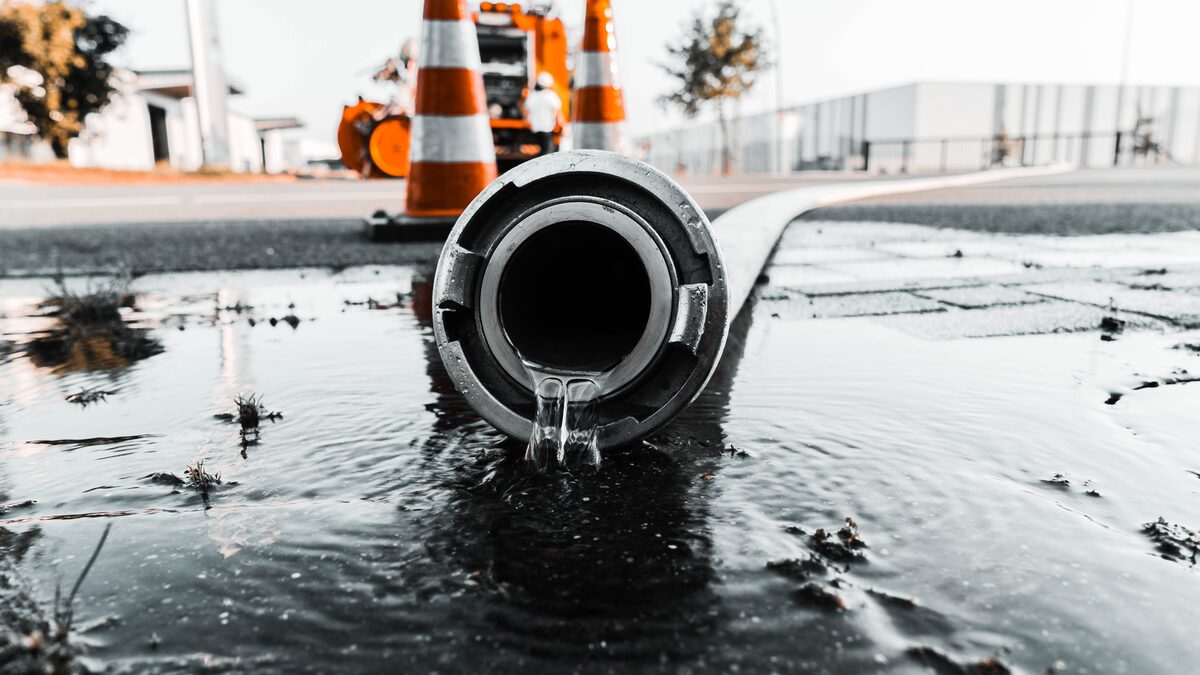
Your Industrial Stormwater Permit Does Not Cover Your Process Water: The 11 Authorized Non-Stormwater Discharges
Your industrial stormwater permit authorizes rain, not process water. The 11 authorized non-stormwater discharges, the 4 banned at food plants, and what to do.
An industrial stormwater permit authorizes rain. It does not authorize process water, and that single distinction is the most misunderstood provision in the NPDES industrial program. EPA’s Multi-Sector General Permit lists exactly eleven non-stormwater discharges that are authorized for every sector. Everything not on that list is unauthorized the moment it reaches your outfall. If your food or beverage plant sends boiler blowdown, cooling tower blowdown, ammonia refrigeration purge, or truck wash water down a storm line, you are not covered by your stormwater permit. You are discharging without one.
The rest of this is the detail a plant manager needs to check it, document it, and fix it, plus an honest read on how much enforcement risk actually sits behind it.
Two things make August 2026 the right moment to read this. First, EPA’s 2021 MSGP expired on February 28, 2026 and has not been reissued, which changes what “covered” means depending on when you got your permit. Second, a federal court is being asked to approve a consent decree against a food manufacturer where one of the four alleged Clean Water Act counts was, in EPA’s own words, failure to evaluate for and eliminate unauthorized non-stormwater discharges. That count is a standalone federal violation, not an afterthought attached to a bigger case.
What is a non-stormwater discharge under an industrial stormwater permit?
A non-stormwater discharge is anything leaving a discharge point that is not rain, snow, or snowmelt runoff. MSGP Part 1.2.2 authorizes a closed list of eleven; everything else is unauthorized. The practical test is dry-weather flow. If a drain or outfall runs on a day with no precipitation, that flow is a non-stormwater discharge and it has to be on the list (EPA 2021 MSGP, Permit Parts 1-7).
The permit does not treat this as a technicality. Part 1.1.3.1 makes a facility ineligible for permit coverage entirely if its stormwater discharge is mixed with a non-stormwater discharge outside the authorized list. Not partially ineligible. Not ineligible for that outfall. Ineligible. A single unauthorized commingled flow can knock the whole facility out of coverage, which converts every discharge from that site into an unpermitted discharge for as long as the condition lasts.
Part 2.1.2.9 states the affirmative duty in one sentence: “You must evaluate for the presence of non-stormwater discharges. You must eliminate any non-stormwater discharges not explicitly authorized in Part 1.2.2 or covered by another NPDES permit, including vehicle and equipment/tank wash water.” This is a stormwater permit that requires a wastewater investigation. Most plant managers never read that far into the document.
Which non-stormwater discharges are actually allowed under the MSGP?
Eleven, at Part 1.2.2.1: emergency firefighting discharges; fire hydrant flushings; potable water and uncontaminated line flushings; uncontaminated condensate from air conditioners, coolers, chillers and compressors; irrigation and landscape drainage; pavement wash water without detergents; external building washdown without detergents; uncontaminated ground or spring water; uncontaminated foundation and footing drains; incidental cooling tower windblown mist; and combinations of the above (EPA 2021 MSGP, Permit Parts 1-7).
Read the qualifiers, because that is where facilities lose the argument. “Uncontaminated” condensate means condensate, not condensate that has picked up product residue on its way across a cooler floor. “Without detergents” means the pavement wash and the building washdown fall off the list the moment someone adds soap. “Incidental” windblown mist from a cooling tower is authorized; cooling tower blowdown is not, and the two come off the same equipment. The list is short and its exceptions are narrow by design.
Does my food or beverage plant need an industrial stormwater permit?
If your primary SIC code falls in the 2011 through 2099 range, you sit in 40 CFR 122.26(b)(14)(xi) and MSGP Sector U. You need permit coverage when industrial materials or activities are exposed to precipitation and the site discharges to a water of the United States or to a municipal storm sewer. Discharging only to sanitary sewer removes the stormwater permit requirement (eCFR, 40 CFR 122.26).
Work the applicability test in order and you can finish it yourself in an afternoon.
Step 1, find your primary SIC code. Use the operation that produces the most revenue or employs the most people. Meat products 2011 to 2015, dairy 2021 to 2026, canned and frozen fruits and vegetables 2032 to 2038, grain mill products 2041 to 2048, bakery 2051 to 2053, sugar and confectionery 2061 to 2068, fats and oils 2074 to 2079, beverages 2082 to 2087, miscellaneous food preparations 2091 to 2099, tobacco 2111 to 2141. All of these are Sector U. Watch the co-location trap: leather tanning under SIC 311 sits in category (b)(14)(ii), not (xi), and rendering or animal by-product operations often carry a second code that pulls in a second sector’s requirements.
Step 2, check exposure. A permit is triggered when industrial materials or activities are exposed to rain, snow, snowmelt, or runoff. If the plant routes all of its stormwater to the sanitary sewer, no industrial stormwater permit is required, but pretreatment rules apply instead.
Step 3, check the no-exposure exclusion, and Step 4, walk the discharge points, are covered in their own sections below. Step 4 is the one almost nobody does.
One geographic note that matters more than it sounds: the federal MSGP does not apply anywhere in iSi’s six-state region. EPA issues the MSGP directly only in Massachusetts, New Hampshire, New Mexico, the District of Columbia, Puerto Rico, most U.S. territories, and most Indian country lands. In Kansas, Oklahoma, Missouri, Nebraska, Texas, and Colorado, a delegated state agency issues the equivalent permit. The federal MSGP is the template your state permit was built from, not the permit you hold.
Which non-stormwater discharges are specifically prohibited at food and beverage plants?
MSGP Part 8.U.2.1 names four for Sector U: boiler blowdown, cooling tower overflow and blowdown, ammonia refrigeration purging, and vehicle washing and clean-out operations. EPA includes the list “solely as a helpful reminder” (EPA 2021 MSGP, Part 8 Sector-Specific Requirements).
Look at that list from the plant floor rather than from the permit. Boiler blowdown happens on a schedule. Cooling tower blowdown happens continuously. Ammonia refrigeration purging happens whenever the system needs it. Trailers and totes get washed out because product safety requires it. Every one of those four is a routine daily operation in food manufacturing, which is exactly why Sector U facilities fail this provision more often than a list of eleven authorized discharges would suggest. The prohibited activities are not unusual events at a food plant. They are Tuesday.
Sector U carries other obligations worth knowing while you are in the permit. Indicator monitoring covers COD, TSS, and pH for Subsector U3, all report-only. Numeric benchmarks apply to grain mill products (TSS 100 mg/L) and to fats and oils (BOD5 30 mg/L, COD 120 mg/L, nitrate plus nitrite nitrogen 0.68 mg/L, TSS 100 mg/L) under Table 8.U-2. Part 8.U.5 adds required inspection of loading and unloading areas, waste management units, vents and stacks from cooking and drying operations, spoiled and broken-container product areas, animal holding pens, staging areas, and air pollution control equipment.
Can a food plant avoid the permit entirely with a no-exposure certification?
Yes, under 40 CFR 122.26(g), if every industrial material and activity at the site is under a storm-resistant shelter. Three categories need no shelter: tightly sealed, non-leaking drums, barrels and tanks without operational taps or valves; adequately maintained material-handling vehicles; and final products other than those that would mobilize in stormwater, such as rock salt. The exclusion is facility-wide only, never outfall by outfall, and it requires re-certification every five years (eCFR, 40 CFR 122.26).
The part that catches facilities is the lapse condition. The exclusion evaporates the moment circumstances change, and at that point the discharge becomes subject to enforcement for an unpermitted discharge. Nobody sends you a notice. A palletized ingredient staged outside for a week during a shutdown, a new outdoor waste compactor, a leaking tote moved to the yard, and the certification you filed three years ago is no longer accurate. Treat the no-exposure certification as a condition to be re-verified during every routine inspection, not a filing you did once.
State variation is real here. Colorado’s exclusion requires division approval and issuance of a certification rather than a self-certifying filing, and CDPHE has been aligning certification expirations onto a common date (CDPHE, COR900000). Oklahoma’s ODEQ inspects to validate a no-exposure claim, the certification does not transfer to a new operator, and Sector AD is excluded from the no-exposure route entirely (ODEQ, Industrial Stormwater).
How do I document the unauthorized non-stormwater discharge evaluation?
MSGP Part 6.2.3.4 requires four elements in the SWPPP within the first year of permit coverage: the date of the evaluation, a description of the evaluation criteria used, a list of every discharge point or onsite drainage point directly observed, and, where anything unauthorized is found, the immediate action taken plus a written explanation of everything done to eliminate it (EPA 2021 MSGP, Permit Parts 1-7).
Four elements. Write them as four headings in the SWPPP and fill them in. If completing the evaluation within the first year is not feasible, the permit lets you document why and set a schedule, but it does not let you skip the record.
The field method behind those four elements is the dry-day walk, and it takes a couple of hours at most plants. Pick a day with no precipitation in the previous 24 hours. Walk every drain, sump, trench, and outfall on the property with the site map in hand. Anything flowing is a non-stormwater discharge. At food plants the recurring finds are consistent: floor drains in wash-down areas tied into a storm line during a renovation nobody documented, cooler condensate lines run to the nearest grate, CIP and tank rinse water routed to a trench that daylights at an outfall, truck wash aprons draining to the yard, and cooling tower blowdown piped to storm because that is where the pipe already went.
Photograph what you find, log the location on the site map, and note the flow condition. That record is what turns an uncomfortable discovery into a documented corrective action, which is a materially different posture in front of an inspector than an undocumented one.
What do I do if I find a floor drain discharging process water to a storm sewer?
MSGP Part 2.1.2.9 allows exactly three responses and no fourth: eliminate the discharge, obtain a separate NPDES permit covering it, or route it to sanitary sewer in accordance with applicable industrial pretreatment requirements. EPA’s cited examples are sealing the floor drain, rerouting a sink drain to sanitary, and applying for a permit covering an unauthorized cooling-water discharge (EPA 2021 MSGP, Permit Parts 1-7).
There is no fourth option called “monitor it and see.” There is no option called “it has always been that way.” Pick one of the three, execute it, and write down what you did and when.
The third option carries a second set of obligations most facilities underestimate. Routing to sanitary means your POTW’s pretreatment program now governs that stream, with its own limits, sampling, and reporting. That is a real path and often the cheapest one, but it is a transfer of the problem to a different regulator, not the end of it. Get the POTW’s discharge authorization in writing before the pipe moves.
What is the maximum penalty for an unauthorized non-stormwater discharge?
$68,445 per day per violation in federal court under 33 U.S.C. 1319(d), as adjusted at 40 CFR 19.4. Administratively, a Class I penalty is $27,378 per violation up to a $68,445 maximum; a Class II penalty is $27,378 per day up to a $342,218 maximum (eCFR, 40 CFR 19.4).
Those are 2025 figures and they are still the operative figures. OMB Memorandum M-26-11, issued April 17, 2026, cancelled the 2026 federal civil penalty inflation adjustment government-wide because the October 2025 CPI-U was never published, and directed agencies to keep using 2025 amounts (OMB M-26-11). The Clean Water Act maximum did not move this year. Anyone telling you penalties went up in 2026 is repeating a habit, not a fact.
The maximum is also not the number to plan around, and the next section explains why.
Do I have to sample authorized non-stormwater discharges?
Only where they are commingled with industrial stormwater. MSGP Part 4.1.8 states that you are required to monitor authorized non-stormwater discharges as delineated in Part 1.2.2 only where they mix with stormwater discharges associated with industrial activity (EPA 2021 MSGP, Permit Parts 1-7).
One change is coming. Under the proposed 2026 MSGP at Part 1.2.2.1, when benchmark monitoring triggers Additional Implementation Measures, the operator must evaluate authorized non-stormwater discharges as a possible source of the exceedance (EPA, proposed 2026 MSGP). That is a new duty, and it is the only substantive addition on this subject in the proposal. Part 2.1.2.9 itself is word-for-word identical between the 2021 permit and the 2026 proposal. The elimination obligation is not changing. It is simply being enforced against facilities that never did the evaluation in the first place.
The 2021 MSGP expired on February 28, 2026. Am I still covered?
If you held coverage before that date, yes. The 2021 MSGP expired at 11:59 pm eastern on February 28, 2026 and has been administratively continued under 5 U.S.C. 558(c) and 40 CFR 122.6. Your NeT-MSGP status now reads “Admin. Continued,” no new Notice of Intent is required, and every monitoring, inspection, and reporting obligation stays live (EPA, Administrative Continuance of the 2021 MSGP).
Do not read “administratively continued” as “expired, therefore relaxed.” It is the opposite. You carry the full 2021 permit, unchanged, indefinitely, until EPA issues the replacement. When the new permit is issued, existing operators get 90 days from its effective date to submit a new NOI.
The genuinely hard case is the facility that does not already hold coverage. New facilities and previously unpermitted existing facilities cannot obtain MSGP coverage at all right now, because there is no permit to obtain coverage under. EPA’s OECA issued a No Action Assurance memorandum stating it will exercise enforcement discretion not to pursue civil or administrative action against qualifying new operators discharging without a permit. Read that carefully: a No Action Assurance is a statement of federal enforcement discretion. It is not permit coverage. It does not run to citizen suits, and it does not help a previously unpermitted existing facility at all.
That distinction has real transactional weight. If you are buying a plant, building one, or bringing an existing site into compliance after discovering it should have been permitted years ago, the federal path is currently closed and your options depend entirely on which state the site sits in. Handle it in diligence, not after closing.
When does my state’s industrial stormwater general permit expire?
Kansas KSR000000 (state number S-ISWA-2111-1) ran November 1, 2021 through October 31, 2026, with a replacement master general permit public-noticed July 2 to August 1, 2026. Texas TXR050000 expired August 14, 2026, with a renewal window through November 11, 2026. Nebraska NER920000 runs to March 31, 2027. Colorado COR900000 took effect July 1, 2024 and is in renewal.
Detail by state, because a SWPPP built to one of these does not satisfy the others:
- Kansas (KDHE). Industrial Stormwater General NPDES Permit, S-ISWA-2111-1 / KSR000000, effective November 1, 2021 through October 31, 2026. KDHE public-noticed the replacement permit from July 2 to August 1, 2026. Applicability is written directly off 40 CFR 122.26(b)(14)(i) through (ix) and (xi) (KDHE, Industrial Stormwater).
- Oklahoma (DEQ). OPDES Multi-Sector General Permit OKR05, 2022 term, on a five-year cycle. Applicability keys to the SIC codes in Table 1-3 of the 2022 permit; the conditional no-exposure exclusion sits at Part 1.16 with the exposure checklist in Part III of the certification form in Appendix D (ODEQ, Industrial Stormwater).
- Missouri (DNR). The outlier. Missouri does not run a single master general permit for most industrial stormwater. Per DNR, most of these permits are written to be site-specific, issued to that one location, normally effective for five years, each redrafted and public-noticed for 30 days before reissuance. The state rule is 10 CSR 20-6.200, and DNR is currently circulating draft Standard Conditions Part 4 for industrial stormwater permits, dated July 15, 2026, for informal comment (Missouri DNR, Stormwater Permits).
- Nebraska (NDEE/DWEE). NPDES Industrial Stormwater General Permit NER920000, effective April 1, 2022, expires March 31, 2027, covering 29 industrial sectors. It superseded NER910000, and holders under the old permit were required to move (Nebraska DWEE, NER920000).
- Texas (TCEQ). TPDES Multi-Sector General Permit TXR050000, effective August 14, 2021, amended without renewal May 7, 2025, expired August 14, 2026. The renewal was slated for adoption in late July 2026 and takes effect August 14, 2026, with existing permittees given a 90-day window, closing November 11, 2026, to submit a renewal NOI or no-exposure certification through STEERS. As of October 2025 Texas had 8,847 active NOIs and 3,846 no-exposure certifications on file (TCEQ, Industrial Stormwater).
- Colorado (CDPHE). Industrial Stormwater General Permit for Non-Extractive Industries, COR900000, effective July 1, 2024, renewal in progress with a public input process open (CDPHE, COR900000).
Worth noting for anyone who assumes the states lag the federal program: on this permit, they do not. Kansas public-noticed its replacement three months before expiration and Texas pushed its renewal through commission adoption on schedule, while EPA let its own permit lapse in February and has not reissued.
What are the recurring MSGP deadlines I have to hit every year?
The Annual Report is due to EPA through NeT-MSGP by January 30 (Part 7.4). Routine facility inspections run at least quarterly (Part 3.1.4). Quarterly visual assessments of stormwater discharges are required (Part 3.2). Benchmark monitoring runs quarterly in the first and fourth year of coverage for applicable subsectors. Numeric effluent limit exceedance reports are due within 30 days of receiving lab results (Part 7.5). No-exposure certifications renew every five years.
The Annual Report is the one that generates the paper trail an inspector reads first. It summarizes the prior calendar year’s routine inspections, visual assessments, and corrective action or Additional Implementation Measures documentation, and it carries a signed certification under Appendix B Subsection 11 plus either a description of every incident of noncompliance or an affirmative statement that you are in compliance. A facility that never performed the Part 6.2.3.4 non-stormwater evaluation has been certifying compliance every January without the record that supports it.
Two live dates worth putting on the calendar right now. Public comment on the proposed Old Dutch Mustard consent decree closes September 17, 2026, 30 days from its August 18, 2026 publication (91 FR 53426). Texas permittees have until November 11, 2026 to re-file.
What actually happens when a plant fails this provision
Here is where most compliance articles overreach, so let us be precise about what the record shows.
On August 13, 2026, EPA and DOJ announced a proposed consent decree with Old Dutch Mustard Co. in New Hampshire. The United States alleged four Clean Water Act counts, and the second one is the reason this article exists: failure to evaluate for and eliminate unauthorized non-stormwater discharges. That is a Part 2.1.2.9 and Part 6.2.3.4 failure charged as a standalone federal count. The alleged conduct ran 1,728 days, from November 2019 to February 2026 (DOJ Office of Public Affairs).
The civil penalty was $50,000, explicitly reduced based on the company’s limited financial ability to pay. The injunctive relief is the part that costs real money, and it survived intact even after the penalty was cut. Under the notice of lodging, the decree requires monitoring for water quality, acetic acid discharge, and stormwater discharge flow; evaluation and elimination of non-stormwater discharges; implementation of control measures; an updated SWPPP; and retention of a third party “to conduct a facility engineering investigation and a facility environmental site assessment and investigation and use the results to implement a comprehensive environmental compliance program” (91 FR 53426).
Read that third-party requirement twice. The government did not order the company to fix a drain. It ordered the company to hire an outside firm to investigate the entire facility and build a compliance program from the findings. That is a multi-year, six-figure obligation attached to a $50,000 penalty.
Now the counter-signal, because you should not act on a distorted picture. This is not an enforcement wave against food and beverage manufacturers, and anyone selling it that way is selling you something. The evidence runs the other way:
- None of EPA’s six current National Enforcement and Compliance Initiatives covers food, beverage, pretreatment, or industrial wastewater. The six are border security, drinking water, chemical accident risk, air, PFAS, and coal ash (EPA, NECIs).
- EPA’s FY2025 civil enforcement case highlights name CEMEX, Manitowoc, Clearwater Paper, and Costco. Food and beverage companies appear zero times (EPA, FY2025 Civil Enforcement Results).
- Overall FY2025 activity was up, with 2,127 civil cases concluded, the highest in nine years. None of that volume is aimed at this sector.
- EPA let its own permit lapse and then issued a formal grant of enforcement discretion for new operators. That is not the behavior of an agency mounting a push.
- Penalty amounts are frozen, not climbing.
The typical enforcement outcome in this niche is nothing like Old Dutch Mustard: most MSGP non-stormwater and SWPPP-update citations resolve as administrative settlements at a small fraction of that scale — same permit, same failure mode, orders of magnitude apart.
So the accurate framing is narrow and it is the one worth acting on: this is what happens to repeat violators. Old Dutch Mustard is unusual, not representative. A facility that runs the dry-day walk, documents the four Part 6.2.3.4 elements, and fixes what it finds is not the profile that draws a federal consent decree. A facility that lets a documented problem run for 1,728 days is.
What to do in the next 30 days
- Pull your permit and find the non-stormwater discharge provision. In the federal MSGP it is Part 2.1.2.9, with the documentation requirement at Part 6.2.3.4. In your state permit it will be somewhere else, with different numbering and the same substance.
- Run the dry-day walk. No precipitation in the previous 24 hours, site map in hand, every drain, sump, trench, and outfall. Photograph anything flowing.
- Write the four required elements into the SWPPP. Date, evaluation criteria, points observed, action taken. If your SWPPP has no section for this, that is the finding.
- Pick one of the three lawful responses for anything you find. Eliminate it, permit it separately, or route it to sanitary under pretreatment. Document which one and when.
- Verify your permit status and your renewal date. Federal permittees should confirm their NeT-MSGP status reads “Admin. Continued.” Texas permittees have until November 11, 2026. Kansas permittees should be reading the replacement permit now.
- If you are acquiring or building, check coverage availability first. New coverage under the federal MSGP is not currently obtainable, and the state answer differs in all six states.
The prevention math on this one is not close. The dry-day walk and the Part 6.2.3.4 documentation are a few hours of work and a SWPPP section. The enforcement path runs through penalties, injunctive relief, and, in the consent-decree scenario, a third-party facility investigation and compliance program build on top. The penalty is rarely the expensive part.
Most plants we walk have at least one dry-weather flow nobody can immediately account for. That is not a competence problem. It is a role-scope problem: the safety manager who owns environmental compliance at a food plant is covering permits, reporting, training, and incident response, and a plumbing decision made during a 2014 line expansion is not on anyone’s list. iSi runs the discharge-point evaluation, writes the Part 6.2.3.4 documentation into the SWPPP, and tells you which of the three lawful responses applies to each finding. If you want the walk done alongside the rest of your environmental program rather than as a one-off, that is what our environmental compliance audit covers.
Send us your site map and your current SWPPP and we will tell you what is missing. Contact iSi or call (316) 264-7050.
For the construction-side permit, which is a different permit with a different audience, see construction stormwater permit and SWPPP requirements. For the Oklahoma industrial permit specifically, see the new OKR05 NOI and SWP3 requirements.
Sources
- EPA, 2021 Multi-Sector General Permit, Permit Parts 1-7: https://www.epa.gov/sites/default/files/2021-01/documents/2021_msgp_-_permit_parts_1-7.pdf (verified 2026-08-19)
- EPA, 2021 MSGP Part 8, Sector-Specific Requirements (Sector U): https://www.epa.gov/sites/default/files/2021-01/documents/2021_msgp_-_permit_part_8_-_sector_specific_requirements.pdf (verified 2026-08-19)
- EPA, Administrative Continuance of EPA’s 2021 MSGP: https://www.epa.gov/npdes/administrative-continuance-epas-2021-msgp (verified 2026-08-19)
- EPA, Proposed 2026 MSGP (docket EPA-HQ-OW-2024-0481): https://www.epa.gov/npdes/stormwater-discharges-industrial-activities-epas-proposed-2026-msgp (verified 2026-08-19)
- eCFR, 40 CFR 122.26, Storm water discharges: https://www.ecfr.gov/current/title-40/chapter-I/subchapter-D/part-122/subpart-B/section-122.26 (verified 2026-08-19)
- eCFR, 40 CFR 19.4, civil monetary penalties as adjusted: https://www.ecfr.gov/current/title-40/chapter-I/subchapter-A/part-19/section-19.4 (verified 2026-08-19)
- Federal Register, Notice of Lodging of Proposed Consent Decree Under the Clean Water Act, 91 FR 53426, published 2026-08-18: https://www.federalregister.gov/documents/2026/08/18/2026-16775/notice-of-lodging-of-proposed-consent-decree-under-the-clean-water-act (verified 2026-08-19)
- U.S. DOJ Office of Public Affairs, release 26-929, 2026-08-13: https://www.justice.gov/opa/pr/old-dutch-mustard-implement-comprehensive-compliance-program-stop-illegal-discharges (verified 2026-08-19)
- EPA, Enforcement and Compliance Assurance Annual Results FY 2025, Civil Enforcement: https://www.epa.gov/enforcement/enforcement-and-compliance-assurance-annual-results-fy-2025-civil-enforcement (verified 2026-08-19)
- EPA, National Enforcement and Compliance Initiatives: https://www.epa.gov/enforcement/national-enforcement-and-compliance-initiatives (verified 2026-08-19)
- OMB Memorandum M-26-11, Cancellation of Penalty Inflation Adjustments for 2026, 2026-04-17: https://www.whitehouse.gov/wp-content/uploads/2026/04/M-26-11-Cancellation-of-Penalty-Inflation-Adjustments-for-2026-Regarding-the-Federal-Civil-Penalties-Inflation-Adjustment-Act-Improvements-Act-of-2015.pdf (verified 2026-08-19)
- KDHE, NPDES Industrial Stormwater Program (S-ISWA-2111-1 / KSR000000): https://www.kdhe.ks.gov/788/Industrial-Stormwater (verified 2026-08-19)
- Oklahoma DEQ, OKR05 Industrial Stormwater: https://oklahoma.gov/deq/permits/water-permits/stormwater-permitting/industrial-stormwater.html (verified 2026-08-19)
- Missouri DNR, Stormwater Permits: https://dnr.mo.gov/water/business-industry-other-entities/permits-certification-engineering-fees/stormwater (verified 2026-08-19)
- Nebraska DWEE, NPDES Industrial Storm Water General Permit NER920000: https://dwee.nebraska.gov/Permitting/online-general-permit/npdes-industrial-storm-water-general-permit (verified 2026-08-19)
- TCEQ, Stormwater Multi-Sector General Permit for Industrial Facilities (TXR050000): https://www.tceq.texas.gov/permitting/stormwater/industrial (verified 2026-08-19)
- TCEQ, What You Need to Know About the 2026 Multi-Sector General Permit Renewal, 2025-10-21: https://www.tceq.texas.gov/downloads/permitting/stormwater-wastewater-conferences/autumn/what-you-need-to-know-about-the-2026-msgp-renewal.pdf (verified 2026-08-19)
- CDPHE, COR900000 Industrial Stormwater General Permit for Non-Extractive Industries: https://cdphe.colorado.gov/renewal-industrial-stormwater-general-permit (verified 2026-08-19)