There Is No Single Kansas Quarry Permit: The Five Environmental Authorizations a Limestone Crusher Holds
A Kansas quarry carries five environmental permits from three divisions in two departments, and three are not KDHE's. The map, and the October 31 clock.
The Kansas industrial stormwater general permit that covers aggregate operations, S-ISWA-2111-1, carries a stated term of November 01, 2021 through October 31, 2026. KDHE public-noticed a draft replacement, the Industrial Stormwater Master General Permit, from July 2 to August 1, 2026. As of this writing the agency’s own Industrial Stormwater program page publishes no number and no effective date for that replacement (KDHE NPDES Industrial Stormwater). A November 1 reissuance is the obvious expectation and it is not a published fact, so the only defensible step for a covered Kansas quarry right now is to confirm coverage status directly with the Bureau of Water rather than infer it.
That is one permit of five. The reason environmental permitting at a Kansas limestone quarry or crushed stone plant gets answered wrong is the premise behind the question. There is no single Kansas quarry permit. There are five authorizations, they come from three divisions inside two different state departments, and three of them are not KDHE’s at all.
The Five Authorizations, and Which Agency Issues Each
Here is the map, in the order the filings actually happen at a new or expanding site.
- KDHE Bureau of Air. A construction permit or construction approval under K.A.R. 28-19-300, and where potential to emit has to be capped, a Class II operating permit.
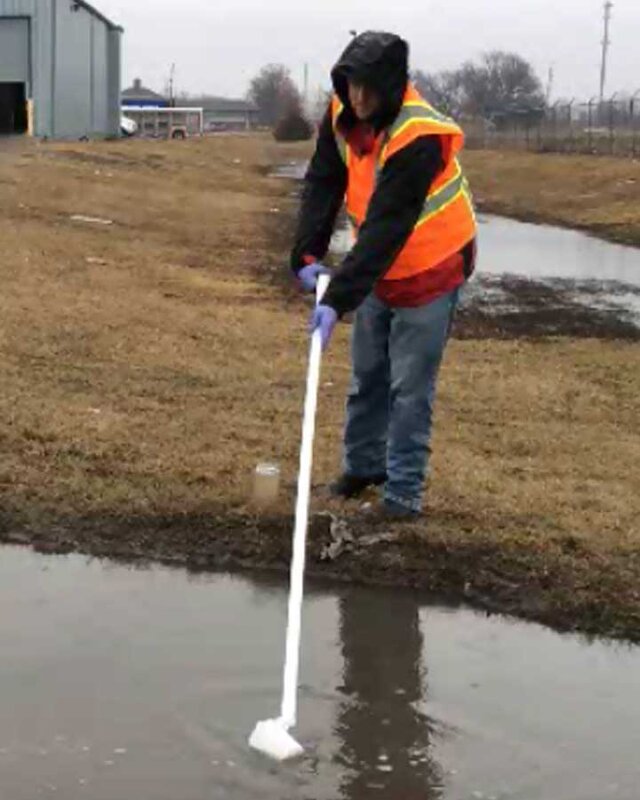
- KDHE Bureau of Water, process water. An individual permit for pit water and wash water, applied for on KDHE Form KS-QRY, Clay, Mineral or Rock Quarries Permit Application. A joint Kansas and NPDES permit if there is an outfall, a Kansas-only Water Pollution Control permit if the site is total retention.
- KDHE Bureau of Water, stormwater. The industrial stormwater general permit by notice of intent, plus a construction stormwater notice of intent for site development disturbing a cumulative total of one acre or more (KDHE Construction Stormwater).
- Kansas Department of Agriculture, Division of Water Resources. The water quantity authorization for dewatering and wash water, administered by the Chief Engineer under the Kansas Water Appropriation Act.
- Kansas Department of Agriculture, Division of Conservation. The mining license, site registration, reclamation plan and reclamation bond under the Surface-Mining Land Conservation and Reclamation Act, K.S.A. 49-601 through 49-624.
Add the county, which issues the conditional use order and which KDA’s own program page notes may require a reclamation bond above the state amounts.
One agency does not belong on that list and shows up on quarry compliance plans anyway. The Kansas Corporation Commission regulates oil and gas, and its water-related authority runs to remediation where oil and gas activity causes pollution (Kansas Legislative Research Department, Administration of Water in Kansas). It has no quarry permitting role. Writing it into the plan costs a review cycle.
At What Size Does a Rock Crushing Plant Become Subject to NSPS Subpart OOO?
A fixed crushed stone or sand and gravel plant is exempt only at 23 megagrams per hour, 25 tons per hour, or less, under 40 CFR 60.670(c)(1). A portable plant gets 136 megagrams per hour, 150 tons per hour, under 60.670(c)(2). Common clay and pumice plants get 9 megagrams per hour, 10 tons per hour, under 60.670(c)(3).
The measurement is where operators get this wrong. Capacity in 40 CFR 60.671 means the cumulative rated capacity of all initial crushers that are part of the plant. Not plant throughput. Not last year’s production tonnage. A spread that produced 180,000 tons last year on two initial crushers rated at 300 tons per hour combined is an affected facility on the rating, and nothing about running it at half capacity changes that.
Two more dates decide the rest of the analysis. Coverage attaches to construction, modification or reconstruction commenced after August 31, 1983 under 60.670(e). The standards then split again at April 22, 2008 in the row headers of Tables 2 and 3 to the subpart (40 CFR Part 60 Subpart OOO). A plant assembled over three decades routinely has units sitting in both tiers, and the limits apply per affected facility rather than per plant, so the screen you bought in 2011 carries a tighter number than the conveyor it feeds.
Kansas adopts all of 40 CFR Part 60 by reference at the July 1, 2017 CFR edition under K.A.R. 28-19-720(a), and EPA Region 7 has delegated Subpart OOO to KDHE with a 7/1/2017 CFR reference date and a 12/11/2020 state rule effective date (EPA Region 7 delegation of authority in Kansas). Because the subpart’s last amendment predates that snapshot, the 2017 Kansas text and the current federal text are substantively the same today for this rule.
Exclusions worth knowing before you run the numbers: facilities in underground mines, plants with no crushers or grinding mills above ground, and wet material processing operations are all outside the subpart under 60.670(a)(2), and cement plants under Subpart F and lime plants under Subpart I, plus everything downstream of them in the process, are excluded by 60.670(b).
Does Subpart OOO Cover the Quarry and the Blasting, or Only the Processing Plant?
Only the processing plant. The affected facility designation at 40 CFR 60.670(a)(1) names each crusher, grinding mill, screening operation, bucket elevator, belt conveyor, bagging operation, storage bin, and enclosed truck or railcar loading station in a fixed or portable nonmetallic mineral processing plant. No drill, no shot, no front-end loader, no haul truck, no haul road and no open stockpile appears in that list. The federal plant boundary begins at the first crusher.
That is a narrower statement than it sounds, and it is worth saying what it does not mean. No KDHE document affirmatively exempting blasting from Kansas air permitting was located for this piece. The Kansas permitting trigger in K.A.R. 28-19-300 is potential to emit rather than an activity list, and the site fugitive dust and opacity conditions written into the permit you already hold still reach the dust a shot makes. Separately, explosives storage, licensing, and seismic and airblast limits sit with other authorities entirely and are not part of either agency’s air permitting program. Nothing here says blasting is unregulated.
What Opacity Limit Applies to a Crusher, and Does Adding a Capture System Help?
A crusher without a capture system gets 15 percent fugitive opacity in the pre-2008 tier and 12 percent in the 2008-and-after tier under Table 3 to Subpart OOO. Add a capture system and what still escapes falls into the general row at 10 percent and 7 percent, and the captured stream picks up a stack limit under Table 2: 0.05 g/dscm, 0.022 gr/dscf, for the pre-2008 tier and 0.032 g/dscm, 0.014 gr/dscf, for the 2008-and-after tier, with a 7 percent stack opacity figure where a dry control device is used (Tables 2 and 3 to 40 CFR Part 60 Subpart OOO).
Hooding a crusher tightens its fugitive allowance. That result surprises people who installed capture to buy margin, and it changes the engineering question from how much dust leaves the crusher to whether the hood, ductwork and control device can hold the tighter number across a full Method 9 observation. The 7 percent stack opacity figure does not apply to wet scrubbers, and in the 2008-and-after tier it applies only to individual enclosed storage bins, so the control technology you pick decides which conditions follow you.
How Is Opacity Compliance Actually Measured at a Crushing Plant?
Under 40 CFR 60.675(c)(3) the Method 9 observation period for fugitive emissions is 30 minutes, five 6-minute averages, and compliance with the Table 3 limits is based on the average of those five 6-minute averages. Not the single worst reading. The observer stands at least 4.57 meters, 15 feet, from the source under 60.675(c)(1)(i).
Operators misread this in both directions. One reads a 14 percent 6-minute average on an unhooded crusher as a violation when the 30-minute average lands at 9 percent. The other treats the 30-minute averaging as slack and runs a plant whose steady-state plume sits at the limit, which fails the whole observation the first time a conveyor transfer surges. Where the performance test involves Method 9 only, 60.675(g) allows the usual 30-day advance notification of a performance test to be reduced to 7 days.
Which Kansas Air Permit Does a Rock Crusher Apply For?
KDHE runs rock crushers through named expedited tracks rather than a conventional general permit. The construction categories are Rock Crusher (Class II General Site) including quarries, and Portable Rock Crusher (Standalone), followed where applicable by the Expedited General Class II Operating Permit for Crushed and Broken Stone (KDHE Bureau of Air, Kansas Air Permitting Update). Filing is through KEIMS. There is no numbered paper application form for it, and KDHE publishes no applicability limits, emission limits or fee schedule for these expedited categories in any document reachable online, so treat the category name as the entry point and get the conditions from the agency.
Which instrument you need comes off K.A.R. 28-19-300. Subsection (a) requires a construction permit at or above 25 tons per year of potential particulate matter or 15 tons per year of PM10. Subsection (b) requires a construction approval at or above 5 pounds per hour of PM or 2 pounds per hour of PM10, and separately for any project at a source subject to a 40 CFR Part 60, 61 or 63 standard. Subpart OOO is not on that paragraph’s short exception list, which means an OOO-affected plant is pulled into the construction approval requirement by the Part 60 trigger even where its hourly PM numbers alone would not reach it. Those (b) thresholds function as the de facto floor in Kansas; there is no published Kansas de minimis table below them.
Fees under K.A.R. 28-19-304 run $750 for a construction approval application and $1,000 to $4,000 for a construction permit application depending on source category, with $1,000 the default for a category not listed. Class II operating permit emission fees under K.A.R. 28-19-546 run $80.00 per ton of hazardous air pollutant emissions and $56.00 per ton of criteria pollutant, capped at 4,000 tons each of SO2, NOx, PM10 and VOC.
Two corrections while you are in this part of the regulations. A Class II operating permit is the instrument by which a source that would otherwise be Title V major accepts federally enforceable throughput, hours or control device limits to pull its potential to emit below the major source threshold. K.A.R. 28-19-540 sets no numeric tonnage threshold at all, so a plant does not grow into Class II the way it grows into a bigger screen. And permit-by-rule is not a crusher route: K.A.R. 28-19-561 covers reciprocating engine stationary sources only, and the generic low-emitter provision at K.A.R. 28-19-564 excludes sources required to permit on criteria other than potential to emit, which is exactly the position a Part 60 affected facility is in.
What Are the First Deadlines After a New Crusher Starts Up?
Two, and both are short. The notification of the actual date of initial startup of each affected facility is postmarked within 15 days after that date under 40 CFR 60.676(i). The initial performance test is due within 60 days after achieving the maximum production rate and in no case later than 180 days after initial startup under 40 CFR 60.672(a) and (b). There is no pre-construction notice under this subpart, because 60.676(h) waives the Subpart A requirement at 60.7(a)(1).
Ongoing monitoring then tracks equipment vintage. Units that commenced construction, modification or reconstruction on or after April 22, 2008 and use wet suppression need monthly inspections confirming water is flowing to the discharge spray nozzles, with corrective action begun within 24 hours of a finding, under 40 CFR 60.674(b). Baghouses on those units need a quarterly 30-minute Method 22 visible emissions inspection with corrective action within 24 hours of any visible emissions under 60.674(c), or a bag leak detection system capable of detecting particulate at 1 milligram per dry standard cubic meter or less, with an alarm cause determined within 1 hour and alleviated within 3 hours. A wet scrubber needs a pressure loss device accurate within plus or minus 250 pascals, one inch water gauge, and a scrubbing liquid flow device accurate within plus or minus 5 percent of design flow, both calibrated annually, with readings recorded during the initial performance test and daily thereafter under 60.676(c). Semiannual deviation reports are postmarked within 30 days after the end of the second and fourth calendar quarters where scrubber pressure loss or liquid flow rate drops more than 30 percent from the most recent performance test average, under 60.676(d) and (e).
What the Two Recent Federal Subpart OOO Cases Actually Charged
Two 2025 and 2026 federal actions at nonmetallic mineral processing plants carry four counts and $94,742 between them, and not one count alleges an exceedance of an opacity or particulate limit.
In EPA Region 1, Docket CAA-01-2026-0007, a rock crushing plant operator and the materials company it worked for paid $37,000 on two counts: failure to notify EPA of the actual initial startup date within 15 days under 60.676(i), where the plant started in April 2024 and the notification was submitted November 29, 2024, and failure to conduct Method 9 testing on all affected equipment within 180 days of startup under 60.672(b) and 60.675(c), with the testing eventually performed May 15, 2025 (Consent Agreement and Final Order). The subcontractor that owned and operated the plant drew liability alongside the materials company.
In EPA Region 3, Docket CAA-03-2025-0086, Final Order filed June 2, 2025, a nonmetallic mineral processing plant paid $57,742 on two counts: failure to perform the monthly wet suppression inspections required by 60.674(b), and failure to make the monthly inspection logbook available to EPA on request under 60.676(b)(1), both charged under Clean Air Act section 111(e), 42 U.S.C. 7411(e) (CAFO).
A monthly nozzle check and a logbook kept where an inspector can see it are the two cheapest requirements in Subpart OOO. They are also the two that produced the larger of those penalties.
Delegation is not insulation on this. EPA Region 7’s delegation page states that EPA retains concurrent authority to enforce the standards, and that for regulations effective after the first date in each delegation block, implementation authority is retained solely by EPA. Both of the cases above are EPA actions in states that hold delegation. For Kansas specifically, one honest limitation: no KDHE air enforcement action against a Kansas quarry, rock crusher or aggregate plant from 2023 through 2026 was locatable in public sources, and that absence is weak evidence, because KDHE does not publish air enforcement in an indexed, searchable form comparable to EPA’s regional consent agreement dockets. Kansas air civil penalty authority at K.S.A. 65-3018 runs to $10,000 per violation with each day a violation continues deemed a separate violation, and a written hearing request is due within 15 days after service of the order. Federal exposure for a Clean Air Act violation sits at $124,426 under 40 CFR 19.4 Table 1, in effect for 2026 and unchanged from 2025.
Is There a Kansas General Permit for Quarry Process Water?
No. KDHE’s Kansas Implementation Procedures for Wastewater Permitting name exactly three general permit categories: Concrete Ready-Mix Plants, Stormwater, and Hydrostatic Test Discharges. Quarries are not among them. A Kansas quarry discharging process water gets an individual permit, applied for on Form KS-QRY, Clay, Mineral or Rock Quarries Permit Application.
Which individual permit depends on one fact: whether water leaves the property. The Implementation Procedures describe NPDES permits as joint federal and state permits for overflowing, meaning discharging, facilities, and Kansas Water Pollution Control permits as Kansas-only permits for non-overflowing, total retention facilities. Permits run up to five years and KDHE may set a shorter term, consistent with the five-year cap Congress placed on authorized state programs at 33 U.S.C. 1342(b)(1)(B). The renewal application is due 180 days before the existing permit expires under 40 CFR 122.21(d)(2).
This is also the point where the two water filings get confused with each other. The process water permit and the industrial stormwater permit are separate instruments covering separate water, and a stormwater permit does not authorize process water reaching an outfall. We covered that distinction and the list of discharges a stormwater permit does authorize in your industrial stormwater permit does not cover your process water, so check your outfalls against that before assuming your pit water has a home.
That Kansas has no quarry process water general permit is a choice rather than the national norm. Oklahoma issues OKG95 for rock, sand and gravel quarries, and Montana and Indiana both run mineral mining general permits. Peer states have them. Kansas does not.
What Effluent Limits Apply to a Crushed Stone Quarry Discharge?
The federal guideline carries pH and nothing else. 40 CFR 436.22(a) sets best practicable control technology limits for crushed stone process water recycling facilities and for mine dewatering at pH within the range 6.0 to 9.0. There is no total suspended solids daily maximum, no 30-day average, and the subpart contains no BAT and no NSPS sections at all. Subsection 436.22(c) adds that in no case shall a pH limitation outside the range 5.0 to 9.0 be permitted.
So the TSS number on a Kansas crushed stone permit did not come from 40 CFR 436. It came from Kansas water quality standards and a wasteload allocation, which is a different authority, a different technical record, and a different argument at reissuance. The same mechanism drives nutrient limits in this state, where KDHE publishes no numeric stream phosphorus criterion and the applicable TMDL supplies the number instead, as we worked through in how a Lower Arkansas TMDL sets your NPDES limit. Knowing which authority you are arguing with decides whether you bring a treatability analysis or a receiving water analysis to the table, and at reissuance that distinction is worth real money.
If the draft permit carrying that limit is on public notice, the comment window is the inexpensive moment to address it. The mechanics of the KDHE notice, the comment clock and how to find your own draft permit are covered in what a KDHE public notice means for your facility.
When Does a Sand and Gravel Operation Flip to No Discharge of Process Water?
When the product stops being construction and fill. 40 CFR 436.30 covers sand and gravel for construction or fill uses and carries pH only. 40 CFR 436.40 covers sand and gravel for other uses, and 436.42(a)(2) provides that there shall be no discharge of process generated waste water pollutants into navigable waters, with 436.42(a)(1) and (a)(4) adding TSS at 45 mg/l maximum for any one day, 25 mg/l as the average of daily values for 30 consecutive days, and pH within 6.0 to 9.0.
Nothing gets filed when that happens. A sales decision to move product into industrial, frac, glass or foundry grades moves the operation from a pH-only subpart to a no-discharge subpart, and the first time anyone looks at it is usually the next renewal or the next inspection. If your sales team is quoting a grade your water permit was not written for, that is a permitting event with no permitting paperwork attached to it.
The companion trap is plumbing. Pit dewatering and wash water that share a treatment structure commingle, and commingling converts the whole stream to process wastewater and forfeits the mine dewatering characterization that kept it simple. Sedimentation ponds get connected for good operational reasons and nobody re-reads the permit afterward.
Does a Kansas Aggregate Quarry Need a Mined-Land Reclamation Permit, and From Which Agency?
Yes, and not from KDHE. The Kansas Department of Agriculture, Division of Conservation administers the Surface-Mining Land Conservation and Reclamation Act, K.S.A. 49-601 through 49-624, which expressly reaches limestone and sand and gravel. Producers must hold a mining license, register each mining site, and carry a reclamation plan and bond at $400.00 per acre for sand and gravel operations and $600.00 per acre for all other minerals, which is where limestone falls (KDA Division of Conservation, Surface Mining and Reclamation).
The recurring filings are two dates. License renewal is due December 31 annually, and the Annual Mine Report, reporting acres affected and tons produced, is due April 1. Both go through RALIS. The program’s stated exclusions are coal mining, oil and gas production, and mining within the banks of streams. KDA also notes that some counties require a reclamation bond above the state per-acre amounts, so the conditional use order is worth re-reading before you set the bond.
This is the filing operators most often assume belongs to KDHE. It does not, and the two programs have different renewal calendars, different staff, and no shared file.
Does a Quarry Need a Kansas Water Right to Dewater the Pit?
Yes. The domestic use exemption at K.S.A. 82a-701(c) reaches household purposes and the irrigation of not more than two acres. Industrial and mining use is nowhere in it.
The KDA Division of Water Resources issues temporary permits for dewatering projects running six months or less and up to 4 million gallons, which is 12.28 acre-feet, with larger amounts possible for dewatering depending on site-specific needs, under K.A.R. Article 5-9 (KDA DWR, temporary and term permits). Continuous dewatering is a different instrument: an appropriation right, or a term permit, which DWR will consider for up to ten years but which triggers safe-yield review above five years, so most land at five years or less. Term permits carry an annual water use report.
The sequencing error here is predictable. A pit deepens, dewatering goes from seasonal to continuous, and the temporary permit keeps getting renewed because that is the form everyone knows. Water quantity and water quality are separate programs in separate departments, and holding a KDHE discharge permit says nothing about your right to pump the water in the first place.
Does Stormwater Permit Coverage End When a Quarry Goes Idle?
No. 40 CFR 122.26(b)(14)(iii) reaches facilities classified in Standard Industrial Classifications 10 through 14, the mineral industry, including active or inactive mining operations, so long as there is an identifiable owner or operator. The Kansas industrial stormwater general permit covers SIC codes 10 through 14 on the same terms (S-ISWA-2111-1).
Idling the pit stops production. It does not stop the permit, the notice of intent fee, the inspections or the recordkeeping. The genuine exit is a non-coal reclamation release, and in Kansas that comes from the KDA Division of Conservation bond release, not from KDHE. Those two programs have to be sequenced deliberately, because a site can sit with released stormwater coverage and an open reclamation bond, or the reverse, for years before anyone reconciles them.
What the Kansas Industrial Stormwater Permit Requires While the Reissuance Is Pending
The obligations under the current permit do not pause while a replacement is drafted. Coverage runs on a notice of intent through KEIMS with a $60.00 fee. The site-specific stormwater pollution prevention plan, which KDHE calls the SWP2 plan, is due within 10 months of KDHE’s authorization of the notice of intent. Routine inspections run at a minimum quarterly, the comprehensive site compliance evaluation runs at least once a year, each outfall gets a visual examination at least annually, and records are retained at least three years. The SWP2 Plan Completion Certification Form goes in with the first annual billing statement.
Kansas is on its own industrial stormwater permit rather than EPA’s Multi-Sector General Permit, and KDHE links the federal permit only as a reference. The practical consequence is that there is no Kansas numeric stormwater benchmark for a quarry to hit. The Kansas permit contains no sector-specific numeric benchmark parameters and states that benchmark concentrations are not effluent limits. Operators who have been managing to a remembered federal mineral mining benchmark number are managing to something their permit does not contain.
What remains open is the term. S-ISWA-2111-1 states November 01, 2021 through October 31, 2026, KDHE noticed a draft Industrial Stormwater Master General Permit from July 2 to August 1, 2026, and KDHE’s program page publishes no number and no effective date for the replacement. Confirm coverage status with the Bureau of Water, in writing, and keep the confirmation.
One Paragraph on Silica, Because It Is Not a Permitting Question
MSHA’s conforming amendments for metal and nonmetal mines at 30 CFR 56.5001T, 56.5005T, 57.5001T and 57.5005T were scheduled to take effect April 8, 2026 and are delayed indefinitely pending judicial review, following an Eighth Circuit order of April 11, 2025 staying the 2024 silica rule’s compliance deadlines. Metal and nonmetal operators continue to follow the existing standards in parts 56 and 57 until the stay ends (91 FR 17143). That notice addresses the conforming amendments and does not state whether the permissible exposure limit provision itself is affected, so do not plan around either answer. This is industrial hygiene and part 46 training territory, and it has nothing to do with the five permits above.
Your Draft Permit Sits in a List of Feedlots
One complete KDHE non-agricultural water permit notice was read in full for this piece, covering September 3 to October 3, 2026 and roughly 18 listings. Eleven were confined feeding reissuances. One was a new confined feeding permit with a scheduled hearing. Three were municipal domestic wastewater reissuances. Two were industrial discharge permits, of which one was a limestone quarrying and crushing operation with stormwater outfalls treated by a sedimentation pond and grass filter strips. One was a section 401 certification for streambank stabilization.
That is a single cycle, not an annual rate, and it should not be read as one. The pattern it does show is the one that matters operationally: an aggregate item appears at roughly one per cycle rather than in a batch, inside a list dominated by feedlots and municipalities. A quarry’s draft permit is easy to miss for exactly that reason. Nobody scanning for their own facility expects to find it as item 16 of 18.
The Counter-Signal: Federal Pressure on This Industry Is Flat to Easing in 2026
Most writing on quarry permitting assumes everything is tightening. For this industry, in this year, the record does not support that, and the direction of travel changes what is worth spending money on.
The governing air rule has not been amended in 17 years. EPA’s Subpart OOO program page shows a rulemaking history ending at the April 28, 2009 final rule, 74 FR 19309, with no pending reconsideration and no proposed amendment. Clean Air Act section 111(b)(1)(B) obliges EPA to review and if appropriate revise each standard of performance at least every 8 years, and the last Subpart OOO review concluded in April 2009, which puts the statutory review years overdue. For an operator, that stability is usable: the April 22, 2008 tier date in Tables 2 and 3 is not about to move, so a plant sized to the 2008 limits can be planned around them.
Federal civil penalties are in effect for 2026 unchanged from 2025. The Clean Air Act section 113(b) figure stands at $124,426 and the Clean Water Act section 309(d) figure at $68,445 under 40 CFR 19.4 Table 1. OMB Memorandum M-26-11, April 17, 2026, cancelled the 2026 inflation adjustment because the appropriations lapse stopped BLS from publishing the October 2025 CPI-U, and agencies continue using 2025 levels (91 FR 41722).
Clean Water Act jurisdiction over on-site features is being narrowed. The supplemental proposal at 91 FR 57284, published September 9, 2026, leans on the Supreme Court’s May 25, 2023 Sackett decision and would define relatively permanent to mean perennial waters only, that is waters having standing or continuously flowing water every day of the year during ordinary conditions. It makes no further changes to the proposed ditch definition and exclusion and no further changes to the waste treatment system definition. The portion of that document reviewed for this piece contains no treatment of excavated pits, quarry pits, mining pits or sediment ponds, so it creates no quarry-pit or sediment-pond exclusion and should not be read as one. The narrower and still useful claim: a perennial-only test, with the existing ditch and waste treatment system exclusions left intact, would if finalized shrink the set of on-site quarry features that count as jurisdictional. It remains proposed, with comments closed October 9, 2026.
The federal industrial stormwater permit lapsed and EPA issued enforcement discretion instead of a new permit. A February 27, 2026 memorandum records that the 2021 Multi-Sector General Permit expired at 11:59 PM Eastern on February 28, 2026, that EPA would be unable to finalize the next permit before expiration, and that the No Action Assurance terminates at 11:59 PM Eastern on February 28, 2027 or 120 days after the next MSGP takes effect, whichever comes first (EPA OECA memorandum). That is enforcement discretion in areas where EPA is the permitting authority. It does not apply in Kansas, which is an authorized NPDES state operating its own permit. Kansas operators get no relief from it. Its value here is evidence of direction, nothing more.
MSHA’s silica compliance deadlines for metal and nonmetal mines are stayed, as described above, which takes the headline aggregate-industry requirement of the last two years out of force for now.
And EPA has proposed to remove the federal public participation floor for the exact permitting program that covers Kansas crushers. 91 FR 41591, published July 7, 2026, would revise 40 CFR 51.161 and remove minor NSR public participation as a minimum requirement for SIP submissions; it remains proposed, and we covered what it changes and what it does not in EPA proposes to drop federal public notice minimums for minor source air permits.
One counter-signal that does not hold, recorded so nobody builds on it: the general enforcement-decline argument fails for 2025 and 2026. EPA reported 2,127 civil enforcement cases completed in FY2025, the highest in nine years, with over $650 million in civil penalties (EPA FY2025 civil enforcement results). The two Subpart OOO cases above are from 2025 and 2026. This subpart is being actively enforced.
Net read for a Kansas operator: the pressure that actually lands on your site is state and local. KDHE individual permit reissuance, the Kansas stormwater permit transition, KDA reclamation bonding, and county conditional use conditions. Not federal escalation.
Segregating Clean Runoff Earns a Statutory Exemption
33 U.S.C. 1342(l)(2) provides that the Administrator shall not require a permit, nor directly or indirectly require any state to require a permit, for discharges of stormwater runoff from mining operations composed entirely of flows from conveyances used for collecting and conveying precipitation runoff and which are not contaminated by contact with, or do not come into contact with, any overburden, raw material, intermediate product, finished product, byproduct or waste product located on the site. It is the mirror image of the 122.26(b)(14)(iii) hook that pulls the industry in.
That makes drainage design a permitting decision. Routing clean runoff around contact areas rather than through them is the pathway to a statutory exemption on that flow, and in Kansas it is also the pathway to the No Exposure certification KDHE makes available across industrial categories. Be honest about where the relief lives: 40 CFR 122.3, the NPDES exclusions section, contains no mining or quarry-pit exclusion. The exemption is in section 402(l)(2) and in the jurisdictional question, not in the exclusions list. This is the one item in this piece that reduces cost rather than adding a filing, which is why it is worth an afternoon with a site drainage map.
The Short List for This Quarter
Five items, in the order they will cost you money if they slip.
- Confirm your industrial stormwater coverage status with the KDHE Bureau of Water in writing, given the October 31, 2026 term end on S-ISWA-2111-1 and the absence of a published replacement number or date.
- Add up the rated capacity of your initial crushers and write the number down with the commencement date for each unit. That single page decides your Subpart OOO applicability and which tier of Tables 2 and 3 each piece of equipment sits in.
- Pull the wet suppression inspection logbook and confirm it is current, on site, and producible. Two of the four counts in the recent federal cases were about that book.
- Check your water permit against what your sales team is currently quoting, and check whether pit dewatering and wash water have been plumbed together since the permit was written.
- Confirm the KDA Division of Conservation license renewal for December 31 and the Annual Mine Report for April 1, and check whether your county conditional use order sets a bond above the state per-acre figures.
Where iSi Fits
Most of that list is tracking work. It only gets done if somebody owns it, and at a Kansas aggregate operation the person who would own it is usually also running safety, training, waste and the pit. That is how a coverage transition passes unnoticed at a plant that had nothing wrong with its dust control.
iSi’s air permitting group handles the construction permit and approval applications, potential-to-emit calculations, Subpart OOO applicability determinations and the Method 9 and Method 22 observation work. The environmental compliance side covers the standing items: stormwater notices of intent and SWPPP development and inspections, watching the KDHE notice for your permit numbers, reviewing draft limits before they bind, and tracking the 180-day renewal and reclamation filing dates on one calendar instead of four. Industrial hygiene handles the respirable silica sampling side, which runs on its own schedule regardless of where the MSHA litigation ends up.
If you are inside a reissuance window or holding a draft permit with a limit you do not think the record supports, send us the permit number and we will read it.
Sources
- 40 CFR Part 60 Subpart OOO, Standards of Performance for Nonmetallic Mineral Processing Plants, including Tables 2 and 3: https://www.ecfr.gov/current/title-40/chapter-I/subchapter-C/part-60/subpart-OOO (verified 2026-10-16)
- 40 CFR 60.670, applicability and designation of affected facility: https://www.ecfr.gov/current/title-40/chapter-I/subchapter-C/part-60/subpart-OOO/section-60.670 (verified 2026-10-16)
- 40 CFR 60.671, definitions, including capacity: https://www.ecfr.gov/current/title-40/chapter-I/subchapter-C/part-60/subpart-OOO/section-60.671 (verified 2026-10-16)
- 40 CFR 60.672, standard for particulate matter: https://www.ecfr.gov/current/title-40/chapter-I/subchapter-C/part-60/subpart-OOO/section-60.672 (verified 2026-10-16)
- 40 CFR 60.674, monitoring of operations: https://www.ecfr.gov/current/title-40/chapter-I/subchapter-C/part-60/subpart-OOO/section-60.674 (verified 2026-10-16)
- 40 CFR 60.675, test methods and procedures: https://www.ecfr.gov/current/title-40/chapter-I/subchapter-C/part-60/subpart-OOO/section-60.675 (verified 2026-10-16)
- 40 CFR 60.676, reporting and recordkeeping: https://www.ecfr.gov/current/title-40/chapter-I/subchapter-C/part-60/subpart-OOO/section-60.676 (verified 2026-10-16)
- 74 FR 19309 (2009-04-28), Subpart OOO final rule, the most recent amendment: https://www.govinfo.gov/content/pkg/FR-2009-04-28/pdf/E9-9435.pdf (verified 2026-10-16)
- 40 CFR Part 436 Subpart B, Crushed Stone: https://www.ecfr.gov/current/title-40/chapter-I/subchapter-N/part-436/subpart-B (verified 2026-10-16)
- 40 CFR Part 436 Subpart C, Construction Sand and Gravel: https://www.ecfr.gov/current/title-40/chapter-I/subchapter-N/part-436/subpart-C (verified 2026-10-16)
- 40 CFR Part 436 Subpart D, Industrial Sand, including the no-discharge provision: https://www.ecfr.gov/current/title-40/chapter-I/subchapter-N/part-436/subpart-D (verified 2026-10-16)
- 40 CFR 122.26, stormwater discharges, including (b)(14)(iii): https://www.ecfr.gov/current/title-40/section-122.26 (verified 2026-10-16)
- 40 CFR 122.3, NPDES exclusions: https://www.ecfr.gov/current/title-40/section-122.3 (verified 2026-10-16)
- 40 CFR 122.21, application for a permit, including the 180-day duty to reapply: https://www.ecfr.gov/current/title-40/section-122.21 (verified 2026-10-16)
- 33 U.S.C. 1342, Clean Water Act section 402, including 1342(l)(2) and 1342(b)(1)(B): https://www.law.cornell.edu/uscode/text/33/1342 (verified 2026-10-16)
- 40 CFR 19.4 Table 1, statutory civil monetary penalties as adjusted: https://www.ecfr.gov/current/title-40/chapter-I/subchapter-A/part-19/section-19.4 (verified 2026-10-16)
- 91 FR 41722 (2026-07-07), no adjustment to civil monetary penalty amounts for 2026: https://www.federalregister.gov/documents/2026/07/07/2026-13629/no-adjustment-to-civil-monetary-penalty-amounts (verified 2026-10-16)
- EPA Region 1, Consent Agreement and Final Order, Docket CAA-01-2026-0007: https://yosemite.epa.gov/OA/RHC/EPAAdmin.nsf/Filings/E2E821812E09FE4385258DBF003C7495/$File/CAA-01-2026-0007%20Consent%20Agreement%20and%20Final%20Order.pdf (verified 2026-10-16)
- EPA Region 3, Consent Agreement and Final Order, Docket CAA-03-2025-0086: https://yosemite.epa.gov/OA/RHC/EPAAdmin.nsf/Filings/5D7BA1E9D921AD2585258C9D006F0027/$File/DCM%20Legacy%20Inc_CAA%20CAFO_June%202%202028_Redacted.pdf (verified 2026-10-16)
- EPA FY2025 civil enforcement annual results: https://www.epa.gov/enforcement/enforcement-and-compliance-assurance-annual-results-fy-2025-civil-enforcement (verified 2026-10-16)
- EPA Region 7, delegation of authority in Kansas for NSPS and NESHAP: https://www.epa.gov/ks/delegation-authority-kansas-new-source-performance-standards-and-national-emission-standards (verified 2026-10-16)
- K.A.R. 28-19-300, construction permits and approvals: https://www.law.cornell.edu/regulations/kansas/K-A-R-28-19-300 (verified 2026-10-16)
- K.A.R. 28-19-540, class II operating permit applicability: https://www.law.cornell.edu/regulations/kansas/K-A-R-28-19-540 (verified 2026-10-16)
- K.A.R. 28-19-561, permit-by-rule, reciprocating engine stationary sources: https://www.law.cornell.edu/regulations/kansas/K-A-R-28-19-561 (verified 2026-10-16)
- K.A.R. 28-19-304, construction permit and approval fees: https://19january2021snapshot.epa.gov/sites/static/files/2017-09/documents/2819-304.pdf (verified 2026-10-16)
- K.A.R. 28-19-546 and 28-19-564, operating permit fees and low-emitter provision: https://www.coronavirus.kdheks.gov/DocumentCenter/View/27177/KAR-28-19-546-and-28-19-564 (verified 2026-10-16)
- K.A.R. 28-19-720, NSPS adopted by reference at the July 1, 2017 CFR edition: https://regulations.justia.com/states/kansas/agency-28/article-19/section-28-19-720 (verified 2026-10-16)
- KDHE Bureau of Air, Kansas Air Permitting Update, naming the expedited rock crusher categories: https://www.coronavirus.kdheks.gov/DocumentCenter/View/2700/Air-Permit-Update-PDF (verified 2026-10-16)
- K.S.A. 65-3018, Kansas air quality civil penalty: https://www.kslegislature.org/li/b2023_24/statute/065_000_0000_chapter/065_030_0000_article/065_030_0018_section/065_030_0018_k/ (verified 2026-10-16)
- KDHE, Kansas Implementation Procedures for Wastewater Permitting: https://www.kdhe.ks.gov/DocumentCenter/View/9333/Kansas-Implementation-Procedures---Wastewater-Permitting-PDF (verified 2026-10-16)
- KDHE Form KS-QRY, Clay, Mineral or Rock Quarries Permit Application: https://www.kdhe.ks.gov/DocumentCenter/View/9317/Form-KS-QRY---Clay-Mineral-or-Rock-Quarries-Permit-Application-PDF (verified 2026-10-16)
- KDHE, Industrial Stormwater General NPDES Permit S-ISWA-2111-1, effective November 1, 2021: https://www.kdhe.ks.gov/DocumentCenter/View/6335/Industrial-Stormwater-General-NPDES-Permit---Effective-November-1-2021-PDF (verified 2026-10-16)
- KDHE, NPDES Industrial Stormwater program page, carrying the July 2 to August 1, 2026 draft public notice: https://www.kdhe.ks.gov/788/Industrial-Stormwater (verified 2026-10-16)
- KDHE, Construction Stormwater program page: https://www.kdhe.ks.gov/757/Construction-Stormwater (verified 2026-10-16)
- Kansas Department of Agriculture, Division of Conservation, Surface Mining and Reclamation: https://www.agriculture.ks.gov/divisions-programs/division-of-conservation/surface-mining-reclamation (verified 2026-10-16)
- K.S.A. 49-601, Surface-Mining Land Conservation and Reclamation Act: https://www.ksrevisor.gov/statutes/chapters/ch49/049_006_0001.html (verified 2026-10-16)
- Kansas Department of Agriculture, Division of Water Resources, temporary and term permits: https://www.agriculture.ks.gov/divisions-programs/division-of-water-resources/water-appropriation/temporary-and-term-permits (verified 2026-10-16)
- K.S.A. 82a-701, definitions including domestic use: https://ksrevisor.gov/statutes/chapters/ch82a/082a_007_0001.html (verified 2026-10-16)
- Kansas Legislative Research Department, Administration of Water in Kansas: https://klrd.gov/publications/administration-of-water-in-kansas/ (verified 2026-10-16)
- 91 FR 41591 (2026-07-07), minor NSR public participation proposal, PROPOSED: https://www.federalregister.gov/documents/2026/07/07/2026-13667/minor-new-source-review-program-air-permitting-public-participation-requirements-for-state (verified 2026-10-16)
- 91 FR 57284 (2026-09-09), updated definition of waters of the United States, supplemental proposal, PROPOSED: https://www.federalregister.gov/documents/2026/09/09/2026-18317/updated-definition-of-waters-of-the-united-states (verified 2026-10-16)
- EPA OECA, No Action Assurance memorandum regarding the 2021 MSGP expiration, February 27, 2026: https://www.epa.gov/system/files/documents/2026-03/oeca-no-action-assurance-memo-msgp.pdf (verified 2026-10-16)
- 91 FR 17143 (2026-04-06), MSHA delay of the metal and nonmetal silica conforming amendments: https://www.federalregister.gov/documents/2026/04/06/2026-06584/lowering-miners-exposure-to-respirable-crystalline-silica-and-improving-respiratory-protection-delay (verified 2026-10-16)