Machine Guarding and the Amputations NEP: What 1910.212 Requires Under CPL 03-00-027
OSHA replaced the amputations National Emphasis Program on June 27, 2025. What CPL 03-00-027 changes, and what 29 CFR 1910.212 has required since 1974.
OSHA’s directive page for CPL 03-00-022 now carries a banner reading “OSHA Archive Document, and may no longer represent OSHA Policy.” That December 10, 2019 directive is the amputations National Emphasis Program this post was originally written about. It was superseded on June 27, 2025 by CPL 03-00-027. Anyone still working from the old NEP is working from a document OSHA has retired.
The program did not go away. It was reissued under a new number, and the standard it enforces has not changed in more than fifty years. 29 CFR 1910.212, “General requirements for all machines,” runs about a page and a half, applies to every general industry employer operating a machine with no headcount threshold and no small-business carve-out (the full standard text is on osha.gov), and sits at number 10 on OSHA’s preliminary FY2026 Top 10 Most Frequently Cited Standards.
The clause most plants miss is not on a press or a saw. It is the pedestal fan in the corner of the shop, which has to be guarded with openings no larger than half an inch any time the blade periphery sits below seven feet. The second thing most plants miss is that 1910.212 only covers the machine. Everything that drives the machine, including the belt at ankle height twenty feet away, sits under a separate standard with its own 60-day clock.
What is the “point of operation” and when does OSHA require it to be guarded?
1910.212(a)(3)(i) defines the point of operation as “the area on a machine where work is actually performed upon the material being processed.” Under (a)(3)(ii), guarding is required on machines whose operation exposes an employee to injury, and the guard must prevent the operator from having any part of the body in the danger zone during the operating cycle.
That language makes 1910.212 a performance standard. It never tells you to install a particular guard. It tells you what the installed condition has to accomplish. The compliance question is therefore never whether you bought a guard. It is whether a body part can reach the hazard while the machine runs. Two plants can buy identical guards from the same vendor and only one of them is compliant, because the determining facts are the geometry of the machine as installed and the reach of the person running it.
Where a specific standard applies, the guard also has to conform to that standard. Woodworking machinery, mechanical power presses and forging machines each carry their own section in Subpart O. Where no specific standard applies, the design test in (a)(3)(ii) is the whole test.
Which machines does OSHA say usually need point-of-operation guarding?
1910.212(a)(3)(iv) names nine types: guillotine cutters, shears, alligator shears, power presses, milling machines, power saws, jointers, portable powered tools, and forming rolls and calenders. The paragraph says these machines usually require point-of-operation guarding, which makes the list OSHA’s own statement of where it expects to find the hazard.
Treat it as the starting inventory for a plant walkthrough rather than the boundary of the duty. The nine types are the machines OSHA has already decided are presumptively in scope, so a facility with any of them should assume the point of operation is covered and work from there. Nothing in the paragraph limits (a)(3)(ii) to those nine. A machine not on the list is still covered whenever its operation exposes an employee to injury.
Can a guard itself be a violation?
Yes. 1910.212(a)(2) requires a guard to be affixed to the machine where possible and secured elsewhere where attachment to the machine is not possible, and states that “the guard shall be such that it does not offer an accident hazard in itself.” A guard with a pinch point, an exposed edge, or one that forces an awkward reach is citable on its own terms.
This is the clause that catches shop-fabricated guards. A plate cut in the maintenance shop and tack welded over an opening solves the original hazard and creates a new one at the cut edge. A guard that has to be lifted and held while the operator feeds stock creates the awkward reach the paragraph is written against. A guard held on with a C-clamp fails the “affixed or secured” requirement before anyone evaluates the hazard it covers.
When iSi’s field team worked a pump shaft and coupling guarding issue for a client, the fix had to satisfy both halves of that paragraph at once: cover the rotating coupling, and do it without adding an edge or a trap that was not there before.
Do tongs and push sticks satisfy the machine guarding requirement?
No. 1910.212(a)(3)(iii) permits special hand tools for placing and removing material that allow handling without the operator placing a hand in the danger zone, and then states that such tools “shall not be in lieu of other guarding required by this section.” Tongs supplement a compliant guard. They never replace one.
That sentence settles an argument that comes up on nearly every press and brake walkthrough. The operator keeps hands out of the die with a magnet or a pair of tongs, the supervisor reports the hazard as controlled, and the citation still writes. The standard treats the hand tool as an additional layer on top of guarding, and the guarding obligation under (a)(3)(ii) is unaffected by how disciplined the tool use is.
Does OSHA require machines to be bolted to the floor?
For machines designed for a fixed location, yes. 1910.212(b) states that machines designed for a fixed location “shall be securely anchored to prevent walking or moving.” The clause is a single sentence, it sits outside the guarding paragraphs of the standard, and it applies whether or not the machine carries a guard.
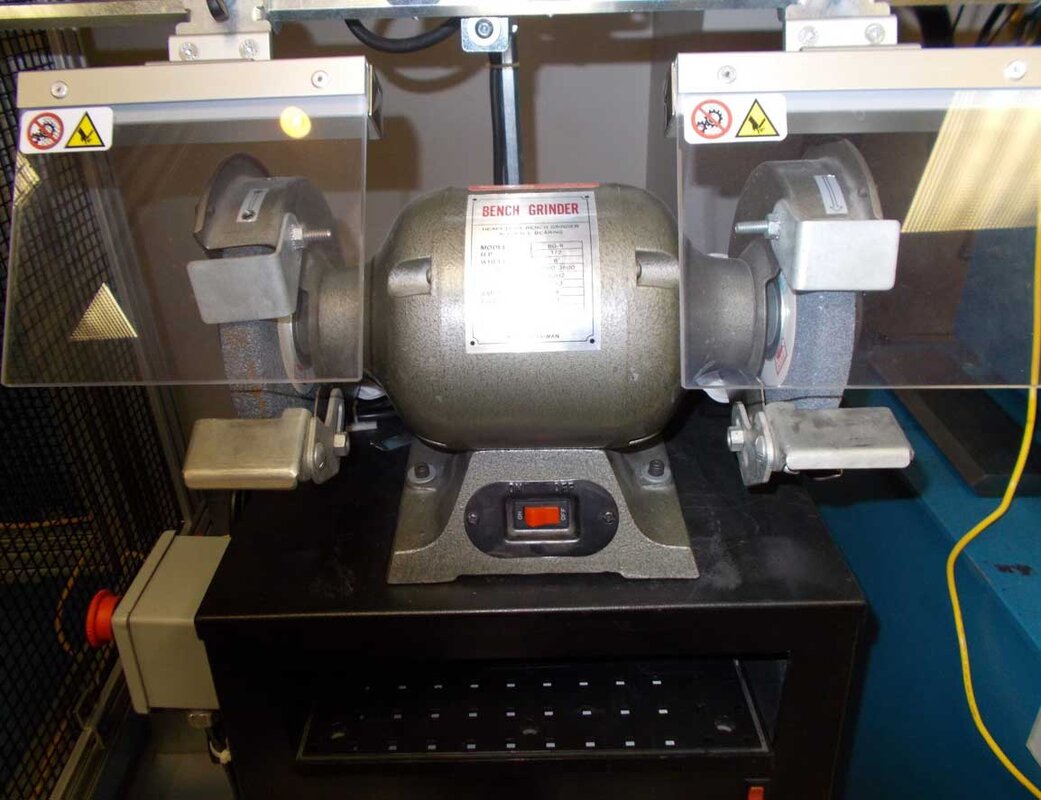
It is routinely overlooked on pedestal grinders, drill presses and bench saws that were set in place years ago and never fastened down. The test is whether the machine was designed for a fixed location. A bench grinder bolted to a stand that is itself sitting loose on the floor does not pass. Neither does a drill press that walks under load. This is one of the easier items to close before an inspection, because closing it takes anchors and an afternoon.
When do fans have to be guarded, and how small do the openings have to be?
Under 1910.212(a)(5), when the periphery of a fan’s blades is less than seven feet above the floor or working level, the blades must be guarded, and the guard openings may be no larger than one-half inch. The clause covers ordinary floor and pedestal fans, not only process equipment.
Most plants read 1910.212 as a production equipment standard and walk right past the fans. The half-inch dimension is the part that fails. A factory-supplied wire cage on a 30-inch drum fan frequently has openings wider than half an inch, which means the fan arrived non-compliant and nobody measured it. A tape measure and one lap of the building closes this item, and it is worth doing before anything more expensive, because the hazard is at hand height in the walkways where people stand.
What is the difference between 1910.212 and 1910.219?
1910.212 covers the machine’s working parts, including the point of operation. 29 CFR 1910.219, “Mechanical power-transmission apparatus,” covers how power reaches those parts: belts, pulleys, shafting, gears, sprockets, chains, flywheels and clutches. 1910.219 is specification-based, keyed to a recurring seven-foot height, and it carries its own 60-day inspection interval.
The seven-foot trigger repeats through most of the section, including paragraphs (b)(1), (c)(2)(i), (c)(3), (d)(1), (e)(1)(i), (f)(3) and (k)(1). Several paragraphs then set their own dimensions. Horizontal belts 42 inches or less from the floor have to be fully enclosed under (e)(1)(i). Gears under six feet from the floor need a disk guard or an enclosure up to six feet under (f)(1)(iii). Cone pulleys under three feet are guarded to three feet under (e)(5)(iii). A balance-wheel pulley is exempt when its contact point sits more than six feet six inches above the floor under (d)(1).
This is where plants that have worked hard on point-of-operation guarding still get cited. The press has a light curtain and the drive sheave behind it has nothing.
How often must power transmission equipment be inspected?
1910.219(p)(1) requires that power transmission equipment be inspected “at intervals not exceeding 60 days.” It is a fixed recurring obligation, separate from any guarding walkthrough, and unlike most of Subpart O it produces a documentable record a compliance officer can ask to see.
Most facilities have never scheduled it. The obligation sits in paragraph (p) at the back end of a long specification standard, and it does not announce itself the way an annual training requirement does. Putting it on the preventive maintenance calendar at a 60-day frequency, with a signed record for each round, is the cheapest documentation item in Subpart O and the one most likely to be asked for.
Which belts are exempt from the power transmission guarding rules?
1910.219(a)(1) exempts flat belts 1 inch wide or less, flat belts 2 inches wide or less that are free of metal lacings or fasteners, round belts 1/2 inch or less in diameter, and single-strand V-belts 13/32 inch or less. Every one of those exemptions applies only when the belt runs at 250 feet per minute or less.
Both halves have to be satisfied. The dimension alone does not exempt anything. A 3/8 inch single-strand V-belt running at 1,200 feet per minute is covered, and that is the common case on a motor-driven unit. The speed condition is also the part nobody calculates, because sheave diameter and motor RPM are what produce belt speed and neither is printed on the belt. If the number has not been run, the belt is not exempt.
Is OSHA’s Amputations National Emphasis Program still active?
Yes, under a new directive. CPL 03-00-027, “National Emphasis Program on Amputations in Manufacturing Industries,” was signed May 29, 2025 and took effect June 27, 2025. It supersedes CPL 03-00-022 of December 10, 2019, which OSHA now flags as an archive document. Section VII states that the instruction terminates five years from its June 27, 2025 effective date.
The practical difference is that this is a programmed-inspection directive. A covered establishment can be inspected without a complaint, a referral or an incident, and it appears on the current OSHA National Emphasis Programs listing. Appendix B of the directive lists 91 six-digit NAICS codes. Whether a particular facility’s code appears on that list is a question to answer by opening Appendix B, because the list is long and specific, and the only reliable way to use it is to look up your own code.
As with every emphasis program, an inspector already on site for another reason can expand the scope to include it.
Which standards does an amputations NEP inspection actually look at?
Section III of CPL 03-00-027 cites 29 CFR 1910.147, Subpart O and Subpart P. Appendix A’s Category 1 targeting is built from prior violations of 1910.147, 1910.212, 1910.213, 1910.217 and 1910.219. Section XI(A) states that inspections cover operation, servicing, maintenance, control of hazardous energy sources, and machine guarding together.
That targeting design has a compounding effect worth understanding. A prior citation under any one of those five standards feeds the establishment list for a programmed inspection that will then look at all five. A lockout/tagout citation from three years ago can be the reason a guarding inspection shows up, and the guarding inspection will re-examine lockout/tagout when it arrives. For facilities inside the targeted codes, iSi’s earlier post on NEP target industries and 2026 inspections covers what the inspection itself looks like.
The energy control side is not optional context. If a machine is serviced or maintained, the 29 CFR 1910.147 energy control program is inspected in the same visit as the guards, under Section XI(A) of the directive.
Where does machine guarding rank among OSHA’s most-cited standards?
Tenth. OSHA’s preliminary FY2026 Top 10, covering October 1, 2025 through August 31, 2026 and updated October 5, 2026, places 29 CFR 1910.212 at number 10. 1910.219 does not appear anywhere on that list, which tells you something useful about how power transmission violations get written.
They are found once an inspector is already in the building, usually alongside the guarding citation that brought the inspection in the first place. The absence of 1910.219 from the Top 10 is not a signal that drive guarding is a low-exposure item. It is a signal that nobody opens an inspection over a belt guard. They open it over a point-of-operation hazard or an amputation, and then they walk the rest of the floor.
OSHA publishes that list as rank order only, without citation counts, so the right use of it is relative position rather than volume.
What does a machine guarding citation cost in 2026?
$16,550 per serious or other-than-serious violation and $165,514 per willful or repeated violation, under OSHA’s memorandum of May 21, 2026. Minimums also apply: $11,823 is the floor for a willful violation, $4,256 for a repeat, and $1,085 for a serious violation. The willful violation maximum and floor of $11,823 are codified at 29 CFR 1903.15(d). The repeat and serious minimums are not set in that regulation; they come from OSHA’s enforcement policy in Field Operations Manual Chapter 6, as the same May 21, 2026 memorandum states.
An unusual thing happened to those numbers this year. There was no 2026 inflation adjustment at all. 91 FR 31358, published May 27, 2026, carries the action line “Notification of no inflation adjustment” and states that the 2026 adjustment is cancelled entirely, because BLS did not publish the October 2025 CPI-U during the appropriations lapse. The May 21, 2026 OSHA memorandum says it plainly: 2025 penalty amounts remain in effect for 2026. If you budgeted an increase, you budgeted an error.
Three enforcement cases on osha.gov show how the figures assemble in practice.
At Appalachian Wood Floors Inc. in Portsmouth, Ohio, announced November 26, 2024, a rip saw’s safety device had been bypassed and a worker suffered a partial arm amputation. OSHA proposed $255,528 across eight repeat, two serious and four other-than-serious violations, and the release describes the company as being in OSHA’s Severe Violator Enforcement Program.
At Artco-Bell Corp. in Temple, Texas, announced October 21, 2024, a hose was pulled into machine rollers and injured a worker’s arm and hand. OSHA proposed $257,183 across twenty-four serious safety and health violations.
At Fostermation Inc. in Meadville, Pennsylvania, announced May 12, 2025, a 16-year-old worker suffered a thumb tip amputation on a metal forming machine. The inspection was conducted under the amputations NEP and found amputation and machine guarding hazards along with lockout/tagout deficiencies. The OSHA outcome was a $14,700 settlement covering six serious and one other-than-serious violation. The same news release also reports a $50,192 penalty, which was issued by the Wage and Hour Division for child labor violations. That is a separate agency and a separate statute, and it is not part of the OSHA figure.
Read across the three, the pattern is the repeat multiplier. Appalachian Wood Floors reached a quarter of a million dollars on eight repeat items priced at up to $165,514 each, and not on the severity of any single guard. Machine guarding exposure compounds through repeat classification and Severe Violator placement over several inspections.
Is OSHA changing the machine guarding standard?
Not 1910.212. Its eCFR source note reads 39 FR 23502, June 27, 1974, redesignated at 40 FR 23072, May 28, 1975, with no later amendments, and the eCFR timeline records no changes to the content after January 3, 2017. The only Subpart O item on the Unified Agenda is RIN 1218-AC98, “Mechanical Power Presses Update”.
That entry sits at Proposed Rule Stage and carries the designation “EO 14192 Designation: Deregulatory.” Its abstract states that OSHA will “limit this rulemaking to eliminating the reporting requirements for specific injuries,” on the stated basis that those requirements “create a burden on employers that does not result in significant reductions in injuries.” It does not propose changing any guarding requirement. Its Request for Information ran at 86 FR 40651 on July 28, 2021, comments closed October 26, 2021, and the NPRM target of 07/00/2026 has passed without publication.
The adjacent item points the same way. RIN 1218-AD00, “Lock-Out/Tag-Out Update,” is also at Proposed Rule Stage and also carries the deregulatory designation, with an NPRM target of 11/00/2026 that had not published as of this writing. Both appear on the DOL and OSHA agency rule list. For a safety manager watching for regulatory motion, the honest read is that the guarding rules are not getting stricter and the reporting around power presses may get lighter.
One more point of text worth knowing, with a caveat attached. The duty in (a)(3)(ii) attaches to machines “whose operation exposes an employee to injury,” and the operative test written into the paragraph is whether the operator can have a body part in the danger zone during the operating cycle. That exposure language is what employers argue over. No Occupational Safety and Health Review Commission or federal court decision interpreting it was verified for this update, and no OSHA letter of interpretation on 1910.212 was located, so the exposure element here is described as the regulatory text states it and nothing more.
Where this lands on a plant floor
Three questions sort a facility quickly. Does any machine in the building have a point of operation an employee can reach during the operating cycle? Is any belt, pulley, shaft, gear, sprocket, chain, flywheel or clutch seven feet or less above the floor and unguarded? Is any machine designed for a fixed location sitting unanchored?
There is no state overlay to reconcile in iSi’s service region. Kansas, Oklahoma, Missouri, Nebraska, Texas and Colorado each carry the sentence on OSHA’s State Plans page stating that the state is not an OSHA-approved State Plan. Federal 1910.212, 1910.219 and CPL 03-00-027 apply directly, with no more-stringent state guarding rule layered on top.
There is also no compliance deadline in this topic. 1910.212 has been in force since 1974 and the 60-day clock in 1910.219(p)(1) has been running the whole time. What changed is the enforcement posture, and the programmed-inspection window under CPL 03-00-027 is open now.
iSi’s safety group walks plant floors against Subpart O for manufacturers across 40 states, measures the guard openings and the heights rather than photographing the guards, and builds the 60-day power transmission inspection into a schedule the maintenance group will actually keep. If you want to know which paragraphs your floor is under before a compliance officer tells you, our safety consulting group starts with a walkthrough and a machine inventory. Send the equipment list and the NAICS code and we will tell you where you stand. We respond the same day.
Sources
- 29 CFR 1910.212, General requirements for all machines (eCFR): https://www.ecfr.gov/current/title-29/subtitle-B/chapter-XVII/part-1910/subpart-O/section-1910.212 (verified 2026-11-09)
- 29 CFR 1910.219, Mechanical power-transmission apparatus (eCFR): https://www.ecfr.gov/current/title-29/subtitle-B/chapter-XVII/part-1910/subpart-O/section-1910.219 (verified 2026-11-09)
- 29 CFR 1903.15, Proposed penalties (eCFR): https://www.ecfr.gov/current/title-29/subtitle-B/chapter-XVII/part-1903/section-1903.15 (verified 2026-11-09)
- OSHA CPL 03-00-027, National Emphasis Program on Amputations in Manufacturing Industries, effective June 27, 2025: https://www.osha.gov/sites/default/files/enforcement/directives/CPL-03-00-027.pdf (verified 2026-11-09)
- OSHA directive record, CPL 03-00-022 (archived): https://www.osha.gov/enforcement/directives/cpl-03-00-022 (verified 2026-11-09)
- OSHA National Emphasis Programs listing: https://www.osha.gov/enforcement/directives/nep (verified 2026-11-09)
- OSHA standard page, 1910.212: https://www.osha.gov/laws-regs/regulations/standardnumber/1910/1910.212 (verified 2026-11-09)
- OSHA Memorandum, 2026 Annual Adjustments to OSHA Civil Penalties, May 21, 2026: https://www.osha.gov/memos/2026-05-21/2026-annual-adjustments-osha-civil-penalties (verified 2026-11-09)
- 91 FR 31358, DOL Federal Civil Penalties Inflation Adjustment Act Annual Adjustments for 2026, May 27, 2026: https://www.govinfo.gov/link/fr/91/31358 (verified 2026-11-09)
- OSHA Top 10 Most Frequently Cited Standards, FY2026 preliminary: https://www.osha.gov/top10citedstandards (verified 2026-11-09)
- Unified Agenda RIN 1218-AC98, Mechanical Power Presses Update: https://www.reginfo.gov/public/do/eAgendaViewRule?pubId=202510&RIN=1218-AC98 (verified 2026-11-09)
- Unified Agenda, DOL and OSHA agency rule list: https://www.reginfo.gov/public/do/eAgendaMain (verified 2026-11-09)
- OSHA news release 24-2405-CHI, Appalachian Wood Floors Inc., Portsmouth OH, November 26, 2024: https://www.osha.gov/news/newsreleases/chicago/20241126 (verified 2026-11-09)
- OSHA news release 24-2128-DAL, Artco-Bell Corp., Temple TX, October 21, 2024: https://www.osha.gov/news/newsreleases/dallas/20241021 (verified 2026-11-09)
- OSHA news release 25-800-PHI, Fostermation Inc., Meadville PA, May 12, 2025: https://www.osha.gov/news/newsreleases/philadelphia/20250512 (verified 2026-11-09)
- OSHA State Plans: https://www.osha.gov/stateplans (verified 2026-11-09)
Frequently Asked Questions
What does OSHA’s machine guarding standard 1910.212 require?
One or more methods of machine guarding to protect the operator and other employees from hazards such as those created by the point of operation, ingoing nip points, rotating parts, flying chips and sparks. The guard must be such that it does not offer an accident hazard in itself.
What is the point of operation?
29 CFR 1910.212(a)(3)(i) defines it as the area on a machine where work is actually performed upon the material being processed. The guarding device must prevent the operator from having any part of the body in the danger zone during the operating cycle.
What is the Amputations National Emphasis Program?
OSHA directive CPL 03-00-027, effective June 27, 2025, which replaced the archived CPL 03-00-022. Its Appendix B targets 91 six-digit NAICS codes, and its inspections cover machine operation, servicing, maintenance, hazardous-energy control and machine guarding together.
What are the 2026 penalties for machine guarding violations?
$16,550 per serious or other-than-serious violation and $165,514 per willful or repeated violation. The 2026 inflation adjustment was cancelled at 91 FR 31358, so these figures carry forward.
How often must power transmission equipment be inspected?
29 CFR 1910.219(p)(1) requires inspection at intervals not exceeding 60 days.