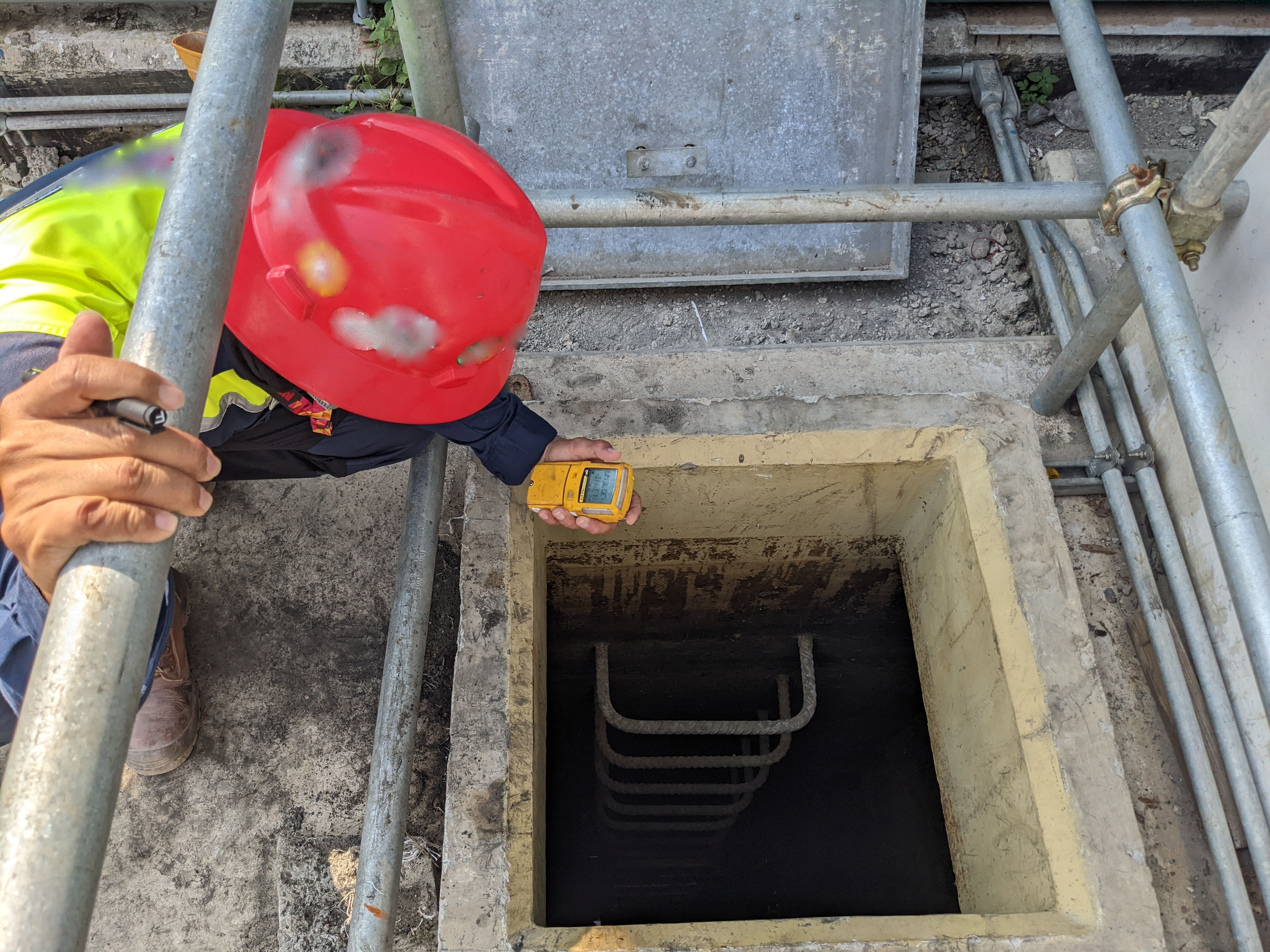
Confined Space Blower CFM: Rated vs. Delivered Under 1910.146
Rated CFM is not delivered CFM. How to calculate confined-space blower output at the duct outlet and document it so OSHA cannot call ventilation inadequate.
A 2,500 CFM blower attached to 100 ft of 8-inch flex hose with two elbows delivers about 1,200 CFM at the duct outlet. The other 1,300 CFM is gone — eaten by static pressure. If the entry supervisor wrote the purge time on the permit using the 2,500 CFM nameplate, the calculation is wrong, the documented purge time is short by roughly half, and an OSHA compliance officer reading that permit has the foundation for a 1910.146(c)(5) citation before the workers ever stepped into the space.
This is the blower-side ventilation math most confined-space programs do not document. We covered the space-side math — air changes, dilution formulas, K-factors — in our confined space CFM derate and purge calculation post from May 5. This post covers the blower-side math: rated versus delivered CFM, hose-run derate by length and diameter, when push-pull is required, and how to write the calculation onto the entry permit so it is defensible under 29 CFR 1910.146(c)(5).
If you are sizing a blower, choosing hose length, or writing entry-permit language for a permit-required confined space, this is the calculation that has to be right.
What Manufacturer “Rated CFM” Actually Means
When you read a portable confined-space blower spec sheet and see “1,500 CFM” or “2,500 CFM,” you are reading the free-air delivery rating — the CFM the blower moves at zero static pressure with no duct attached. It is the theoretical maximum, measured under conditions you will never encounter in the field.
Three things change once you connect a hose:
- The hose introduces friction. Air moving through 8-inch flexible duct loses pressure as it travels.
- Each elbow, bend, and compression point adds further resistance.
- The blower is no longer running at zero static pressure — it is now running at whatever pressure the duct system imposes (typically 0.5 to 1.5 in. H₂O for confined-space setups).
Centrifugal blowers — the most common style for confined-space work — lose flow rapidly as static pressure rises. A blower rated 2,500 CFM at 0 in. H₂O may deliver only 1,250 CFM at 1.5 in. H₂O. That is not a defect. It is how centrifugal blowers behave, and it is why every reputable manufacturer publishes a performance curve showing CFM at multiple static pressure points — not just the headline number.
If your facility’s confined-space program documents a blower as “rated 2,500 CFM” without referencing the manufacturer curve and the operating point, you are documenting a number that does not describe the equipment in service.
How to Calculate Delivered CFM at the Duct Outlet
The calculation has three parts:
Step 1: Find the static pressure load on the blower. This is the sum of duct friction loss plus elbow losses plus any compression or kink penalty.
A typical 8-inch flexible duct has these approximate static pressure loads at confined-space flow rates:
- 25 ft of 8” flex duct, no compression: about 0.3 in. H₂O
- 50 ft of 8” flex duct, light compression: about 0.6 in. H₂O
- 75 ft of 8” flex duct, one elbow, moderate compression: about 0.9 in. H₂O
- 100 ft of 8” flex duct, two elbows, moderate compression: about 1.5 in. H₂O
These values are derived from the friction-loss tables in the ACGIH Industrial Ventilation Manual and confirmed by published manufacturer curves from companies like Allegro Industries and Air Systems International.
Step 2: Read the manufacturer curve at that static pressure. A 2,500 CFM free-air centrifugal blower typically delivers:
- ~2,100 CFM at 0.3 in. H₂O (25 ft hose)
- ~1,800 CFM at 0.6 in. H₂O (50 ft hose)
- ~1,500 CFM at 0.9 in. H₂O (75 ft hose, one elbow)
- ~1,250 CFM at 1.5 in. H₂O (100 ft hose, two elbows)
Step 3: Apply a field-condition penalty. Compressed, coiled, or kinked duct multiplies the pressure drop by 2 to 4 times, which collapses delivered CFM further. A 100-ft run of compressed hose can drop delivered CFM from 1,250 to 600–800 CFM with no warning to the entry supervisor.
For the practitioner-friendly version, here is the derate table we use on iSi field assessments. It assumes 8-inch flex duct off a centrifugal blower rated at 2,500 CFM free-air:
| Hose configuration | Approx. derate | Delivered CFM (off 2,500 free-air) |
|---|---|---|
| 25 ft, no elbows, no compression | 15% | ~2,125 |
| 50 ft, no elbows, light compression | 25% | ~1,875 |
| 75 ft, one elbow, moderate compression | 35% | ~1,625 |
| 100 ft, two elbows, moderate compression | 50% | ~1,250 |
| 100 ft, kinks or poor routing | 65–75% | ~625–875 |
Source: derived from ACGIH friction-loss data and Allegro / Air Systems published performance curves. Verify against your specific blower’s manufacturer curve before relying on these numbers for a permit calculation.
Why a 2,500 CFM Blower at 100 ft of 8” Hose Delivers ~1,200 CFM
Walk through the math:
- Rated CFM at 0 in. H₂O: 2,500
- Static pressure load (100 ft of 8” duct + 2 elbows + moderate compression): ~1.5 in. H₂O
- Manufacturer curve at 1.5 in. H₂O: ~50% of free-air delivery
- Delivered CFM at the duct outlet: ~1,250 CFM, less a small velocity-loss penalty at the outlet, settles at ~1,200 CFM
That ~1,200 CFM is your real number for purge-time calculations and dilution-formula inputs. If the entry supervisor sized purge time off 2,500 CFM, the actual purge time is roughly double the documented number, the atmospheric tests at the documented time will show contaminants above target, and the entry permit becomes the evidence trail for an inadequate-ventilation citation.
This is exactly the gap we covered in the May 5 post on space-side purge math — the air-change calculation only works if the CFM number going into it is the delivered number, not the nameplate.
When Push-Pull Is Required
Single-blower forced-air ventilation works for small, simple confined spaces with one entry portal and short interior dimensions. For larger or more complex spaces, single-blower configurations cannot deliver effective ventilation at any reasonable CFM, and dual-blower push-pull is required.
The trigger conditions, drawn from ANSI/ASSP Z117.1-2022 (Safety Requirements for Entering Confined Spaces) and the OSHA Technical Manual Section III, Chapter 3 on industrial ventilation:
- Space length exceeds 4× the blower’s effective throw distance. A 2,500 CFM portable blower has an effective throw of roughly 10–15 ft. Spaces longer than ~50 ft will not mix adequately on a single supply blower regardless of CFM rating.
- Multiple workers in the space simultaneously. Each worker is a contaminant source (CO₂, body heat, possibly exhaled solvent vapor from off-gassing PPE). Single-blower mixing cannot keep up.
- High contaminant generation rates. Solvent residual tanks, sludge, biological residue, hot work in confined spaces — any space generating contaminants in real time often requires push-pull to maintain adequate dilution at the worker’s breathing zone.
- Geometry with dead zones. Internal baffles, corners, vertical drops, multiple compartments — all create zones where single-blower air cannot reach. Push-pull establishes a directional flow that sweeps the entire volume.
In a push-pull configuration:
- The supply blower (push) delivers clean air at one end of the space, drawing makeup from outside the entry portal.
- The exhaust blower (pull) removes contaminated air at the opposite end of the space, discharging to a safe location away from the entry portal.
The result is a directional sweep — clean air enters, moves through the space, contaminated air exits — rather than the recirculation-and-mixing pattern of a single blower.
29 CFR 1910.146(c)(5)(ii)(D) requires the air supply to be from a clean source. In push-pull configurations, the supply blower’s intake must be positioned outside the contaminated discharge zone of the exhaust blower — a basic field error that has shown up in OSHA citations when the two blowers are placed too close together and the exhaust contaminates the supply intake.
Why Ducted Exhaust Is Not the Same as Ducted Supply
Practitioners sometimes assume a 2,500 CFM blower in exhaust mode delivers the same effective CFM as in supply mode. It does not.
In supply (push) mode, the blower pushes clean air through the duct. Friction loss reduces velocity, but airflow has direction and momentum.
In exhaust (pull) mode, the blower pulls contaminated air against duct resistance, entry-portal loss, and the inertia of ambient air being pulled in to replace what was exhausted. The static pressure load is higher for the same physical setup, and effective CFM is typically 15–25% lower than in supply mode.
Exhaust at the low point of a heavier-than-air contaminant is a defensible strategy — but the supervisor must apply the additional 15–25% derate, or the calculated effective CFM will overstate what the blower actually delivers. The OSHA Technical Manual Section III, Chapter 3 identifies exhaust-mode underperformance as a common field error. If your program selects exhaust mode, document the additional derate on the entry permit.
Documenting the Calculation on the Entry Permit
Most permit-required confined-space programs use a permit form that asks for “ventilation method” and “blower CFM” and stops there. That is the documentation gap an OSHA inspector exploits. The fix is to add three lines to the entry permit:
Line 1 — Blower equipment and rated CFM (with operating point): “Allegro 9533 centrifugal blower, rated 1,500 CFM free-air; manufacturer curve shows 1,100 CFM at 0.5 in. H₂O operating point.”
Line 2 — Hose configuration and derate: “25 ft of 8-inch flex duct, one elbow, no compression; estimated derate 20%.”
Line 3 — Calculated delivered CFM (with the math shown): “Delivered CFM = 1,100 × (1 − 0.20) = 880 CFM at duct outlet. Purge-time calculation uses 880 CFM.”
Three lines. Maybe 30 seconds at the permit station. What this documents: the supervisor read the manufacturer curve and used the operating-point number, accounted for hose configuration with a quantified derate, and carried delivered CFM forward into the purge calculation.
If an OSHA inspector asks “How did you determine the ventilation was adequate?” — the permit answers it. The math is on the page. Under 29 CFR 1910.146(c)(5), this is the difference between defensible compliance and a serious violation that runs into five figures.
A 2026 serious violation under 1910.146 carries a penalty of up to $16,550 per citation under 29 CFR 1903.15. Willful or repeated violations reach $165,514 per citation. With OSHA’s instance-by-instance citation policy, a four-worker entry with one ventilation-inadequacy finding can yield 4 × $16,550 = $66,200 in serious-violation exposure on the ventilation issue alone.
In August 2024, Minnesota OSHA cited Wayne Transports, Inc. $621,600 for 10 serious 1910.146 violations, several of which involved ventilation and atmospheric-testing failures. The citations stemmed in part from program documentation that did not show how ventilation adequacy was determined.
Field Audit Checklist
If you are auditing a confined-space ventilation program — your own or a client’s — these are the items that catch the gaps:
- Pull a recent entry permit. Does it document the delivered CFM at the duct outlet, not the nameplate?
- Inspect the blower. Is the manufacturer curve available to the entry supervisor?
- Inspect the hose. Is it stored without kinks or compression? Is the run length documented?
- Check elbow count and routing. Multiple sharp elbows or coiled hose signal a setup that under-delivers.
- Verify push-pull threshold. Are spaces over ~50 ft long ventilated with push-pull?
- Check supply/exhaust selection. If exhaust mode is in use, is the additional 15–25% derate documented?
- Spot-check a delivered-CFM measurement. Take an anemometer reading at the duct outlet and compare to the permit.
State-Plan Notes for the Region
Kansas, Missouri, and Oklahoma operate under federal OSHA jurisdiction for private-sector employers. 29 CFR 1910.146 applies as written — there is no state-specific confined-space standard that supersedes federal language.
State-plan states such as California (Title 8 §1953) and Oregon (OAR 437-002-0146) impose stricter testing and documentation requirements; if your operation crosses into those states, verify state-specific rules before relying solely on federal guidance.
How iSi Helps
Most confined-space programs we audit are built on best intentions and incomplete field data. The blower-side calculation gap — rated CFM treated as delivered CFM, hose derate ignored, push-pull thresholds missed, entry permits documenting the wrong number — shows up on roughly 90% of first-time program assessments.
iSi Environmental’s industrial hygiene consulting includes field measurement of delivered CFM, manufacturer-curve analysis, permit-language review, push-pull configuration design, and entry-supervisor training on blower selection and the math behind the permit.
For multi-site operators, our EHS COOP retainer ($15,000–$90,000/year depending on tier) covers ventilation auditing across the portfolio with consistent documentation and a national team in 40 states. A single OSHA willful violation on confined-space ventilation runs up to $165,514 per instance. An iSi industrial hygiene assessment that catches the gap before the inspector does costs $4,050. That is a 41:1 return on a phone call.
If your entry permits show a blower CFM number with no manufacturer-curve reference and no hose-derate calculation, the gap is in your own files. We can close it before OSHA reads it. Call (316) 264-7050 or contact iSi Environmental to schedule a confined-space ventilation audit.
For the space-side math — purge time, air changes, the dilution formula — read our companion post: Why Your Confined Space Purge Time Is Probably Wrong.
Sources
- 29 CFR 1910.146 — Permit-Required Confined Spaces (OSHA.gov, verified 2026-05-10)
- eCFR § 1910.146 — Permit-Required Confined Spaces (Electronic Code of Federal Regulations, verified 2026-05-10)
- OSHA Technical Manual Section III, Chapter 3 — Industrial Ventilation (OSHA.gov, verified 2026-05-10)
- OSHA Standard Interpretations — 1910.146 letters of interpretation (OSHA.gov, verified 2026-05-10)
- 29 CFR 1903.15 — OSHA Civil Penalty Adjustments (2026 inflation-adjusted) (OSHA.gov, verified 2026-05-10)
- ANSI/ASSP Z117.1-2022 — Safety Requirements for Entering Confined Spaces (ANSI Webstore, verified 2026-05-10)
- ACGIH Industrial Ventilation Manual (30th ed.) — friction-loss tables and design hierarchy (subscription resource, verified 2026-05-10)
- NIOSH Pub 80-106 — Working in Confined Spaces (CDC/NIOSH, verified 2026-05-10)
- NIOSH Pub 87-113 — Guide to Industrial Respiratory Protection (CDC/NIOSH, verified 2026-05-10)
- OSHA News Release — Wayne Transports Citation, August 2024 ($621,600) (OSHA.gov, verified 2026-05-10)
- Cal/OSHA Title 8 §1953 — Confined Space Operations (state-plan reference) (California Department of Industrial Relations, verified 2026-05-10)
- Oregon OSHA — Confined Spaces Resources (osha.oregon.gov, verified 2026-05-10)
- iSi Environmental — companion post: Why Your Confined Space Purge Time Is Probably Wrong — Field Guide to CFM Derate and the 7-Air-Change Myth