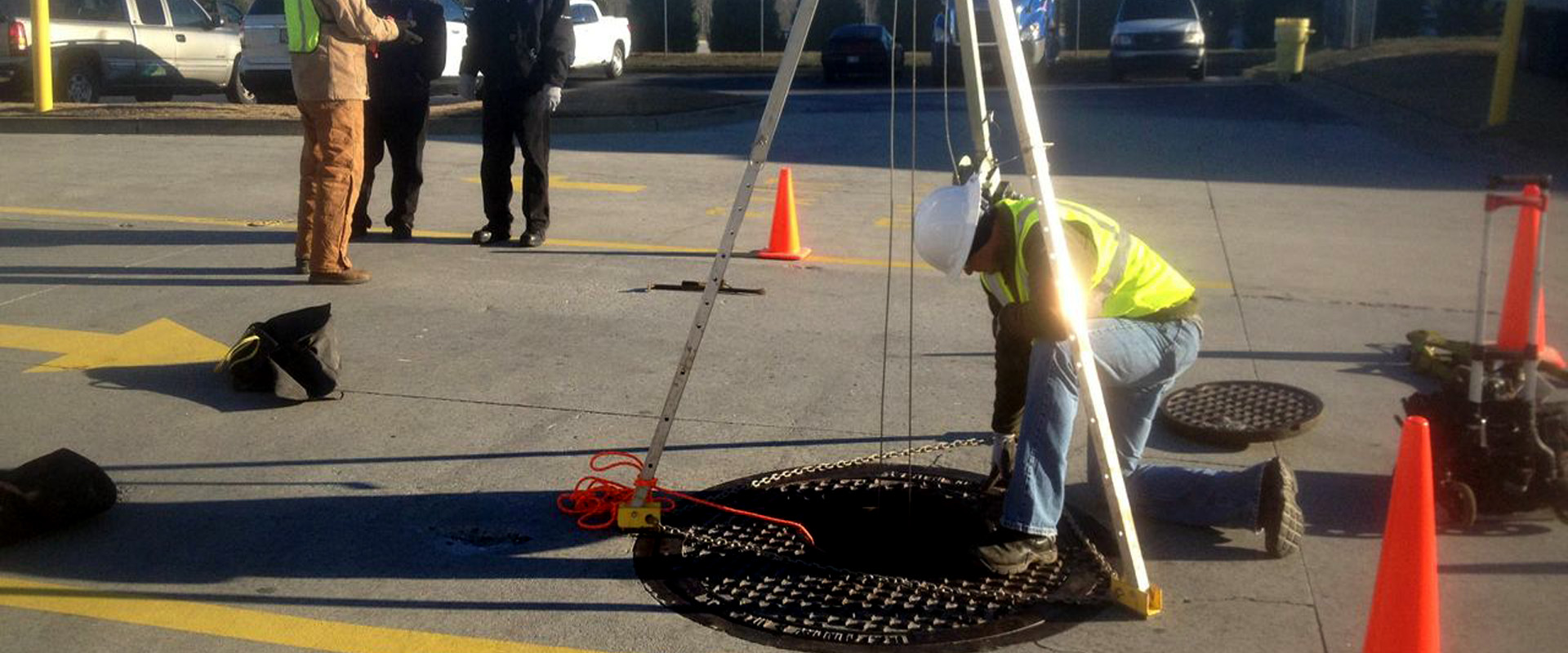
OSHA Hydrogen Sulfide Monitoring: The Gas Your Nose Stops Smelling Before It Kills You
OSHA hydrogen sulfide monitoring requirements: the 20 ppm ceiling, when gas detection is required, alarm set points, and the enforcement after H2S deaths.
Hydrogen sulfide gives you exactly one warning, and it is a lie. At low concentrations it smells like rotten eggs. Within a breath or two at dangerous concentrations, it paralyzes the olfactory nerve, the smell fades while the gas keeps rising, and above roughly 100 ppm there may be no odor at all. Workers who trust their nose walk into a space that reads “clearing up” right up until they collapse. That single property is why OSHA hydrogen sulfide monitoring requirements are built around instruments, not senses, and why “it didn’t smell bad” is the most dangerous sentence in a confined-space entry.
OSHA does not regulate H2S through one tidy substance-specific standard. The exposure limits sit in the air-contaminant tables, and the monitoring and control obligations are spread across confined-space, respiratory-protection, ventilation, hazard-communication, and emergency-response rules (OSHA, Hydrogen Sulfide). This post walks the twelve questions plant managers and EHS managers actually ask, the permissible exposure limit, whether continuous monitoring is required, where alarms should trip, and what happens when a facility gets it wrong, each answered directly, with the citation behind it.
What is the OSHA permissible exposure limit (PEL) for hydrogen sulfide?
For general industry, OSHA’s PEL is a 20 ppm ceiling under 29 CFR 1910.1000 Table Z-2, it cannot be exceeded at any point in an 8-hour shift, except a single 50 ppm peak for up to 10 minutes if no other measurable exposure occurs that shift. Construction and maritime use a 10 ppm 8-hour TWA instead.
The word “ceiling” is doing heavy work here. A ceiling is not an average, it is a line you never cross, measured at any instant. That makes H2S in general industry a fundamentally different compliance test than the 8-hour time-weighted averages most EHS managers are used to running for dusts and solvents. You do not get to offset a 40 ppm spike with a clean afternoon. The only relief valve in the rule is the narrow conditional peak: 50 ppm, once, for no more than 10 minutes, and only if the worker had no other measurable H2S exposure during that shift. Treat that exception as the exception it is, not a second limit to design around.
Does OSHA require continuous H2S gas monitoring?
OSHA has no rule that says “install a continuous monitor” by name, but because odor fails as a warning and the ceiling can be breached instantly, the atmospheric-testing duties of 29 CFR 1910.146 and the exposure-assessment duty of 1910.1000 effectively require instrument monitoring, pre-entry and, where levels can change, continuous, wherever H2S may be present.
This is the point where facilities talk themselves into trouble. “OSHA doesn’t require a continuous monitor” is technically true and practically useless. If a space can go from safe to lethal between the pre-entry test and the end of the task, a manway cracked on a sour tank, a slug of product moving through a line, a sump disturbed, then a single pre-entry reading does not discharge the employer’s duty to keep the atmosphere below the ceiling. The instrument is not optional; the phrasing in the standard just describes the outcome instead of the hardware. Personal monitors worn in the breathing zone plus area monitors are how you actually meet the obligation.
What H2S level should a gas detector alarm at?
OSHA’s Oil and Gas eTool notes industry practice sets the low alarm at 10 ppm to warn workers and trigger evacuation, matching the NIOSH 10 ppm ceiling. Action levels are set below the 20 ppm general-industry ceiling so workers respond before the enforceable limit is reached, not after.
Set your alarm at the PEL and you have designed a system that tells people they are already in violation. That is backwards. The 10 ppm low-alarm convention exists to buy response time, it gives an entrant and attendant a margin to stop work, move, and reassess before the atmosphere reaches the 20 ppm line you are legally bound not to cross. Tie the alarm to a written response procedure: what happens at 10 ppm (warn), what happens as levels climb (evacuate), and who has authority to call the space. An alarm with no procedure behind it is a noise, not a control.
What is the IDLH level for hydrogen sulfide?
NIOSH sets the Immediately Dangerous to Life or Health (IDLH) value for H2S at 100 ppm (NIOSH, Hydrogen sulfide IDLH). At and above this level a worker cannot escape without respiratory protection, and effects escalate quickly; near 700 ppm “knockdown” can cause collapse within one or two breaths, with death in minutes.
IDLH is the threshold where the math on rescue changes. Below it, an escape is survivable if the worker moves. At 100 ppm and up, unprotected entry, including a coworker rushing in to pull someone out, is how one fatality becomes two or three. The gas is also heavier than air, so it pools in the low, enclosed spaces where people work: pits, sumps, cellars, tanks, vaults, sewers. A reading of “0 ppm” at the hatch tells you nothing about what is sitting at the bottom.
How do you test the atmosphere in a confined space for H2S?
Under 29 CFR 1910.146, test before entry and monitor during entry using a calibrated multi-gas detector, in this order: oxygen first, then flammable gases and vapors, then toxic gases and vapors including H2S. Never rely on smell, H2S paralyzes the olfactory nerve at higher concentrations.
The order is not arbitrary. Oxygen comes first because most sensors for the other channels need adequate oxygen to read accurately, and because oxygen displacement is its own killer. Flammables come next, H2S is not only toxic, its flammable range runs from 4.0% to 44.0% in air. Toxics, including H2S, come last. Run the test in that sequence, in the correct location (including the bottom of a low-lying space where the gas settles), and only with an instrument that has been bump-tested and calibrated. A detector that has not been verified against known gas is an assumption wearing a display. For the underlying mechanics of keeping detectors trustworthy, see our breakdown of calibration gas expiry and bump-test accuracy.
Which industries have the highest H2S exposure risk?
OSHA and NIOSH flag oil and gas (sour gas), wastewater and sewage systems, agriculture (manure pits), pulp and paper, tanneries and rendering, hot-asphalt work, mining, and chemical manufacturing (OSHA, Hydrogen Sulfide). The common thread is decaying organic matter or sulfur processing plus confined, low-lying spaces where the gas accumulates.
If your operation has a space where organics break down or sulfur compounds are handled, a lift station, a digester, a manure storage pit, a sour production tank, you are on this list whether or not H2S is in your job title. There is no small-business exemption from the PELs or from the confined-space, respiratory, and hazard-communication standards. The test is exposure potential, not headcount. And “sweet” systems turn “sour” over time; a process that read clean last year can generate H2S today. The applicability question is answered by the space, not the org chart.
What respiratory protection is required for H2S exposure?
Under 29 CFR 1910.134, when H2S concentrations are unknown or exceed exposure limits, including any atmosphere at or above the 100 ppm IDLH, employers must provide NIOSH-approved supplied-air respirators or SCBA. Air-purifying cartridges are not permitted for unknown or IDLH atmospheres; reliable quantitative data is required before downgrading protection.
The trap is the cartridge respirator. A filtering facepiece or air-purifying cartridge does nothing in an oxygen-deficient or IDLH atmosphere, and “we don’t know the concentration” is legally the same as unknown-and-dangerous. Until you have reliable instrument data proving the atmosphere is within limits, the correct protection is supplied air or SCBA. Downgrading from that level is a decision that has to be earned with numbers, not comfort or convenience.
Is H2S training required by OSHA?
Yes. Hazard Communication (1910.1200), respiratory protection (1910.134), and confined-space (1910.146) standards each carry training duties that apply to H2S. OSHA’s eTool points employers to ANSI/ASSE Z390.1-2017, Accepted Practices for H2S Safety Training Programs, covering detection, alarm response, symptoms, rescue, and PPE, delivered before work begins.
There is no single “H2S training rule,” which is precisely why it gets missed, the obligations live inside three separate standards, and a facility that trains on HazCom but not on confined-space entry, or on respirators but not on alarm response, has a hole in the program. Z390.1-2017 is the consensus reference OSHA names, and it maps the content that actually keeps people alive: how the gas behaves, what the alarms mean, what the symptoms feel like before knockdown, and why nobody enters to rescue without air-supplied protection. The training has to land before the first entry, not after the first incident.
What are the OSHA penalties for hydrogen sulfide violations?
For 2026, penalties are frozen at 2025 levels: up to $16,550 per serious or other-than-serious violation and up to $165,514 per willful or repeat violation, with failure-to-abate at $16,550 per day (2026 Annual Adjustments to OSHA Civil Penalties). A single fatal H2S confined-space case can stack many citations, OSHA proposed $103,232 against one Oklahoma wellsite contractor in 2024.
Note what did not happen: the 2026 amounts did not rise. They are held at 2025 levels because the data needed for the annual inflation adjustment was unavailable, with the next annual adjustment due by January 15, 2027. The exposure that should keep a plant manager up at night is not an escalating penalty schedule, it is the way a single H2S fatality generates a stack of citations across confined-space, respiratory, training, and PPE standards from one event. That is the enforcement pattern, covered next.
Does the H2S exposure limit differ between general industry and construction?
Yes. General industry (1910.1000 Table Z-2) uses a 20 ppm ceiling with a conditional 50 ppm/10-minute peak. Construction (1926.55 App A) and shipyard/maritime (1915.1000) instead use a 10 ppm, 15 mg/m³ 8-hour TWA. Employers doing both types of work must apply the correct limit to each operation.
This is where mixed operations get tripped up. The same worker can fall under a 20 ppm ceiling during a plant maintenance task and a 10 ppm 8-hour average during a construction task on the same site, and the two limits are measured in completely different ways, an instantaneous line versus a shift-long average. There is also a third number that gets quoted as if it were law and is not: the ACGIH Threshold Limit Value of 1 ppm TWA (with a 5 ppm STEL). That is a best-practice target roughly twenty times tighter than OSHA’s general-industry ceiling, a recommendation, not an enforceable PEL. A facility can be fully OSHA-compliant at concentrations ACGIH considers unacceptable. The honest position: OSHA sets the enforceable floor, ACGIH sets the best-practice target, and the gap between them is a real risk-tolerance decision, not a rounding error. Do not let a vendor quote 1 ppm as “the OSHA limit.”
When does hydrogen sulfide trigger OSHA’s Process Safety Management standard?
A process containing 1,500 pounds or more of hydrogen sulfide is covered by Process Safety Management, 29 CFR 1910.119 Appendix A, which lists H2S as a highly hazardous chemical. PSM adds process hazard analysis, mechanical integrity, operating procedures, and management-of-change duties on top of the exposure and monitoring requirements.
The 1,500 lb threshold is a distinct trigger from the exposure limits, you can be well under it and still owe the full monitoring, respiratory, and confined-space program, and you can cross it and inherit an entire additional standard. Most manufacturers running an H2S process at scale, and some gas facilities, cross it. Where H2S is present, material selection matters too: the gas attacks metal through sulfide stress cracking and corrosion, which is why sour-service operators evaluate materials against references like NACE MR0175 / ISO 15156. Mechanical integrity under PSM is not paperwork; it is what keeps the containment that keeps the gas off your people.
Why can’t workers rely on smell to detect hydrogen sulfide?
H2S smells like rotten eggs at low concentrations but rapidly paralyzes the olfactory nerve, so the smell fades even as the gas rises, and above roughly 100 ppm there may be no odor at all. Longer low-level exposure has the same desensitizing effect. OSHA’s rule: never rely on the sense of smell.
This is the property the whole program is built to defeat, and it is worth stating plainly because it is so counterintuitive: the gas that smells worse is often safer than the gas that smells like nothing. A rising H2S concentration deadens the very sense workers instinctively trust, so the human warning system reads “improving” at the exact moment the danger peaks. That is why every other requirement, instrument monitoring, alarms set below the limit, supplied-air respirators for unknown atmospheres, the ban on unprotected rescue, exists. Take away the instrument and you have taken away the only honest witness in the room.
One tank, sixteen citations, $103,232, the enforcement pattern
The urgency here is not a coming deadline. As of mid-2026 there is no pending OSHA rulemaking on H2S; the exposure limits have been stable for decades. The risk driver is enforcement of the existing rules after a death, and the pattern is consistent. In March 2024, OSHA proposed $103,232 against C&M Roustabout Services LLC after a worker died of asphyxiation entering a production water tank at a McClain County, Oklahoma wellsite, 16 serious citations, including entering a confined space with no atmospheric evaluation and no permit, no flame-resistant PPE, and no testing or ventilation program (OSHA News Release 24-532-DAL).
Read the failure list and the lesson writes itself: no atmospheric testing before entry, reliance on odor, and the absence of a program turned a single routine task into a fatality and a stack of citations. The recurring sequence across H2S deaths in oil and gas, wastewater, and agriculture is the same, no pre-entry testing, trust in smell, and unprotected rescue attempts that turn one death into several. Confined spaces are the dominant venue; BLS recorded 1,030 U.S. confined-space fatalities between 2011 and 2018. Atmospheric testing before entry would have prevented the C&M event outright. Where the hazard is ventilation-driven, the purge math matters too, see our walkthrough of confined-space ventilation CFM and purge calculation under 1910.146, and the broader confined space program requirements that tie these elements together.
Where iSi fits
If your facility has a space where H2S can accumulate, a sour tank, a lift station, a digester, a manure pit, a sump, the question is not whether OSHA “requires a monitor.” It is whether your exposure assessment, your detector calibration and alarm set points, your respiratory decisions, and your confined-space entry procedures would hold up the day an inspector arrives after an incident. That is exactly the review iSi’s industrial hygiene and OSHA compliance consulting teams run: an H2S exposure assessment against the correct PEL for each operation, a gas-detection program review down to alarm set points and bump-test discipline, and a confined-space monitoring and entry-procedure check under 1910.146. A single willful violation is priced at up to $165,514; an assessment that closes the gap before the inspector, or the fatality, arrives costs a small fraction of that. If you are not certain which H2S limit applies to which of your operations, or when you last verified your detectors against known gas, that uncertainty is the finding. Call iSi at (888) 264-7050 to scope an H2S exposure and gas-detection program review.
Sources
- OSHA, Hydrogen Sulfide: Standards: https://www.osha.gov/hydrogen-sulfide/standards (verified 2026-07-31)
- OSHA, 29 CFR 1910.1000 Table Z-2 (Toxic and hazardous substances): https://www.osha.gov/laws-regs/regulations/standardnumber/1910/1910.1000TABLEZ2 (verified 2026-07-31)
- OSHA, Oil and Gas eTool: H2S Safety and Health Hazards / Monitoring: https://www.osha.gov/etools/oil-and-gas/general-safety/h2s-monitoring (verified 2026-07-31)
- OSHA, 29 CFR 1926.55 Appendix A (Construction): https://www.osha.gov/laws-regs/regulations/standardnumber/1926/1926.55AppA (verified 2026-07-31)
- OSHA, 29 CFR 1915.1000 Table Z (Shipyard): https://www.osha.gov/laws-regs/regulations/standardnumber/1915/1915.1000 (verified 2026-07-31)
- OSHA, 29 CFR 1910.119 Appendix A (PSM highly hazardous chemicals list): https://www.osha.gov/laws-regs/regulations/standardnumber/1910/1910.119AppA (verified 2026-07-31)
- OSHA, 29 CFR 1910.146 (Permit-required confined spaces): https://www.osha.gov/laws-regs/regulations/standardnumber/1910/1910.146 (verified 2026-07-31)
- OSHA, 29 CFR 1910.134 (Respiratory protection): https://www.osha.gov/laws-regs/regulations/standardnumber/1910/1910.134 (verified 2026-07-31)
- OSHA, 29 CFR 1910.1200 (Hazard Communication): https://www.osha.gov/laws-regs/regulations/standardnumber/1910/1910.1200 (verified 2026-07-31)
- NIOSH Pocket Guide to Chemical Hazards, Hydrogen sulfide (0337): https://www.cdc.gov/niosh/npg/npgd0337.html (verified 2026-07-31)
- NIOSH, Hydrogen sulfide IDLH: https://www.cdc.gov/niosh/idlh/7783064.html (verified 2026-07-31)
- OSHA, 2026 Annual Adjustments to OSHA Civil Penalties (memo 2026-05-21): https://www.osha.gov/memos/2026-05-21/2026-annual-adjustments-osha-civil-penalties (verified 2026-07-31)
- OSHA, Penalties: https://www.osha.gov/penalties (verified 2026-07-31)
- OSHA News Release 24-532-DAL, C&M Roustabout confined-space fatality, $103,232: https://www.osha.gov/news/newsreleases/region6/03182024-0 (verified 2026-07-31)
- Texas Railroad Commission, Hydrogen Sulfide (H2S) / Statewide Rule 36: https://www.rrc.texas.gov/oil-and-gas/research-and-statistics/field-data/hydrogen-sulfide-h2s/ (verified 2026-07-31)