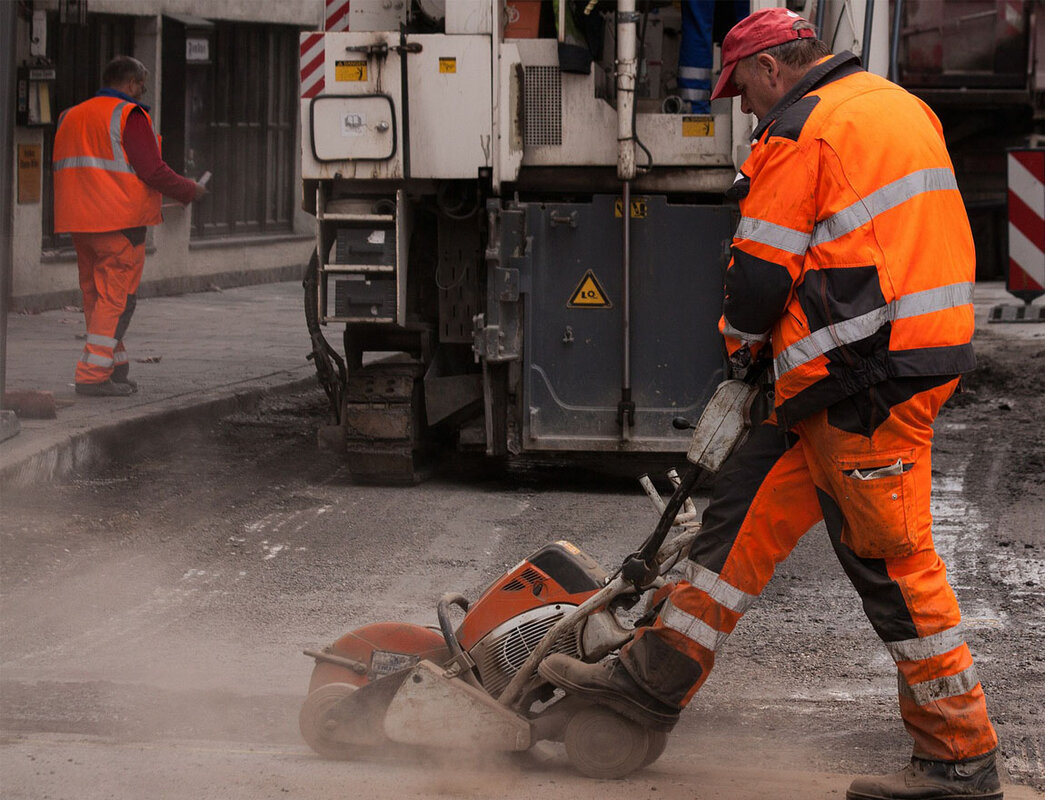
When Wet-Cutting Doesn't Actually Get You Out of the Silica Respirator Program: The Table 1 Trap in 29 CFR 1926.1153(c)
Running water at the blade isn't a free pass on OSHA's construction silica standard. The Table 1 safe-harbor requires 'fully and properly' implementing the entry — and one misread row collapses the whole program back to paragraph (d).
A concrete contractor on a parking-deck rehab pulls a walk-behind saw off the trailer at 7:15. The saw has an integrated water tank, the operator runs the water line, and by 9:00 the crew has been cutting for ninety minutes in the second-level enclosed parking deck. Nobody is wearing a respirator. The site safety supervisor walks past, sees water running, sees no visible dust cloud, and signs off. By the standard the crew was taught — “wet-cutting equals Table 1, Table 1 equals no respirator program” — they are compliant.
They are not compliant.
The OSHA silica Table 1 wet-cutting pathway for construction under 29 CFR 1926.1153(c) is a real safe-harbor — but the language that defines it is narrower than most contractors read it. Miss a row in Table 1, miss the “fully and properly” enforcement test, or miss the indoor-vs-outdoor split, and the contractor drops out of Table 1 and into the full paragraph (d) program — exposure assessment, respirator program, medical surveillance, the works.
This post is for the safety manager, general contractor, or facility owner trying to figure out whether wet-cutting a saw lets their crew skip the silica program — and what they actually have to do to qualify.
What the Standard Actually Says
29 CFR 1926.1153, OSHA’s respirable crystalline silica standard for construction, applies wherever an employer’s employees are exposed to respirable crystalline silica in construction work, unless exposure will remain below 25 µg/m³ as an 8-hour TWA under any foreseeable conditions (29 CFR 1926.1153, eCFR). The Permissible Exposure Limit (PEL) is 50 µg/m³ and the Action Level (AL) is 25 µg/m³, both 8-hour TWA.
The standard gives the construction employer two ways to comply.
Pathway 1 — Table 1, paragraph (c). Eighteen common construction tasks are listed in Table 1, each with a specified engineering control method, specified work practices, and a specified respiratory protection requirement based on task duration. If the employer “fully and properly” implements the listed controls for an employee performing a listed task, the employer is not required to conduct exposure assessments or otherwise comply with a PEL for that employee while performing that task (OSHA Silica Construction Info Page).
Pathway 2 — Alternative Exposure Control Methods, paragraph (d). The employer assesses each employee’s exposure, applies the hierarchy of controls to keep exposure at or below the PEL, supplements with respiratory protection where engineering controls are not sufficient, runs a respiratory protection program under 29 CFR 1910.134, conducts medical surveillance for employees required to wear a respirator for 30 or more days per year, and documents everything (29 CFR 1926.1153(d)).
Two obligations apply no matter which pathway the contractor picks. A written exposure control plan under paragraph (g)(1) that identifies tasks involving exposure and the methods used to protect workers. And a designated competent person under paragraph (g)(4) — someone capable of identifying foreseeable silica hazards and authorized to take prompt corrective action — making frequent and regular inspections of job sites, materials, and equipment to implement the written plan (OSHA Silica Construction page). Table 1 does not eliminate either obligation.
Table 1 Entry 4 — Walk-Behind Saws, Row by Row
Most concrete contractors live and die by Table 1 Entry 4. The entry reads short, but every line matters.
The required engineering control: use a saw equipped with an integrated water delivery system that continuously feeds water to the blade, and operate and maintain the tool in accordance with the manufacturer’s instructions to minimize dust emissions (OSHA FS-3633, Control of Silica Dust in Construction, Walk-Behind Saws).
The respirator requirements vary by where the saw is operated:
- Outdoor task, four hours or less per shift — no respirator required
- Outdoor task, more than four hours per shift — no respirator required
- Indoor or enclosed area, four hours or less per shift — APF 10 respirator required
- Indoor or enclosed area, more than four hours per shift — APF 10 respirator required
The parking-deck crew at the top of this post was working in an enclosed area. The moment the saw entered the deck, the indoor row of Entry 4 fired and the APF 10 respirator was mandatory at any duration — including for the first ten minutes of cutting. The fact that water was running does not change the row. The fact that no visible dust was floating around does not change the row. Indoor or enclosed silica work with a walk-behind saw requires the respirator under Table 1, period.
And once a respirator is required, the contractor must run a written respiratory protection program under 29 CFR 1910.134 — fit-testing, training, medical evaluation, recordkeeping, cartridge replacement schedule, the whole standard. The Table 1 safe-harbor for the silica standard does not exempt the contractor from the respiratory protection standard. It pulls 1910.134 in by reference.
Entry 1 for stationary masonry saws is the cleaner cousin: same integrated water delivery system requirement, but no respirator required at any duration whether the saw is indoor or outdoor (OSHA Table 1 PDF). Crews running stationary masonry saws have a wider safe-harbor than crews running walk-behind saws — which is one reason contractors should know which Table 1 entry their work actually falls under, not which one they wish it did.
”Fully and Properly” — The Enforcement Test
Table 1 is a safe-harbor only if the contractor “fully and properly implements” the entry. The phrase is doing real work. OSHA’s Interim Enforcement Guidance for the Respirable Crystalline Silica in Construction Standard, 29 CFR 1926.1153 (October 19, 2017) tells inspectors exactly what to do when the test is not met:
“Where the construction employer has not fully and properly implemented the engineering controls, work practices, and respiratory protection listed in Table 1 for all employees engaged in Table 1 tasks, CSHOs must collect personal air samples to measure the 8-hour TWA for the silica operations likely to exceed the PEL.”
The same guidance clarifies that if Table 1 requires a respirator above four hours of task duration, the employee must wear the respirator for the entire task period — not just the portion exceeding four hours.
In practice “fully and properly” means four things on a walk-behind saw job:
- The saw actually has an integrated water delivery system attached to and fed by the saw itself — not a second worker spraying water at the blade from a hose. OSHA’s March 4, 2019 Letter of Interpretation on Integrated Water Delivery Systems is direct on this for saw entries.
- Water is flowing continuously to the blade during cutting at a flow rate sufficient to minimize visible dust.
- The saw is being operated and maintained per the manufacturer’s instructions — clean blade housing, correct blade for the material, correct blade speed.
- The required respirator is worn for the entire task period when Table 1 requires it.
If an OSHA inspector arrives and sees visible dust escaping a walk-behind saw running water, the inspector is going to conclude the wet method is not being fully and properly implemented — and the Table 1 defense collapses. Visible dust is the objective indicator. “Minimize dust emissions” is not an aspirational standard. It is the line.
When the Safe-Harbor Collapses — What Drops Onto the Contractor
A contractor who thought they were running Table 1 and is found by an inspector not to have fully and properly implemented it is suddenly graded against paragraph (d). The compliance gap is large.
Exposure assessment. Required for every employee whose exposure may be at or above the AL — initial assessments and additional assessments when conditions change, conducted per 1926.1153(d)(2). A contractor who ran Table 1 has no exposure data and no documented assessment program.
Respiratory protection program. Required wherever engineering controls don’t reduce exposure to the PEL. Contractors who already issued respirators for indoor Entry 4 work may still not have a written program under 1910.134 covering selection, fit-testing, medical evaluation, training, change-out schedule, and recordkeeping. Respiratory Protection (1910.134) sits at #5 on OSHA’s Top 10 most frequently cited standards for FY2025 — a high-citation-risk standard inherited cold.
Medical surveillance. Required for any employee with exposure at or above the AL for 30 or more days per year. Initial baseline exam, periodic exams every three years, exam by a PLHCP, written medical opinion to employer and employee, recordkeeping.
Written exposure control plan adequate to the task. A plan that says “we use wet methods per Entry 4” does not document the alternative-method program the contractor is now being graded against.
Competent person inspection records and full recordkeeping. Exposure data, medical surveillance records, and objective data per 1926.1153(j). Source: OSHA Small Entity Compliance Guide, OSHA 3902.
The cost of being in the wrong column is not one citation. It is four to six citations stacked on a single inspection, plus an over-PEL exposure citation if sampling supports it.
The Penalty Math
The current OSHA penalty maximums under 29 CFR 1903.15, set by the 2025 Annual Adjustments memo (January 7, 2025) and published at 90 FR 1858 (January 10, 2025), are:
- Serious or other-than-serious violation: $16,550 per violation
- Willful or repeat violation: $165,514 per violation
Per-element stacking on a typical Table 1 collapse on indoor walk-behind saw work runs five separate serious citations easily — no exposure assessment, no respiratory protection program, no medical surveillance offer, no written exposure control plan adequate to paragraph (d), and the over-PEL exposure if sampling supports it. At $16,550 each that is $82,750 from one inspection on documented program absence alone. If the inspector finds prior warning history and upgrades to willful, the math runs to $165,514 per element — into seven figures fast.
This is also why the silica National Emphasis Program matters. Construction silica work is under active programmed inspection targeting under CPL 03-00-023, National Emphasis Program – Respirable Crystalline Silica (effective February 4, 2020). Inspectors apply the NEP procedures in CPL 02-02-080, Inspection Procedures for the Respirable Crystalline Silica Standards. Street-level concrete cutting work is not waiting on a complaint to draw an inspector — programmed inspections are part of the enforcement model.
What Wet-Cutting Is Not
Three counter-signals are worth carrying off this page.
First — “wet” is not a synonym for “compliant.” The Entry 4 language requires “an integrated water delivery system that continuously feeds water to the blade” and operation “in accordance with the manufacturer’s instructions to minimize dust emissions.” Both conditions have to be true at the same time. A saw running water through a fouled nozzle, a clogged blade housing, a wrong blade for the material, or at the wrong RPM can produce visible dust even when the water gauge says water is flowing. Visible dust at the blade is the inspector’s objective indicator that the entry is not being fully and properly implemented.
Second — Table 1 does not cover every tool. Eighteen tasks are listed. A handheld grinder used as a saw, a non-listed concrete cutter, or a tool being used in a configuration the entry does not contemplate drops the contractor into paragraph (d) for that task regardless of how much water is involved. The entry has to match the actual work.
Third — the indoor Entry 4 trap is the most-missed obligation in the standard. Most contractors read “outdoor — no respirator” and stop. The indoor or enclosed row of Entry 4 requires an APF 10 respirator at any duration — and a respiratory protection program under 1910.134 to support it. A walk-behind saw running in a parking deck, basement, or enclosed renovation zone is in the indoor row, water or no water.
For multi-state contractors with West-Coast work, one more wrinkle: California Title 8 Section 1532.3 carries the same PEL and AL as federal 1926.1153, but Cal/OSHA’s Table 1 recognizes local exhaust ventilation (LEV) options that the federal table does not for some tools (Cal/OSHA Silica FAQ). A control method that satisfies California may not satisfy federal Table 1 for the same tool. Contractors with uniform SOPs across states need to write to the stricter federal wet-method requirement.
What a Defensible Table 1 Program Looks Like on Paper
Contractors who treat Table 1 as a paperwork-light pathway get cited every time. Contractors who treat it as a documented compliance choice survive inspections. The difference is five artifacts the competent person can hand the inspector inside ten minutes.
A written exposure control plan that names the Table 1 entries actually in use — not a generic “we follow Table 1” plan. The plan identifies each Table 1 task by entry number, the engineering controls in use for that entry, the respirator selection by row (including the indoor row when applicable), and the competent person responsible for inspection.
Equipment records that match the entries. For Entry 4: manufacturer documentation that the saw has an integrated water delivery system, maintenance logs showing the system is operational, and a blade inventory matching manufacturer specifications for each material cut.
Competent person inspection logs documenting that water is flowing at the blade during cutting, that no visible dust is escaping, that the correct respirator is worn when the indoor row applies, and that housekeeping requirements under paragraph (f) are being met.
Training records covering the silica standard, the Table 1 entries in use, and the respiratory protection program when respirators are required.
A documented decision rule for when the crew moves to paragraph (d) — a non-Table 1 tool gets pulled to the job, a control fails, work moves indoors mid-shift. The competent person needs a written decision tree for stopping Table 1 work and either fixing the control or shifting to paragraph (d) compliance with sampling and a respirator program.
The five artifacts together are what “fully and properly implemented” looks like in a binder. The inspector arriving after a complaint or under an NEP programmed inspection asks for them in roughly that order.
Where iSi Comes In
A Table 1 compliance audit is the cheapest insurance a contractor running concrete work can buy. iSi’s industrial hygiene team conducts silica IH sampling on active job sites, audits Table 1 implementation against the entry-level requirements (water flow rates, respirator selection by duration and location, manufacturer-instruction conformance, competent person documentation), drafts written exposure control plans that hold up against paragraph (d) scrutiny when crews cross the line, and runs the respiratory protection program documentation under 1910.134 for indoor Entry 4 work.
For contractors with continuous concrete-cutting exposure across multiple project sites, iSi’s EHS COOP retainer puts a licensed industrial hygienist on call — periodic site visits, sampling, Table 1 audits, written program updates as crews and tools change, and direct OSHA-inspector interface when an inspection arrives.
The decision on this standard is not whether the silica rule applies. The decision is which column of compliance the contractor is documented in when the inspector shows up. Table 1 is the cheaper column, but only if the documentation matches the entry.
Sources
All sources verified 2026-05-19.
- 29 CFR 1926.1153, Respirable crystalline silica (construction), eCFR — https://www.ecfr.gov/current/title-29/subtitle-B/chapter-XVII/part-1926/subpart-Z/section-1926.1153
- OSHA Silica Construction Info Page (29 CFR 1926.1153) — https://www.osha.gov/silica-crystalline/construction-info
- OSHA Silica Construction Overview — https://www.osha.gov/silica-crystalline/construction
- OSHA Table 1 — Specified Exposure Control Methods PDF — https://www.osha.gov/silica/Table1sect1926.1153.pdf
- OSHA FS-3633, Control of Silica Dust in Construction, Walk-Behind Saws — https://www.osha.gov/sites/default/files/publications/OSHA_FS-3633.pdf
- OSHA Letter of Interpretation, March 4, 2019, Silica in Construction, Integrated Water Delivery System, Exposure Assessment, Medical Surveillance, Respiratory Protection — https://www.osha.gov/laws-regs/standardinterpretations/2019-03-04
- OSHA Interim Enforcement Guidance for 29 CFR 1926.1153, October 19, 2017 — https://www.osha.gov/laws-regs/standardinterpretations/2017-10-19
- OSHA Small Entity Compliance Guide, OSHA 3902 — https://www.osha.gov/sites/default/files/publications/OSHA3902.pdf
- OSHA Inspection Procedures for Silica Standards, CPL 02-02-080 — https://www.osha.gov/sites/default/files/enforcement/directives/CPL_02-02-080.pdf
- OSHA National Emphasis Program — Respirable Crystalline Silica, CPL 03-00-023 — https://www.osha.gov/enforcement/directives/cpl-03-00-023
- 29 CFR 1903.15, Proposed Penalties — https://www.osha.gov/laws-regs/regulations/standardnumber/1903/1903.15
- 2025 Annual Adjustments to OSHA Civil Penalties (memo 2025-01-07) — https://www.osha.gov/memos/2025-01-07/2025-annual-adjustments-osha-civil-penalties
- Federal Register 90 FR 1858, 2025 OSHA Penalty Inflation Adjustments — https://www.federalregister.gov/documents/2025/01/10/2024-31602/federal-civil-penalties-inflation-adjustment-act-annual-adjustments-for-2025
- OSHA Top 10 Most Frequently Cited Standards — https://www.osha.gov/top10citedstandards/
- Cal/OSHA 8 CCR 1532.3, Occupational Exposures to Respirable Crystalline Silica (construction) — https://www.dir.ca.gov/title8/1532_3.html
- Cal/OSHA Respirable Crystalline Silica FAQ — https://www.dir.ca.gov/dosh/respiratory-silica-FAQ.html