8,600 Pounds Against a 10,000-Pound Threshold: The Process Safety Duties PSM Never Covered
A 2,000-gallon propylene tank holds 8,600 lb, under the 10,000 lb PSM threshold. Two general duty clauses and 29 CFR 1910.110 reached that site anyway.
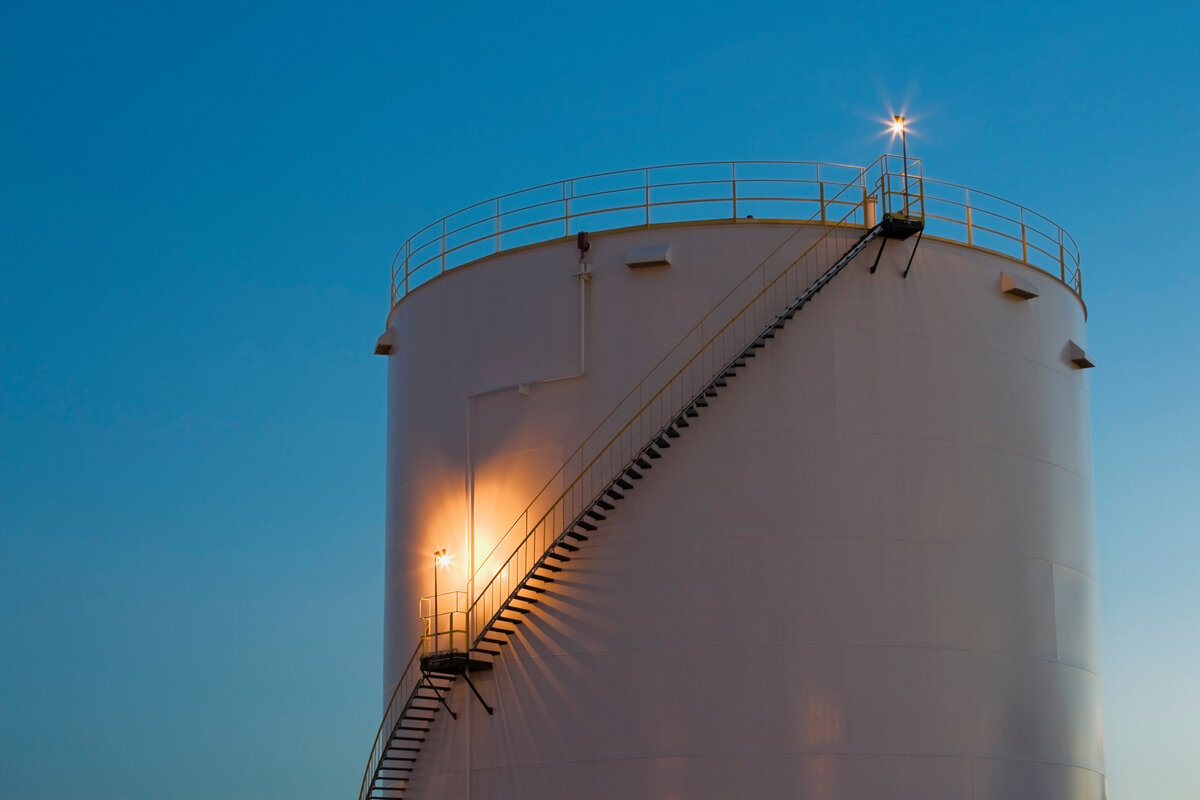
The bulk propylene tank at a Houston machine shop held 2,000 gallons, which works out to about 8,600 pounds of liquid. OSHA Process Safety Management starts at 10,000 pounds of a Category 1 flammable gas on site in one location. That vessel could not have reached the trigger if someone had topped it off every morning for a decade. The facility sat permanently under the PSM threshold and permanently under the EPA Risk Management Program threshold, and on January 24, 2020 an explosion there killed three people. Being under the number described the tank. It never described the hazard.
Two legal duties reached that site with no quantity trigger at all, and so did at least one specific OSHA standard written for propylene by name. None of them come from 29 CFR 1910.119. Every one of them applies to a facility that deliberately sized a tank or capped an inventory to stay under 10,000 pounds, which in this region describes a very large number of plants.
Does OSHA process safety management apply below 10,000 pounds?
No. PSM applies to a process with a Category 1 flammable gas, or a flammable liquid with a flashpoint below 100 degrees F, at 10,000 pounds or more on site in one location, per 29 CFR 1910.119(a)(1)(ii). It also applies to a listed chemical at or above its appendix A threshold. Under those amounts the standard itself does not reach the process.
EPA’s Risk Management Program runs on the same architecture. Coverage turns on having more than a threshold quantity of a regulated substance in a process, determined under 40 CFR 68.115, with the thresholds printed in the tables at 40 CFR 68.130. Propylene, CAS 115-07-1, sits in Table 3 at 10,000 pounds, the same figure OSHA uses. A facility that clears one threshold usually clears both.
The exclusions inside the standard are narrower than most people assume. 1910.119(a)(2) carves out only retail facilities, oil or gas well drilling or servicing operations, and normally unoccupied remote facilities, and that last phrase is defined in paragraph (b) to require that no employees are permanently stationed there and that the facility is geographically remote from all other buildings, processes and persons. A separate carve-out at 1910.119(a)(1)(ii)(A) covers hydrocarbon fuels used solely for workplace consumption as a fuel, propane for comfort heating being the usual example, and only when they are not part of a process containing another covered highly hazardous chemical. If you want the applicability analysis and the 14 elements for a facility that is over the line, that ground is already covered in what process safety management is and which companies it applies to.
If PSM does not apply to my process, what do I still owe?
Four things. OSH Act Section 5(a)(1) requires a workplace free of recognized hazards likely to cause death or serious physical harm. Clean Air Act Section 112(r)(1) requires hazard identification, safe design and maintenance, and minimizing the consequences of a release. Every specific OSHA standard that reaches the material still applies. And you have to be able to document all of it.
The first two have no threshold, no form, no filing and no renewal date. OSH Act Section 5(a)(1), 29 U.S.C. 654(a)(1), is a statutory duty on every employer covered by the Act. Clean Air Act Section 112(r)(1) is a statutory duty on every owner or operator of a stationary source handling an extremely hazardous substance, and EPA sets out the three component duties on its general duty clause fact sheet: identify the hazards that could result from an accidental release and assess their potential impacts, design and maintain a safe facility to prevent releases, and minimize the consequences of a release that happens anyway.
That architecture is why the fourth item carries so much weight. Neither clause produces an inspection checklist, so the only artifact that ever shows the first three were satisfied is the file the employer built on its own initiative.
Which facilities this actually reaches, and the test you can run in an afternoon
In iSi’s region the sub-threshold population is large and it rarely identifies itself. Machine shops and coating operations burning propylene, propane or acetylene for thermal spray, flame hardening or welding. Plating and finishing shops with chlorine, nitric acid or ammonia under threshold. Food and beverage plants with anhydrous ammonia refrigeration charges below 10,000 pounds. Grain and feed operations, agricultural anhydrous ammonia dealers, and water and wastewater plants that switched from chlorine gas to hypochlorite and assumed the conversion closed the question. Any plant that sized a vessel or capped an inventory specifically to stay under the number belongs on that list too.
Four steps settle your own status, and none of them needs a consultant.
- List every flammable or toxic chemical on site with the maximum quantity present in one location at one time. That is the measure PSM uses at 1910.119(a)(1)(ii) and the measure RMP uses at 40 CFR 68.115, and it is a different number from annual throughput.
- Compare each quantity against appendix A to 1910.119 and the tables at 40 CFR 68.130. If everything is under, PSM and RMP are out, and that is the end of what being under accomplishes.
- Ask whether a specific OSHA standard reaches the material at any quantity, and whether the hazard is recognized with a feasible fix available. For propylene, propane, butanes and butylenes the answer to the first half is yes, because 29 CFR 1910.110 covers all four. For any hazardous chemical, Hazard Communication reaches it at any quantity.
- If either answer in step 3 is yes, you hold an obligation the threshold never touched, and you hold it today rather than at some future compliance date.
A plant manager who runs that list usually lands on step 3 with one tank, one hose and no inspection record for either. The hazard was never in dispute. The paperwork that proves somebody looked at it is what does not exist.
What must OSHA prove to cite the general duty clause?
Four elements, set out in the OSHA Field Operations Manual, Chapter 4, Section 3.1: the employer failed to keep the workplace free of a hazard to which its own employees were exposed, the hazard was recognized, the hazard was causing or likely to cause death or serious physical harm, and a feasible and useful method existed to correct it. Only serious hazards may be cited this way.
Read those four as a scoring sheet and it becomes obvious where a case is won or lost. Element one is rarely contested after a release, and element three is settled by the nature of a flammable gas. Elements two and four are decided almost entirely inside the employer’s own records.
Recognition can be established three ways: the employer knew, the industry knew, or the hazard was obvious to any reasonable person. Every maintenance work order, hazard assessment, near-miss log, insurance recommendation and out-of-service tag in the building is evidence on that element, and it is evidence the employer wrote. Feasible abatement works the same way in reverse. If a fix is cheap, available and already installed somewhere else in the plant, element four is satisfied from the inside.
The public CSB case supplies both elements in two sentences of facts. CSB final report No. 2020-03-I-TX, issued June 29, 2023, records that the automated gas detection alarm, the exhaust fan startup and the gas shutoff system were inoperative, and that the manual shutoff valve at the storage tank had not been closed at the end of the previous workday. An inoperative safety system is documented recognition of exactly the hazard it was installed to catch, and its own existence proves abatement was feasible. For the broader pattern of what 5(a)(1) citations look like across ordinary workplace hazards, see general duty clause citations in the workplace.
Does EPA’s general duty clause apply below the RMP threshold quantity?
Yes. EPA states on its general duty clause fact sheet that an owner or operator using a regulated or other extremely hazardous substance in any amount is subject to Clean Air Act Section 112(r)(1). That includes a source that reduced its inventory and no longer submits a risk management plan, and it includes chemicals that appear nowhere in 40 CFR 68.130.
The second half of that is the part that surprises people. Dropping off the RMP program by lowering inventory removes the filing, the five-year update and the program level requirements. It does not remove the statutory duty, because the duty was never keyed to the threshold in the first place. The same logic reaches substances that are not regulated under Part 68 at all, which is how a facility with no listed chemical on site can still hold a 112(r)(1) obligation for an extremely hazardous substance.
For the definitional question of what the EPA clause is and where it sits in the Clean Air Act, this post covers it. The point worth adding here is structural: there are two general duty clauses, in two statutes, administered by two agencies, with two separate penalty tables, and most facilities have only ever heard of one of them.
Was Watson Grinding covered by PSM or RMP?
Neither. CSB final report No. 2020-03-I-TX records that PSM did not apply because the amount stored was below the 10,000-pound threshold, and that propylene is listed under the RMP rule but that RMP did not apply for the same reason. The bulk tank held at most about 8,600 pounds. Three people died.
The sequence is short and it is in the public record. Propylene leaked overnight from a degraded, poorly crimped welding hose inside a coating booth. Shortly before 4:30 a.m. on January 24, 2020 an employee turned on the lights and the accumulated vapor found its ignition source. Two employees were killed, a nearby resident died about two weeks later, two more employees were injured, and hundreds of neighboring homes were damaged. The CSB estimated about 2,600 pounds of propylene were released, which is roughly a quarter of the quantity that would have brought the process inside either rule.
Two details from that report deserve to be read together. The quantity on site was a function of the vessel someone bought, and the vessel was smaller than the threshold by design or by accident, nobody outside the company knows which. Whichever it was, the facility was outside PSM and outside RMP for the entire life of that tank, and the hazard sat at full strength the whole time. The CSB also noted that neither PSM nor RMP covers hazardous substances used as a fuel, which widens the uncovered population further than the threshold alone does.
The CSB directed its two recommendations, 2020-03-I-TX-R1 and R2, to the Compressed Gas Association and to Matheson Tri-Gas. Neither recommendation went to a regulator asking for a lower threshold. Both went to the places where the recognized practice for handling this material is written and distributed, which is a useful signal about where a sub-threshold facility should be looking for its own standard of care.
Can OSHA cite the general duty clause when a specific standard already covers the hazard?
Normally no. The Field Operations Manual limits the clause at Chapter 4, Sections 3.3.1 and 3.4.1 to hazards no standard addresses, and Sections 3.4.2 and 3.4.3 bar using it to impose a stricter requirement than a standard sets or an abatement method a standard does not require. At the public CSB case OSHA issued both kinds: one standard citation and one under Section 5(a)(1).
That combination is worth understanding before an inspection rather than during one. The limitation protects an employer who is complying with a specific standard from being second-guessed under the general duty clause on the same hazard. It does nothing for an employer whose hazard falls in the space between standards, which is exactly where a sub-threshold flammable gas process tends to sit. Remove 1910.119 from the picture and the release scenario, the detection system, the shutoff logic and the maintenance program for the gas piping stop having a dedicated standard to point to. The general duty clause is what remains, and it is where OSHA goes.
The practical read is that complying with a specific standard narrows your 5(a)(1) exposure only for the hazards that standard actually addresses. Hazard Communication training is not a release prevention program, and compliance with one is no answer to a citation about the other.
Which specific OSHA standards still apply to a sub-threshold flammable gas process?
For propylene, propane, butanes and butylenes, 29 CFR 1910.110 applies at any quantity, because 1910.110(a) defines LP-Gas to include all four of those materials by name with no quantity trigger. Hazard Communication at 1910.1200 reaches every hazardous chemical regardless of amount. Being under the PSM threshold removes one standard, not the rest of subpart H or subpart Z.
Almost nobody states that plainly. The facility everybody describes as unregulated was inside a specific OSHA standard for the entire time the propylene tank was on site. 1910.110 is not a courtesy document. It carries container requirements, piping and tubing requirements, valve and fitting requirements, relief device requirements, and installation and maintenance requirements for LP-Gas systems, and a degraded welding hose feeding a coating booth is squarely inside its subject matter.
Hazard Communication is the other standard that never went away, and it is the one that produced the only standard-based citation in the public case, under 1910.1200(h)(1), the employee training provision. Beyond those two, the ordinary list applies on its own terms: lockout/tagout, hot work permitting, emergency action plans, fire protection, electrical classification in areas where flammable vapor can accumulate, and respiratory protection where it is triggered. A facility that reads its PSM non-applicability determination as a global exemption has misread a single paragraph as a verdict on the whole of 29 CFR 1910.
What is the penalty for a general duty clause violation?
On the OSHA side, up to $16,550 per serious violation under 29 CFR 1903.15(d), with willful violations running from $11,823 to $165,514 and failure to abate at $16,550 per day unabated. These figures are in effect for 2026, unchanged from 2025. On the EPA side, Clean Air Act penalties run far higher. In the public CSB case the 5(a)(1) citation was proposed at $134,937.
The OSHA arithmetic there is not a typo. A single serious violation caps at $16,550, and the proposed penalty on that one citation was more than eight times that figure, because OSHA may cite each instance of a violation separately and build a grouped penalty. A fatality case with multiple exposed employees and multiple failed systems generates instances quickly. OSHA’s memorandum of May 21, 2026 confirms that no inflation-based increases were made this year and that the 2025 amounts remain in effect, citing OMB Memorandum M-26-11 and the Bureau of Labor Statistics being unable to produce the October 2025 CPI-U.
The Clean Air Act figures sit in 40 CFR 19.4 Table 1, in the column for violations after November 2, 2015 with penalties assessed on or after January 8, 2025, and they are likewise in effect for 2026 unchanged from 2025. Administratively, under 42 U.S.C. 7413(d)(1), the figure is $59,114 per day of violation with a $472,901 total cap. Judicially, under 42 U.S.C. 7413(b), it is $124,426 per day of violation. A field citation under 42 U.S.C. 7413(d)(3) is $11,823.
One caution for anyone checking this themselves. EPA’s own general duty clause fact sheet still prints a lower per-day figure for the Section 113(d) penalty, and that figure is superseded. The operative amount is the one in 40 CFR 19.4 Table 1, and the fact sheet has not been updated to match it. Cite the regulation rather than the fact sheet when the number matters.
What this section cannot tell you is how often EPA actually assesses a general duty clause penalty. No Clean Air Act Section 112(r)(1) general duty clause enforcement action from 2024 through 2026 with a stated penalty amount was located in the research behind this post. What is verifiable is the authority and the current ceilings. Treat any claim that EPA routinely assesses these penalties as unsourced until someone produces the case.
How do I document compliance with a duty that has no regulation behind it?
By building the record yourself. EPA states on its fact sheet that the general duty clause is not a regulation, so there is no form to file and no data submission to check compliance against. The defensible file holds a written hazard identification covering release scenarios, equipment inspection and maintenance records, functional-test records for detection and shutoff systems, and evidence that you follow the recognized industry practice for the material.
Six documents carry most of the weight, and a facility with a single flammable gas system can assemble them in a few weeks.
- A written hazard identification for each chemical and each process, naming the credible release scenarios and what each one would reach. This is the first duty EPA states under 112(r)(1) and the one that documentation satisfies directly.
- A design and maintenance basis for the equipment that contains the chemical. Vessel, piping, hoses, valves, relief devices, and for LP-Gas the specific requirements of 1910.110. Note which code or standard each element was built to.
- Inspection and maintenance records on that equipment, with dates and findings. A degraded hose is only a surprise in a building where nobody inspects hoses.
- Functional-test records for every safety system. Gas detection, alarms, exhaust fan startup, automatic shutoff. The test record is what converts an installed system into a working one, and its absence is what converts a working system into evidence against you.
- A consequence minimization plan: emergency shutdown procedure, end-of-shift valve positions, who is called, and how occupants and neighbors are warned.
- Evidence of the recognized practice you are following for the material. For LP-Gas and compressed gases, the material published by the Compressed Gas Association is the body the CSB pointed to, and following a published industry practice is both a safety decision and a direct answer to the recognition element of a 5(a)(1) citation.
None of that is a 14-element program, and nobody should build one. It is a hazard file, and its job is to exist on the day an inspector or a plaintiff’s expert asks what the facility knew.
Does keeping inventory under the threshold actually reduce my liability?
It removes two rule sets and leaves the hazard, both general duty clauses and every other applicable standard exactly where they were. The tank in the public CSB case could hold about 8,600 pounds against a 10,000-pound threshold, and about 2,600 pounds released killed three people. OSHA’s initial proposed penalty was $143,612 across two citations. Under-threshold is a description of paperwork, not of risk.
Capping inventory is still worth doing, and this post is not an argument against it. Less material on site means a smaller release, a smaller cloud and a smaller affected radius, and that is a real safety gain measured in consequence. What it does not do is change the legal position, and the two get confused constantly in budget conversations. A facility that drops from 11,000 pounds to 9,500 pounds has bought itself a modest consequence reduction and the complete loss of the one framework that would have told it how to manage what remains.
The honest version of the trade looks like this. Over the threshold, you get a prescriptive program with 14 elements, defined audit cycles and a clear compliance test. Under it, you get the same hazard, two statutory duties with no instructions, and total responsibility for designing your own standard of care. Plenty of operators would rather have the checklist.
The OSHA penalty was the smallest number in this event
The enforcement record cuts against the alarmed version of this topic, and leaving it out would be dishonest. OSHA opened its inspection of the public CSB case and issued citations on July 21, 2020 following a close conference the day before. Two citations, both classified Serious. No willful, no repeat. Citation 01001 cited 1910.1200(h)(1) at $8,675. Citation 02001 cited Section 5(a)(1) with an initial proposed penalty of $134,937. The inspection detail record shows the case closed on October 1, 2021 with both citations resolved by formal settlement. The current penalty on the 5(a)(1) citation is $8,675, down from $134,937. The total went from $143,612 to $17,350.
A reader who manages to the fine has the arithmetic on their side. Three fatalities, two injuries, hundreds of damaged homes, and the regulatory consequence settled at about 12 percent of the proposal. If the OSHA penalty is the number you are protecting against, this topic is not worth your afternoon.
The reason to keep reading is that the OSHA penalty is the smallest number attached to an event like this. The civil exposure is the large one, and it is handled in a courtroom where the general duty clause elements, the missing inspection records and the inoperative detection system are exhibits rather than citation items. Press reporting in June 2025 described a jury awarding almost $38 million to five victims of this explosion. That figure has not been verified against a court docket for this post and should be treated as an unverified news report rather than a fact, which is why no part of the argument above rests on it. The structural point stands without a number: a company that cannot produce a hazard identification, an inspection history or a functional test record is defending a civil case with an empty file, and the $17,350 OSHA settlement is what it has to show for the regulatory side.
Are EPA and OSHA tightening or loosening process safety rules in 2026?
Loosening on the EPA side and static on OSHA’s. EPA proposed amendments to the 2024 Safer Communities by Chemical Accident Prevention rule at 91 FR 8970 on February 24, 2026, RIN 2050-AH37, with the comment period extended to May 11, 2026. OSHA has published no proposed revision of 1910.119. Neither general duty clause is in play.
The EPA proposal is broad. Its stated reach includes the safer technology and alternatives analysis provisions, information availability, third-party audits, employee participation, community and emergency responder notification, stationary source siting, natural hazards, loss of power, documentation of declined recommendations, emergency response exercises, process safety information and RAGAGEP, the deregistration form, hot work permit retention and the retail facility definition. EPA frames the revisions as avoiding duplicative requirements, and the docket is EPA-HQ-OLEM-2025-0313. All of that matters to RMP-covered sources. None of it applies to a facility that was never covered.
On the OSHA side there is no proposal at all. The agency held a public meeting on PSM on August 30, 2022 at 87 FR 53020, and its last substantive rule action touching the standard was the Process Safety Management of Highly Hazardous Chemicals and Slings technical amendment of April 15, 2019 at 84 FR 15102, with the related Standards Improvement Project Phase IV final rule of May 14, 2019 at 84 FR 21416. Everything in the Federal Register on PSM since then has been paperwork renewal, most recently 90 FR 26830 on June 24, 2025. Nobody should plan around a lower threshold, because no proposal to lower one exists. Penalty pressure is flat too, as the May 21, 2026 OSHA memorandum confirms for the OSHA figures and the January 8, 2025 column of 40 CFR 19.4 Table 1 confirms for the EPA ones.
Then the counter to all of it. Both general duty clauses are statutory. 29 U.S.C. 654(a)(1) and Clean Air Act Section 112(r)(1) live in the statutes, and no rulemaking on the list above amends either one. A deregulatory year at EPA and a quiet decade at OSHA leave the two duties that reach a sub-threshold facility precisely where they were. The 2024 compliance date of May 10, 2027 also remains codified at 40 CFR 68.10(g) while the amendments are pending, which matters to any facility that crosses the threshold between now and then.
Do process safety requirements differ in Kansas, Missouri, Oklahoma, Nebraska, Texas or Colorado?
On the OSHA side, no. None of the six has an approved State Plan, per OSHA’s State Plans page, so federal 29 CFR 1910.119 and OSH Act Section 5(a)(1) apply directly to private-sector employers in all of them with no state modification. On the EPA side, Missouri is now different. EPA finalized partial delegation of Missouri’s Clean Air Act Section 112(r) program for agricultural anhydrous ammonia facilities at 91 FR 23015 on April 29, 2026.
Two cautions on that delegation, because it is being described loosely in a lot of places. It is partial, and its stated scope is agricultural anhydrous ammonia facilities, following the Missouri Department of Natural Resources request of October 6, 2025 with supplements later that month and the proposed approval at 91 FR 9523 on February 26, 2026. Whether the delegated program carries Section 112(r)(1) general duty clause authority, as distinct from the Section 112(r)(7) risk management program requirements, was not resolved in the research behind this post. Read it as an open question. Do not assume a state inspector now holds general duty clause authority over a Missouri ag retail site, and do not assume they do not. The delegation itself is covered in detail in the Missouri RMP delegation for agricultural anhydrous ammonia.
One correction worth stating plainly, because it circulates in regional compliance material and it is wrong: Missouri is not an OSHA State Plan state for private employers. Federal OSHA has jurisdiction. The only genuine coverage gap in the six is the public sector, where state and local government employees are outside federal OSHA jurisdiction, which is a gap in who enforces rather than a different rule.
What to do if your process sits under the threshold
The work is small enough to scope in an afternoon and it does not resemble a PSM program.
- Write the inventory list from step 1 of the test above, with maximum quantity in one location, and keep it as a dated record rather than a spreadsheet somebody rebuilds each year.
- Write the hazard identification. Name each credible release scenario, what it would reach, and what prevents it. This single document satisfies the first duty under Clean Air Act 112(r)(1) and supplies the factual base for everything else.
- Identify every specific standard that still reaches each material at any quantity, starting with 1910.110 for LP-Gas and 1910.1200 for everything, and check your actual installation against the requirements rather than against your memory of them.
- Pull the inspection and maintenance history on the equipment that contains the chemical. If there is no history, that is the finding, and the fix is a schedule.
- Functionally test every detection, alarm, ventilation and shutoff device and record the result. Set the recurrence before you leave the room.
- Write the end-of-shift and emergency procedures, including valve positions, and train to them under 1910.1200(h)(1) alongside the hazard communication training you already owe.
- Put a date on the next review. The general duty clauses have no deadline, which means nothing external will ever remind you.
If an inventory change, a new line or an acquisition takes a process over 10,000 pounds, the work changes shape entirely and the program build is a different project. Start with what process safety management is and which companies it applies to, and bring the program build to a consultant early rather than after the first audit finding.
Most facilities that work through the list above reach the same place: they now know they owe a documented hazard identification, and there is nobody on staff with the time or the background to write it. That is the work iSi’s safety consulting team does, including the hazard identification, the release scenario review, the LP-Gas and Hazard Communication gap check against 1910.110 and 1910.1200, and the functional-test program for detection and shutoff systems. The Clean Air Act Section 112(r)(1) side, including the hazard assessment and consequence minimization record for a facility under the RMP threshold, runs through environmental compliance. For a plant that needs the file maintained rather than written once, the EHS cooperative program, or EHS COOP, puts an iSi project manager on the facility’s calendar so the inspections, the functional tests and the annual review happen as scheduled tasks. Call iSi at (316) 264-7050 or contact us with your inventory list and the vessel sizes and you will get a response the same day.
Sources
- 29 CFR 1910.119, Process safety management of highly hazardous chemicals, current eCFR text (10,000-pound flammable threshold at (a)(1)(ii), appendix A thresholds at (a)(1)(i), exclusions at (a)(2), remote facility definition at (b)): https://www.ecfr.gov/current/title-29/subtitle-B/chapter-XVII/part-1910/subpart-H/section-1910.119 (verified 2026-10-19)
- 29 CFR 1910.110, Storage and handling of liquefied petroleum gases, current eCFR text (LP-Gas defined at (a) to include propylene, propane, butanes and butylenes, with no quantity trigger): https://www.ecfr.gov/current/title-29/subtitle-B/chapter-XVII/part-1910/subpart-H/section-1910.110 (verified 2026-10-19)
- 29 CFR 1903.15, Proposed penalties and adjusted civil monetary penalties, current eCFR text (serious $16,550, willful $11,823 minimum to $165,514 maximum, failure to abate $16,550 per day): https://www.ecfr.gov/current/title-29/subtitle-B/chapter-XVII/part-1903/section-1903.15 (verified 2026-10-19)
- OSH Act Section 5, Duties, 29 U.S.C. 654, as published by OSHA (the general duty clause at 654(a)(1)): https://www.osha.gov/laws-regs/oshact/section5-duties (verified 2026-10-19)
- OSHA Field Operations Manual, Chapter 4, Section 3 (the four general duty clause elements at 3.1; the limitations at 3.3.1, 3.4.1, 3.4.2 and 3.4.3): https://www.osha.gov/fom/chapter-4 (verified 2026-10-19)
- OSHA memorandum, 2026 Annual Adjustments to OSHA Civil Penalties, May 21, 2026 (no inflation-based increases for 2026, 2025 amounts remain in effect, citing OMB Memorandum M-26-11): https://www.osha.gov/memos/2026-05-21/2026-annual-adjustments-osha-civil-penalties (verified 2026-10-19)
- OSHA inspection detail, inspection 1458001.015, the public CSB case (two Serious citations issued July 21, 2020; 1910.1200(h)(1) at $8,675; Section 5(a)(1) proposed at $134,937 and currently $8,675; total $143,612 reduced to $17,350; case closed October 1, 2021 by formal settlement): https://www.osha.gov/ords/imis/establishment.inspection_detail?id=1458001.015 (verified 2026-10-19)
- CSB final report No. 2020-03-I-TX, Fatal Propylene Release and Explosion at Watson Grinding, issued June 29, 2023 (PSM and RMP non-applicability below 10,000 pounds, 2,000-gallon tank holding about 8,600 pounds, about 2,600 pounds released, inoperative detection and shutoff systems, manual valve left open, recommendations R1 and R2 to the Compressed Gas Association and Matheson Tri-Gas): https://www.csb.gov/assets/1/6/watson_final_report_2023-06-29.pdf (verified 2026-10-19)
- CSB news release on the final report: https://www.csb.gov/csb-releases-final-report-on-2020-fatal-propylene-release-and-explosion-at-the-watson-grinding-facility-in-houston-texas/ (verified 2026-10-19)
- 40 CFR 68.10, Applicability, current eCFR text (the May 10, 2027 compliance date at (g)): https://www.ecfr.gov/current/title-40/chapter-I/subchapter-C/part-68/subpart-A/section-68.10 (verified 2026-10-19)
- 40 CFR 68.130, List of substances, current eCFR text (Table 3 regulated flammable substances, propylene CAS 115-07-1 at 10,000 pounds): https://www.ecfr.gov/current/title-40/chapter-I/subchapter-C/part-68/subpart-F/section-68.130 (verified 2026-10-19)
- 40 CFR 19.4, EPA statutory civil monetary penalties as adjusted for inflation, Table 1, current eCFR text (42 U.S.C. 7413(b) at $124,426 per day; 7413(d)(1) at $59,114 per day with a $472,901 cap; 7413(d)(3) at $11,823; operative column for penalties assessed on or after January 8, 2025): https://www.ecfr.gov/current/title-40/chapter-I/subchapter-A/part-19/section-19.4 (verified 2026-10-19)
- EPA General Duty Clause Fact Sheet, Clean Air Act Section 112(r)(1) (any amount applicability, the three component duties, the statement that the clause is not a regulation; note that the penalty figure printed on this page is superseded by 40 CFR 19.4 Table 1): https://www.epa.gov/rmp/general-duty-clause-fact-sheet (verified 2026-10-19)
- 91 FR 8970, Accidental Release Prevention Requirements: Risk Management Programs Under the Clean Air Act; Common Sense Approach to Chemical Accident Prevention, proposed rule, February 24, 2026, RIN 2050-AH37, docket EPA-HQ-OLEM-2025-0313: https://www.federalregister.gov/documents/2026/02/24/2026-03633/accidental-release-prevention-requirements-risk-management-programs-under-the-clean-air-act-common (verified 2026-10-19)
- 91 FR 16621, same proposed rule, extension of the comment period to May 11, 2026, April 2, 2026: https://www.federalregister.gov/documents/2026/04/02/2026-06444/accidental-release-prevention-requirements-risk-management-programs-under-the-clean-air-act-common (verified 2026-10-19)
- 91 FR 23015, Approval of Missouri’s Request for Partial Program Delegation of the Clean Air Act Section 112(r) Prevention of Accidental Release Program, final rule, April 29, 2026 (partial delegation limited to agricultural anhydrous ammonia facilities): https://www.federalregister.gov/documents/2026/04/29/2026-08348/approval-of-missouris-request-for-partial-program-delegation-of-clean-air-act-112r-prevention-of (verified 2026-10-19)
- 91 FR 9523, same Missouri delegation, proposed approval, February 26, 2026, docket EPA-R07-OAR-2026-0497: https://www.federalregister.gov/documents/2026/02/26/2026-03891/approval-of-missouris-request-for-partial-program-delegation-of-clean-air-act-section-112r (verified 2026-10-19)
- OSHA State Plans (no approved State Plan in Kansas, Missouri, Oklahoma, Nebraska, Texas or Colorado): https://www.osha.gov/stateplans (verified 2026-10-19)
- Federal Register history on 29 CFR 1910.119 with no pending revision: 87 FR 53020 (public meeting on PSM, August 30, 2022), 84 FR 15102 (Process Safety Management of Highly Hazardous Chemicals and Slings, technical amendment, April 15, 2019), 84 FR 21416 (Standards Improvement Project Phase IV, final rule, May 14, 2019), 90 FR 26830 (information collection renewal, June 24, 2025).