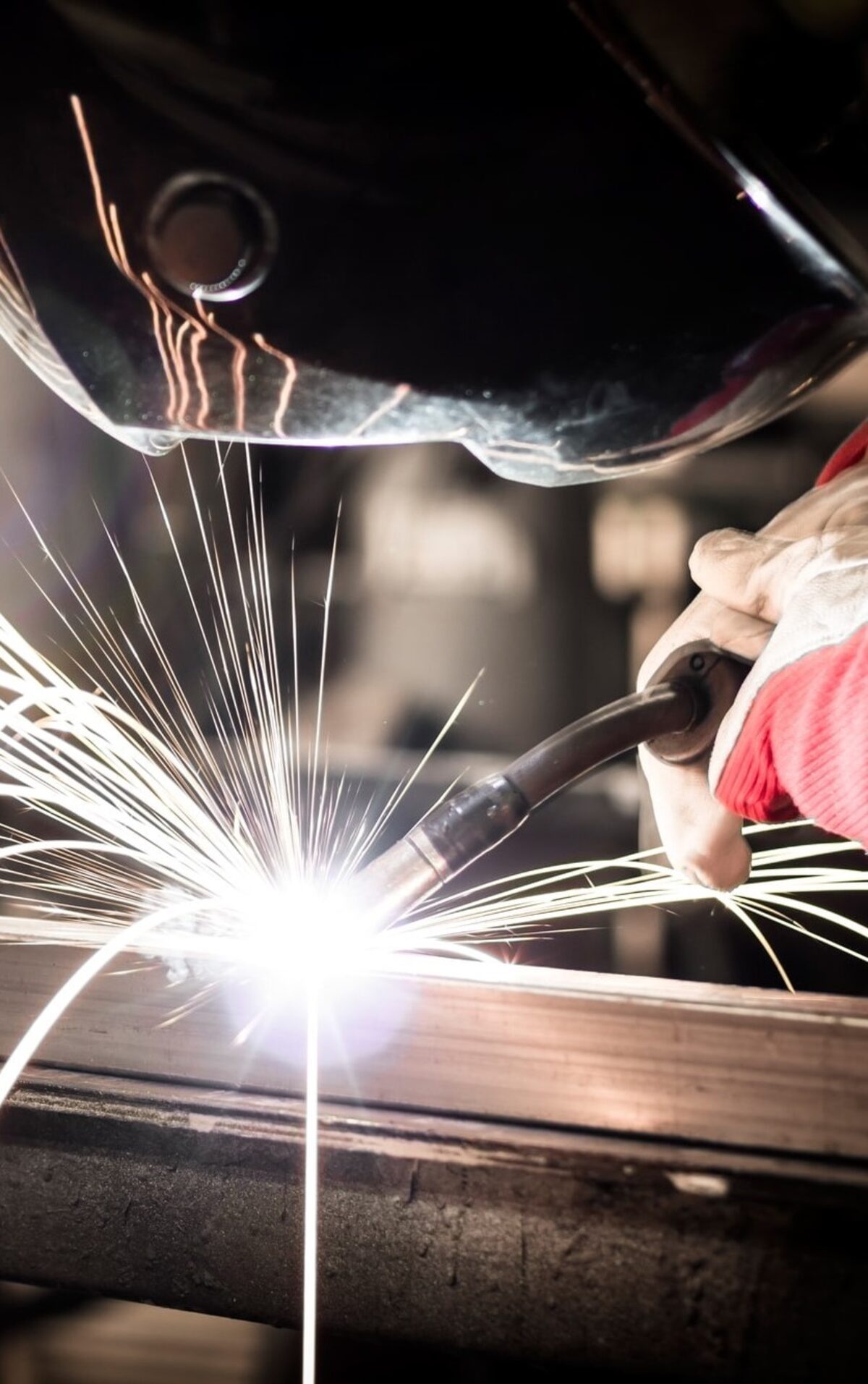
Your Shop Just Switched to Stainless: When OSHA Requires Welding Fume Sampling for Cr(VI) and Manganese
A stainless or chrome-alloy changeover triggers additional exposure monitoring under 29 CFR 1910.1026(d)(2)(vi). What that means for Cr(VI), manganese, and who gets sampled.
The day a fab shop runs its first production job on 304 plate, it has changed its raw material. OSHA’s hexavalent chromium standard treats that as a monitoring trigger, and the trigger attaches to the date of the change rather than to the date an inspector walks in.
Chromium enters the arc as metal or as trivalent chromium in the base plate, the filler wire and the electrode coating. Arc temperatures oxidize part of it to the hexavalent state. OSHA’s own hexavalent chromium topics page states that a major source of worker exposure to Cr(VI) occurs during hot work such as welding on stainless steel and other alloy steels containing chromium metal. Cr(VI) is a lung carcinogen. The permissible exposure limit is 5 micrograms per cubic meter of air as an 8-hour time-weighted average, and the action level that starts the periodic monitoring clock is half of that.
The exposure is real whether or not anyone measures it. The citation exposure is separate, and a serious violation currently carries a penalty of up to $16,550 under 29 CFR 1903.15(d)(3).
Does switching to stainless steel require new OSHA exposure monitoring?
Yes, if the switch may create new or additional exposures. 29 CFR 1910.1026(d)(2)(vi) requires additional monitoring on any change in the production process, raw materials, equipment, personnel, work practices or control methods that may result in new or additional exposures. An alloy changeover is a change in raw materials.
Read the clause slowly, because most shops read it once and underestimate how many doors it opens. A new welder assigned to the stainless cell is a change in personnel. Moving a fume arm is a change in control methods. Swapping from a solid wire to a flux-cored consumable is a change in the process. Adding a second shift on the same cell is a change in work practices. Each is an independent trigger under the same sentence, and the clause carries no de minimis threshold and no production-volume floor.
The companion requirement sits one level up at 1910.1026(d)(1): every employer covered by the standard owes an initial exposure determination. If your shop has been welding stainless for three years and never did one, the changeover question is academic. You owe the determination now.
Which welding processes generate the most hexavalent chromium?
OSHA’s Cr(VI) National Emphasis Program ranks the processes most likely to exceed the 5 µg/m3 PEL, from highest to lowest: thermal cutting (plasma cutting), shielded metal arc welding, gas metal arc welding, flux-cored arc welding, air cutting and arc gouging, plasma welding, then oxy-fuel welding. That ordering is in Appendix B-1 of CPL 02-02-076.
That ordering sits oddly beside OSHA’s own fume data. The welding fact sheet FS-3647 ranks arc processes by total fume production in decreasing order: flux-cored arc welding first, then shielded metal arc, then gas metal arc, with tungsten inert gas lowest. The two rankings disagree because they measure different things. One is how much smoke you see. The other is how likely the Cr(VI) fraction of that smoke is to put a welder over the legal limit.
A shop that changes process to cut visible plume can move the wrong number. The only way to know which direction your Cr(VI) result went is to sample after the change, which is what (d)(2)(vi) already requires.
How much chromium is in the alloys my shop actually welds?
OSHA draws the line at 10.5 percent. Carbon steels sit below it and stainless steels sit at or above it, per Table B-2 of the Cr(VI) National Emphasis Program. 304 runs 17 to 19 percent chromium and 316 runs 16 to 18.5 percent, and OSHA flags both as high-volume grades.
The rest of that table is worth putting in front of your purchasing manager:
| Alloy | Percent chromium |
|---|---|
| A36 | 0.0 |
| HSLA 80 | 0.6 to 0.9 |
| HY-80 and HY-100 | 1.0 to 1.8 |
| P91 | 8 to 9.5 |
| Inconel | 10 to 20 |
| 409 stainless | 10.5 to 11.75 |
| 410 stainless | 11.5 to 12.5 |
| 316 stainless | 16 to 18.5 |
| 304 and 321 stainless | 17 to 19 |
| 309 stainless | 22 to 24 |
| 310 stainless | 24 to 26 |
The same appendix adds the line that pulls mild-steel shops back in scope. OSHA states that shielded metal arc, gas metal arc and flux-cored arc welding use an electrode and filler metal that may contain Cr(VI), so exposures are possible during those operations even when welding on a non-stainless base material. A shop running chromium-bearing consumables on A36 plate is not automatically outside the standard. Check the consumable safety data sheets alongside the mill certs.
What is the OSHA exposure limit for manganese in welding fume?
Manganese fume (as Mn) carries a PEL of 5 mg/m3 as a ceiling limit in Table Z-1 of 29 CFR 1910.1000, not an 8-hour average. Footnote 1 to that table states that PELs are 8-hour TWAs unless otherwise noted and that a (C) designation denotes a ceiling limit. NIOSH recommends 1 mg/m3 TWA with a 3 mg/m3 short-term limit.
The ceiling format changes how a consultant designs the sampling event. A ceiling limit is a concentration that must not be exceeded at any point during the shift, so a single full-shift average can mask a compliant number sitting on top of brief excursions well above 5 mg/m3. Short-duration samples during the highest-emission tasks belong in the plan.
Manganese is also the metal most fab shops never think to include. It sits on the Cr(VI) National Emphasis Program’s own Appendix C list of substances commonly sampled alongside chromium, next to nickel, iron oxide, cadmium, cobalt, copper fume, lead, zinc oxide and six others. OSHA’s annotated PEL table records how far the federal ceiling sits from current practice: California enforces 0.2 mg/m3 as an 8-hour TWA. California law has no effect in Kansas, and the gap tells you something about the age of the federal number. Prolonged manganese exposure is associated with Parkinson’s-like neurological effects, which is why NIOSH and Cal/OSHA both sit far below the federal ceiling.
One pump and one sampling event covers Cr(VI) and the metals panel together. Two mobilizations cost more and tell you less about the same shift.
Does a welder complaint about fume by itself require sampling?
It can. The second half of 1910.1026(d)(2)(vi) requires additional monitoring whenever the employer has reason to believe new or additional exposures have occurred. A credible symptom report from a welder working chrome-bearing alloy is reason to believe, and the clause does not require the employer to agree with the complaint first.
The practical reading matters for how a safety lead handles the conversation. Once a welder reports throat irritation, a metallic taste, shortness of breath or a lingering cough on a stainless job, the employer is on notice. Declining to sample and documenting nothing leaves the shop with the worst of both outcomes: no data to defend the exposure, and a dated complaint record showing the question was asked and dropped.
How soon after a stainless changeover do we have to sample and tell workers?
The standard sets no fixed day count for the additional monitoring itself, which makes the obligation immediate and the changeover date the clock. Notification is specific: 1910.1026(d)(4)(i) requires the employer to notify each affected employee of the results within 15 work days after making the exposure determination.
In practice the schedule is set by lab turnaround, not by the regulation. Write down the changeover date, get the pumps on representative welders during normal production, and let the 15 work days run from the determination.
How often does Cr(VI) monitoring repeat, and when can we legally stop?
The result sets the clock. Below the action level on initial monitoring, you may discontinue for the employees that sampling represents under 1910.1026(d)(2)(ii). At or above 2.5 µg/m3, monitor at least every six months. Above the 5 µg/m3 PEL, every three months.
Getting off the periodic clock takes two samples rather than one. Under (d)(2)(v), you discontinue when a periodic result comes back below the action level and a second sample taken at least seven days later confirms it. Shops routinely budget for the first sample and forget the confirming one, then stay on a six-month schedule by default for years.
Above the PEL, the obligations stack. 1910.1026(e) requires a regulated area wherever exposure is or can reasonably be expected to be above the PEL, with demarcation and access limited to authorized persons, employee designated representatives observing monitoring, and persons authorized by the OSH Act. The full scheme for regulated areas, medical surveillance and recordkeeping is covered in our hexavalent chromium exposure limits overview.
Can objective data replace air sampling for welding exposures?
Yes. 1910.1026(d)(3) permits the 8-hour TWA to be determined from any combination of air monitoring data, historical monitoring data, or objective data sufficient to accurately characterize exposure. OSHA’s November 14, 2006 interpretation letter sets the documentation bar and states that the burden is on the employer.
That letter is the most useful document OSHA has published on this question, because it lists what the record has to hold: the specific chromium-containing material, the source of the objective data, the testing protocol and results, a description of the process and how the data support the determination, and any other relevant data. OSHA then adds parameters it recommends documenting for welding specifically, including the welding process type, the chromium content of the materials, the welder’s orientation to the work and other work practices, the presence and type of engineering controls, the shielding gas, the distance from the point of welding to the local exhaust intake, and whether the work happens indoors, outdoors or in a confined space.
The letter also explains the phrase “closely resemble” in the standard’s definitions. Data from an earlier job can predict current exposure only where the conditions of that earlier job were no more protective than today’s, meaning employees were not better trained, work practices were not applied more consistently, and no more supervision was present. Borrowed data from a better-run shop does not qualify.
Does installing local exhaust ventilation remove the sampling obligation?
No. Engineering controls under 1910.1026(f)(1)(i) and exposure determination under paragraph (d) are separate duties, and the standard grants no exemption to a shop with fume arms installed. The timing is worse than neutral: installing or repositioning LEV is itself a change in control methods, which triggers additional monitoring.
OSHA has addressed one specific version of this. Its April 10, 2017 interpretation letter on ductless welding booths that recirculate filtered air back into the workspace restates that employers must use engineering and work practice controls to reduce and maintain exposure at or below the PEL, and that respirators supplement those controls where they are not sufficient. A recirculating booth is a control whose performance is a question of fact, and the only instrument that answers it is a sample.
The design side of this, including capture velocity and the simultaneous-demand problem when several welders share one collector, is covered in our post on local exhaust ventilation for multi-operator welding.
Does OSHA’s welding ventilation standard cover stainless steel fume?
Only indirectly. 29 CFR 1910.252(c)(1)(iii) requires local exhaust or general ventilating systems arranged to keep toxic fume, gas and dust below the maximum allowable concentration specified in 1910.1000. Paragraph (c)(5)(ii) notes that protection has proven desirable for fixed-location production welding and for all production welding on stainless steels.
Subpart Q is the older rule and it shows. Its substance-specific paragraphs name fluorine compounds, zinc, lead, beryllium, cadmium and mercury. There is no chromium paragraph anywhere in (c)(5) through (c)(12), which is why 1910.1026 carries the Cr(VI) obligations instead.
What Subpart Q does give you is hard ventilation numbers. Where mechanical ventilation is required, 1910.252(c)(2)(ii) sets a minimum of 2,000 cubic feet per minute per welder. For local exhaust hoods, (c)(3)(i) requires a velocity of 100 linear feet per minute in the welding zone with the hood at its most remote distance, and its table specifies 150 cfm through a 3-inch duct at 4 to 6 inches from the arc, rising to 600 cfm through a 5.5-inch duct at 10 to 12 inches. A shop that cannot hit those figures has a measurable design problem before any lab result comes back.
Do Kansas, Missouri, Oklahoma, Nebraska, Texas or Colorado add their own welding fume rules?
None of the six operates an OSHA-approved State Plan. OSHA’s State Plans page states for each that the state is not an OSHA-approved State Plan and is under federal OSHA jurisdiction covering most private sector workers within the state. Federal 1910.1026 and Table Z-1 apply directly, with no state overlay and no state-specific welding fume rule.
Nationally there are 22 State Plans covering both private sector and state and local government workers, and seven covering state and local government workers only. A Kansas or Missouri fab shop answers to a federal area office, which also means federal directives such as the Cr(VI) National Emphasis Program apply without a state adoption step.
The enforcement picture is softer than the duty
Any consultant who tells you inspectors are swarming metal fabrication over Cr(VI) is selling something. The published record says otherwise, and it says so in two places.
The Cr(VI) National Emphasis Program is still on OSHA’s current directives list, with an information date of February 23, 2010 and minor updates in October 2017. Its definition section names welding directly, stating that Cr(VI) includes material created by an industrial process such as when welding of stainless steel generates Cr(VI) fume. Its inspection commitment, though, is five inspections per OSHA Region per year, which is a modest programmed-inspection floor. The strongest public citation-frequency figure for 1910.1026 comes from a Pittsburgh area local emphasis program reporting that NAICS 332 fabricated metal manufacturing drew the highest number of 1910.1026 citations of any industry in federal OSHA states in fiscal year 2017. That document is now marked as an OSHA archive, carries a notice that it may no longer represent OSHA policy, and expired on September 30, 2023.
Rulemaking points the same direction. Across 2025 and 2026, OSHA reopened fifteen substance standards, with informal public hearings beginning August 19, 2026 covering asbestos, benzene, cadmium, lead, formaldehyde, ethylene oxide, inorganic arsenic and others (FR Doc 2026-11126). Hexavalent chromium appears nowhere in that docket set. OSHA has separately proposed removing some medical evaluation requirements from the respiratory protection standard for filtering facepiece respirators and loose-fitting powered air-purifying respirators (FR Doc 2026-11093), which a shop could easily read as the respirator route getting cheaper.
So the inspection odds on any given Tuesday are low and the rules are not tightening. None of that moves the duty under (d)(2)(vi), which attached on the day the alloy changed and stays open until a documented record closes it.
What a first round of sampling actually covers
A first round after a stainless changeover is a small scope: full-shift personal breathing zone samples on the highest-exposed welder and a helper, Cr(VI) by OSHA Method ID-215 or NIOSH 7605 alongside a metals panel that includes manganese and nickel, run during normal production on the alloys and processes you actually operate. The design decisions behind that, including personal versus area placement and short-term sampling for ceiling limits, are covered in our guide to industrial hygiene sampling types and methods.
iSi’s industrial hygiene team does exposure monitoring of this kind: the sampling plan, the field work, the lab coordination, and the written exposure determination with the employee notification language that satisfies the 15-work-day requirement. If your shop changed alloy this year, or a welder has raised a question about the plume, the determination is already owed. Start by writing down the date it changed.
Sources
- 29 CFR 1910.1026, Chromium (VI): https://www.ecfr.gov/current/title-29/part-1910/section-1910.1026 (verified 2026-10-13)
- 29 CFR 1910.1000 Table Z-1, Limits for Air Contaminants: https://www.osha.gov/laws-regs/regulations/standardnumber/1910/1910.1000TABLEZ1 (verified 2026-10-13)
- 29 CFR 1910.252, Welding, Cutting and Brazing, general requirements: https://www.osha.gov/laws-regs/regulations/standardnumber/1910/1910.252 (verified 2026-10-13)
- 29 CFR 1903.15, Proposed penalties: https://www.ecfr.gov/current/title-29/part-1903/section-1903.15 (verified 2026-10-13)
- OSHA Safety and Health Topics, Hexavalent Chromium: https://www.osha.gov/hexavalent-chromium (verified 2026-10-13)
- OSHA CPL 02-02-076, National Emphasis Program for Hexavalent Chromium, including Appendix B-1, Appendix C and Table B-2: https://www.osha.gov/sites/default/files/enforcement/directives/CPL_02-02-076.pdf (verified 2026-10-13)
- OSHA directive record for CPL 02-02-076: https://www.osha.gov/enforcement/directives/cpl-02-02-076 (verified 2026-10-13)
- OSHA Fact Sheet FS-3647, Controlling Hazardous Fume and Gases during Welding: https://www.osha.gov/sites/default/files/publications/OSHA_FS-3647_Welding.pdf (verified 2026-10-13)
- OSHA interpretation letter on objective data for Cr(VI) during welding operations, November 14, 2006: https://www.osha.gov/laws-regs/standardinterpretations/2006-11-14-0 (verified 2026-10-13)
- OSHA interpretation letter on applicability of the Cr(VI) standard to welders, February 23, 2011: https://www.osha.gov/laws-regs/standardinterpretations/2011-02-23-1 (verified 2026-10-13)
- OSHA interpretation letter on ductless welding booths, April 10, 2017: https://www.osha.gov/laws-regs/standardinterpretations/2017-04-10-0 (verified 2026-10-13)
- OSHA Directive 2019-14 (CPL 04), Local Emphasis Program for Health Hazards in Metal Fabrication, archived and expired September 30, 2023: https://www.osha.gov/sites/default/files/enforcement/directives/2019-14_CPL_04.pdf (verified 2026-10-13)
- OSHA Annotated PEL Table Z-1: https://www.osha.gov/annotated-pels/table-z-1 (verified 2026-10-13)
- NIOSH Pocket Guide to Chemical Hazards, manganese compounds and fume (as Mn): https://www.cdc.gov/niosh/npg/npgd0379.html (verified 2026-10-13)
- OSHA Hexavalent Chromium, Exposure and Controls, sampling and analytical methods: https://www.osha.gov/hexavalent-chromium/exposure-controls (verified 2026-10-13)
- OSHA State Plans: https://www.osha.gov/stateplans (verified 2026-10-13)
- Federal Register, FR Doc 2026-11126, informal public hearings on fifteen substance standards: https://www.federalregister.gov/documents/2026/06/03/2026-11126/12-dibromo-3-chloropropane-1-3-butadiene-13-carcinogens-4-nitrobiphenyl-etc-acrylonitrile-asbestos (verified 2026-10-13)
- Federal Register, FR Doc 2026-11093, respiratory protection medical evaluation amendment: https://www.federalregister.gov/documents/2026/06/03/2026-11093/amending-the-medical-evaluation-requirements-in-the-respiratory-protection-standard-for-certain (verified 2026-10-13)