Used Oil Rules Under 40 CFR Part 279: Storage, Labeling and the Two Halogen Numbers
Part 279 has no generator size tiers and has not moved since 2016. What the used oil storage, labeling and halogen rules require in Kansas and Missouri.
Count 4 of a $337,253 federal enforcement case rested on two 4-quart containers. In a 2023 EPA Region 7 consent agreement and final order covering a Kansas City, Missouri manufacturing plant, the used oil count was titled “Failure to Comply with Used Oil Regulations.” The underlying fact: two unlabeled 4-quart containers of used oil sitting in the tool and die shop. The citation runs through Missouri’s 10 CSR 25-11.279(1), which incorporates 40 CFR 279.22(c)(1) by reference: containers and aboveground tanks must be labeled or marked clearly with the words “Used Oil.”
That is the cheapest requirement in the entire used oil rule. It is also the one that gets written up, because a missing two-word marker is the only obligation in 40 CFR Part 279 that an inspector can see from the doorway.
⚡ Start here: Part 279 has no generator size categories. There is no very small quantity generator, small quantity generator or large quantity generator tier the way Part 262 has. A machine shop draining five gallons a month and a fleet yard draining five thousand are both used oil generators under Subpart C with identical obligations. If anyone on your site drains a crankcase, a gearbox, a hydraulic reservoir, a compressor or a transformer, the storage, labeling and release-response rules at 40 CFR 279.22 already apply to you in full.
What is “used oil” under 40 CFR 279, and is it a hazardous waste?
40 CFR 279.1 defines used oil as any oil refined from crude oil, or any synthetic oil, that has been used and is contaminated by physical or chemical impurities as a result of that use. It is not hazardous waste by default. Under 40 CFR 279.10(a), Part 279 applies whether or not the oil exhibits a hazardous waste characteristic, so a passing TCLP result does not exempt it.
Part 279 is a recycling rule inside RCRA Subtitle C rather than a hazardous waste rule. The structural premise sits in 279.10(a): EPA presumes used oil is to be recycled unless a handler disposes of it or sends it for disposal, and the part applies “whether or not” the oil exhibits a characteristic under 40 CFR Part 261, Subpart C. EPA’s own guidance states the same thing from the other direction, citing 40 CFR 261.6(a)(4) for the proposition that recycled used oil is regulated regardless of whether it exhibits a characteristic (EPA, Managing Used Oil: Answers to Frequent Questions for Businesses).
The practical consequence is one plants get backwards constantly. Running an analysis on a used oil drum does not create an exit. A clean result does not move the oil out of Part 279, and a failing result does not automatically convert it into a listed or characteristic hazardous waste either. The test that matters for status is not the lab report, it is what the oil was mixed with and what the facility intends to do with it.
Why Part 279 sorts facilities by role instead of by volume
The part is organized around the role a company plays. Per the Part 279 table of contents on eCFR, Subpart A holds definitions at 279.1, Subpart B applicability at 279.10 through 279.12, Subpart C generators at 279.20 through 279.24, Subpart D collection centers and aggregation points at 279.30 through 279.32, Subpart E transporters and transfer facilities at 279.40 through 279.47, Subpart F processors and re-refiners at 279.50 through 279.59, Subpart G burners of off-specification used oil at 279.60 through 279.67, Subpart H used oil fuel marketers at 279.70 through 279.75, and Subpart I use as a dust suppressant and disposal at 279.80 through 279.82.
Most facilities live entirely in Subpart C and want to stay there. Three moves push a site out of it. Accepting another company’s used oil makes the site a collection center or aggregation point. Holding someone else’s oil for more than 24 hours, up to 35 days, makes it a transfer facility under the definition EPA describes in its used oil FAQ. Burning off-specification oil or marketing oil as fuel lands the site in Subpart G or Subpart H. Each of those carries materially heavier obligations than generator status, and facilities tend to cross the line as a favor rather than as a decision. The neighboring shop that drops off four drums is not a courtesy. It is a change in regulatory category.
Two exemptions run the other way and get missed. Under 40 CFR 279.10(d)(2), used oil that a generator mixes on site with diesel fuel for use in its own vehicles is outside Part 279 after mixing, though it is squarely inside Subpart C before mixing. Under 279.10(f), wastewater discharges permitted under Clean Water Act Section 402 or 307(b) that carry de minimis quantities of used oil are outside Part 279, unless the oil came from abnormal operations causing substantial releases or was recovered from the wastewater.
What exactly must a used oil generator label its containers and tanks?
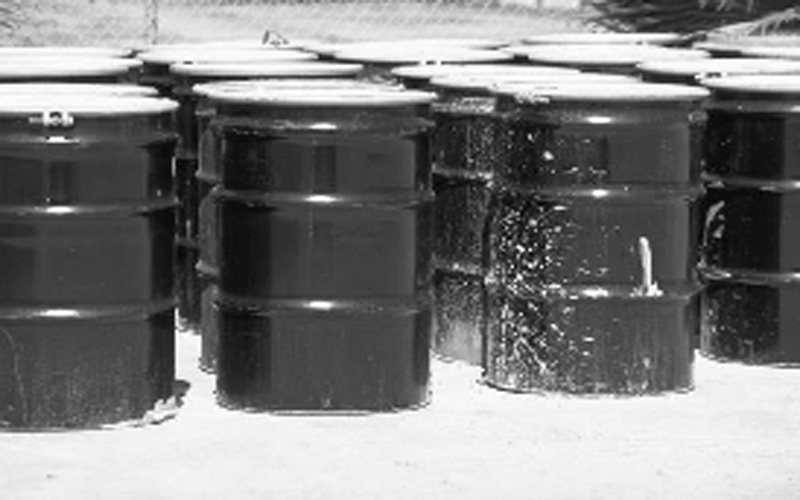
40 CFR 279.22(c)(1) requires containers and aboveground tanks to be labeled or marked clearly with the words “Used Oil.” The rule prescribes that wording. “Waste Oil,” “Oil,” a drum number or a pictogram alone does not satisfy it. EPA Region 7 cited this exact paragraph in a settlement arising from a March 2025 inspection.
That settlement is the TCC Materials expedited settlement agreement and final order, Docket RCRA-07-2025-0120, covering a facility at 636 S. 66th Terrace in Kansas City, Kansas (EPA ID KSD985003987, inspected March 25, 2025). EPA assessed $10,000 across eight cited provisions. Item (h) of the alleged violations reads: “40 C.F.R. § 279.22(c) … Failure to clearly label totes of used oil with the words ‘Used Oil.’” The other seven counts were ordinary Part 262 and Part 265 generator findings.
Note what the label requirement does not say. It does not require an accumulation start date, a generator name and address, a hazard pictogram or the words “hazardous waste.” Those belong to other rules. Plants that run their used oil drums through the hazardous waste labeling habit often end up with a compliant hazardous waste label on a container that is still missing the two words Part 279 asks for.
Do I label the underground storage tank or the fill pipe?
The fill pipe. 40 CFR 279.22(c)(2) applies the “Used Oil” marking requirement to the fill pipes used to transfer used oil into underground storage tanks, not to the tank itself. This is a frequent inspection finding because facilities label the tank riser or the tank shell and leave the fill pipe unmarked.
It reads like a technicality until you watch how the finding happens. An inspector standing in a shop yard cannot see an underground tank. The fill pipe is the only visible part of the system, which makes it both the regulated item and the first thing photographed.
What do I have to do when a used oil container or tank leaks?
40 CFR 279.22(d) prescribes four steps in order: stop the release; contain the released used oil; clean up and manage properly the released used oil and other materials; and if necessary, repair or replace any leaking used oil storage container or tank before returning it to service. The paragraph applies to releases not covered by 40 CFR Part 280, Subpart F.
The fourth step is the one facilities skip. Stopping, containing and cleaning up a drip happens the same afternoon. Putting the drum back in the same spot, still rusted at the chime, still weeping at the bung, is the default outcome unless someone owns the repair-or-replace decision. The rule makes returning a leaking container to service a violation on its own, independent of the spill that revealed it.
Two more paragraphs in the same section carry the rest of the storage program. 279.22(a) allows a generator to store used oil only in tanks, containers, or units subject to 40 CFR Part 264 or 265, and the section’s lead-in also subjects generators to Spill Prevention, Control and Countermeasure requirements under 40 CFR Part 112 and to underground storage tank standards under 40 CFR Part 280 for used oil held underground, again whether or not the oil is characteristically hazardous. If your used oil tank pushed the site over an SPCC threshold, the plan obligation is real and separate (see what an SPCC plan actually requires). 279.22(b) requires containers and aboveground tanks to be “(1) In good condition (no severe rusting, apparent structural defects or deterioration)” and “(2) Not leaking (no visible leaks).”
Federal storage duration is a different question with a different answer, and it belongs to our post on in-plant waste management for manufacturing, which covers how long material can sit before the clock matters.
What is the rebuttable presumption for used oil, and what halogen level triggers it?
40 CFR 279.10(b)(1)(ii) presumes used oil containing more than 1,000 ppm total halogens has been mixed with halogenated hazardous waste listed in 40 CFR Part 261, Subpart D, and is therefore hazardous waste. A generator may rebut the presumption by demonstrating the oil contains no hazardous waste, for instance that it holds no significant concentrations of the halogenated constituents listed in Part 261, Appendix VIII.
Two carve-outs sit inside the same paragraph and they matter to machine shops. The presumption does not apply to metalworking oils or fluids containing chlorinated paraffins when they are processed through a tolling arrangement under 279.24(c) to reclaim metalworking oils and fluids. It also does not apply to used oils contaminated with chlorofluorocarbons removed from refrigeration units when those CFCs are destined for reclamation. Both carve-outs collapse the moment the material goes somewhere else: the presumption applies in full if those fluids are recycled any other way or disposed, and it applies to CFC-contaminated oil that has been mixed with used oil from other sources.
The rebuttal is a documentation exercise, not a phone call. A facility that wants the option available later needs sampling, constituent-level analysis and a written demonstration on file before the shipment, not after an inspector asks why a 1,400 ppm result left the site as used oil.
Why does Part 279 have both a 1,000 ppm and a 4,000 ppm total halogen number?
They answer different questions. The 1,000 ppm figure in 40 CFR 279.10(b)(1)(ii) is the hazardous waste presumption. The 4,000 ppm figure in 40 CFR 279.11 Table 1 is the maximum for on-specification burning. Oil at 2,000 ppm halogens passes the burn specification and fails the presumption at the same time; footnote 2 to 279.11 routes it to 40 CFR Part 266, Subpart H unless the presumption is rebutted.
This is the single most expensive misreading in the part. Two total-halogen numbers appear a few hundred feet apart in the CFR, both expressed in parts per million, both about halogens, and a technician holding a 2,000 ppm lab report can reasonably conclude the oil is fine because it came in under 4,000. The on-specification determination governs one activity: burning for energy recovery. It says nothing about whether the oil is presumed to be hazardous waste for every other purpose, including shipment off site.
What are the used oil specification limits in §279.11?
40 CFR 279.11 Table 1 sets arsenic at 5 ppm maximum, cadmium at 2 ppm, chromium at 10 ppm, lead at 100 ppm, total halogens at 4,000 ppm, and flash point at a 100°F minimum. Used oil not exceeding any allowable level is not subject to Part 279 when burned for energy recovery, provided the person complies with 40 CFR 279.72, 279.73 and 279.74(b).
Read the flash point row carefully, because it runs opposite to every other line in the table. Arsenic, cadmium, chromium, lead and total halogens are ceilings. Flash point is a floor: the oil must flash at 100°F or above. Oil that flashes low has almost always picked up solvent, which is a mixing problem rather than a specification problem, and the mixing rules below decide what the drum actually is.
The specification is also not a status badge. Meeting it does not make the oil clean, it makes a specific downstream activity available, and only for the person who complies with the marketer and burner provisions at 279.72, 279.73 and 279.74(b).
What happens if used oil gets mixed with a hazardous waste?
Under 40 CFR 279.10(b)(1)(i), a mixture of used oil and any listed hazardous waste is regulated as hazardous waste, full stop. For a characteristic waste, 279.10(b)(2) asks whether the resulting mixture exhibits a characteristic: if it does, the mixture is hazardous waste; if it does not, it stays used oil. 279.10(b)(2)(iii) keeps ignitable-only mixtures as used oil if the resulting mixture does not exhibit ignitability under 40 CFR 261.21.
Mixing is the largest source of accidental hazardous waste generation in this program, and it almost never happens as a decision. It happens when a parts washer gets dumped into the used oil drum at the end of a shift, when a drum labeled for oil becomes the shop’s general liquids drum, or when a vendor’s tote of unknown provenance gets consolidated into the bulk tank. A listed waste contribution is unforgiving: there is no concentration at which the mixture returns to being used oil.
The ignitable-only case at 279.10(b)(2)(iii) is the one forgiving path. Ignitable-only mineral spirits mixed into used oil remain used oil as long as the resulting mixture does not itself exhibit ignitability. There is also a quantity-based path at 279.10(b)(3), which treats mixtures of used oil and hazardous waste from a very small quantity generator regulated under 40 CFR 262.14 as used oil. Note the current term: eCFR says very small quantity generator, not the older conditionally exempt small quantity generator. If you are not certain which generator category your site lands in for a given month, that determination is a monthly arithmetic exercise, and we walk through it in hazardous waste generator categories. One wrinkle for Kansas facilities: EPA’s authorization of the Kansas program found the state rules analogous to the federal used oil provisions except for 279.10(b)(3), the very small quantity generator mixing allowance (78 FR 43810).
Polychlorinated biphenyls get their own cutoff. Under 40 CFR 279.10(i), used oil under 50 ppm PCBs stays in Part 279, and oil at 50 ppm or greater is regulated under 40 CFR Part 761 instead.
Are oily rags, absorbents and used oil filters regulated as used oil?
Generally not, once drained. 40 CFR 279.10(c) provides that materials from which the oil has been drained or removed “to the extent possible,” leaving no visible free-flowing oil, are not used oil, though they may still be hazardous waste under other parts. EPA cites 40 CFR 261.4(b)(13) for the Subtitle C exclusion covering hot-drained, non-terne-plated oil filters not mixed with listed hazardous wastes (EPA used oil FAQ).
Two things follow from that paragraph. The test is visible free-flowing oil, which means the filter crusher, the drain rack and the time the filters spend on it are compliance equipment rather than housekeeping. And oil later drained from a material that had already been excluded is used oil again the moment it is collected, which puts the drip pan under the drain rack back inside Subpart C.
Can I burn my own used oil in a shop space heater?
Yes, under three conditions, all of which must hold. 40 CFR 279.23 allows a generator to burn used oil in a used oil-fired space heater only if the heater burns only used oil the owner or operator generates or receives from household do-it-yourself generators; the heater is designed to have a maximum capacity of not more than 0.5 million Btu per hour; and the combustion gases are vented to the ambient air.
Condition (a) is the one that breaks in practice. Taking the neighboring shop’s drums, or a fleet customer’s oil, or a contractor’s leftovers, ends the exemption immediately and moves the facility toward Subpart G burner status. Condition (b) is a design-capacity limit, so it is answered from the nameplate and the manufacturer’s literature rather than from how hard the unit is actually run.
Missouri adds to this list, and its additions cut both ways. Under 10 CSR 25-11.279(2)(C)4, Missouri permits space heaters to burn used oil received from farmers who are not regulated under Subpart C, which is a slightly wider intake than the federal condition. Under (2)(C)5, Missouri prohibits burning used oil mixed with hazardous waste in space heaters, with an exception for ignitable-only conditionally exempt small quantity generator waste. Kansas space-heater conditions and Kansas fuel-specification limits could not be read from the state’s own rule text for this post, so nothing in this section should be applied to a Kansas burner without checking the current Kansas administrative regulation directly.
Do Kansas and Missouri used oil rules differ from the federal rule?
Yes, materially. Missouri’s 10 CSR 25-11.279 incorporates 40 CFR Part 279 as it existed on July 1, 2013 and states that it “does not incorporate any subsequent amendments or additions,” then adds roughly twenty provisions of its own. Kansas’s EPA-authorized KAR 28-31-279 adds disposal and dust-suppressant prohibitions, plus state-only transporter registration and liability insurance (78 FR 43810).
Missouri: incorporated as of July 1, 2013, then layered
10 CSR 25-11.279, “Recycled Used Oil Management Standards” (authority RSMo 260.370), was last amended effective February 28, 2025 per the Missouri Register of January 15, 2025, volume 50, number 2. It incorporates “40 CFR parts 110.1, 112, and 279, July 1, 2013” and then expressly refuses subsequent federal amendments. What Missouri adds on top includes a broader used oil definition reaching spilled oil and dielectric transformer oil at (2)(A); a prohibition on disposing of any used oil in solid waste disposal areas and on disposal into the environment at (2)(B)3; the space heater provisions noted above; a requirement that containers exposed to rainfall be kept closed, repeated across (2)(C)6, (2)(D)4, (2)(E)7, (2)(F)5 and (2)(G)4; notification to the solid waste district or the department for collection centers and aggregation points at (2)(D)2; a 12-month storage limit at collection centers and aggregation points at (2)(D)3; transporter licensing under 10 CSR 25-6.263 at (2)(E)1; secondary containment of at least 10 percent of containerized volume or of the largest container at (2)(E)2, (2)(F)2 and (2)(G)1; an annual filing on form MO 7801555 due August 31 for transporters moving 1,000 gallons or more per reporting period at (2)(E)(3)(B); a shipment inventory log completed within 35 days and kept three years at (2)(E)4 and (2)(E)5; a three-year retention requirement for the Transporter’s Used Oil Shipment Record, form MO 780-1449(4-94), for burners at (2)(G)3; non-incorporation of 40 CFR 279.81 together with a flat prohibition on releasing even non-hazardous used oil at (2)(I)1; a prohibition on used oil as a dust suppressant on roads at (2)(I)2; and low-concentration PCB used oil rules for 2 ppm to under 50 ppm at (3). The rule resolves conflicts in one line: “In the case of contradictory or conflicting requirements, the more stringent rules control.”
Read that date again. A Missouri facility that updated its used oil procedure against the current federal CFR text updated against a document Missouri does not use. The applicable federal baseline in Missouri is Part 279 as of July 1, 2013, plus twenty state provisions, in a state whose own rule says the stricter requirement wins. The regulation text above was read from the Cornell Legal Information Institute copy; the official Missouri Secretary of State code is the controlling version and is what a compliance file should cite.
Kansas: authorized, with state-only additions EPA does not enforce
EPA authorized the Kansas used oil program at 78 FR 43810 (docket EPA-R07-RCRA-2013-0447), effective September 20, 2013, finding KAR 28-31-279 analogous to the federal used oil provisions across Subparts A through I, except 40 CFR 279.10(b)(3). In Section H.2 of that notice EPA identifies which Kansas provisions are more stringent than federal: KAR 28-31-279(b)(2) prohibits used oil as a dust suppressant; KAR 28-31-279(a)(1) prohibits disposal of used oil on or into sewers, storm drains, surface water, groundwater or the ground; and KAR 28-31-279a(a)(2) prohibits use as a coating, sealant, dust suppressant, pesticide carrier or similar application.
EPA separately classifies KAR 28-31-279a(b) and KAR 28-31-6, which subject used oil transporters to registration with the Secretary and to liability insurance, as broader in scope. That phrase has teeth. Broader-in-scope provisions are Kansas law but are not federally enforceable under RCRA, which means a Kansas facility can be in flawless federal compliance and still be cited by KDHE under the state rule. The federal inspection and the state inspection are not asking the same questions.
One honest limit on this section: the Kansas regulation text itself was not available for this post, and every Kansas statement above traces to EPA’s own description in the 2013 authorization notice. That is a primary federal source, and it is a 2013 snapshot rather than a current-status check. Confirm the live Kansas text before relying on it. The same discipline applies outside Region 7: Oklahoma DEQ, TCEQ and NDEE used oil rules were not reviewed here and must be checked separately rather than assumed to track the federal part.
What is the maximum penalty for a used oil violation?
40 CFR 19.4 Table 1 sets the RCRA Section 3008(a)(3) statutory maximum at $124,426 per day per violation and Section 3008(g) at $93,058 per day per violation, for penalties assessed on or after January 8, 2025 (90 FR 1377). The table has no 2026 column. OMB Memorandum M-26-11 cancelled the 2026 inflation adjustment, so the 2025 levels remain in effect.
Those are statutory ceilings, not forecasts. The two verified Region 7 used oil cases settled at $10,000 and $337,253 respectively, and in the larger case the used oil count was one of four. What the ceiling does is set the arithmetic a facility is arguing against once a count is written.
The federal rule has not moved. What moved is everything around it
The standard compliance alert says the rule changed and your procedure is stale. For Part 279 that framing is simply wrong, and getting it wrong sends facilities to the wrong document.
eCFR displays Part 279 as up to date as of October 22, 2026, and the section-level timelines for 279.11, 279.21, 279.22 and 279.23 each read “No changes found for this content after 1/03/2017.” The source notes are older still: 279.22, the paragraph behind both verified enforcement counts above, has not been amended since 63 FR 24969 on May 6, 1998. 279.21 and 279.23 trace to 58 FR 26425, May 3, 1993. 279.1 and 279.11 trace to 71 FR 40280, July 14, 2006. The newest amendment in any section read for this post is 81 FR 85828, November 28, 2016, at 279.10. No Part 279 compliance date, phase-in or rulemaking deadline is pending, and no EPA deregulatory action, proposed rule or rulemaking docket touching Part 279 was identified in the research behind this post. That is a statement about what was found, not a guarantee that nothing is in motion.
The second piece of the usual framing also fails this year. There was no January 2026 RCRA penalty increase. OSHA’s May 21, 2026 memo explains the government-wide reason, citing OMB Memorandum M-26-11, “Cancellation of Penalty Inflation Adjustments for 2026,” and the absence of the required October 2025 CPI-U data from BLS during the government shutdown. We covered the mechanics in the 2026 penalty schedule freeze. Any content telling you your used oil exposure went up in January 2026 is reporting an adjustment that did not happen.
So where is the actual movement? In the states, and in what inspectors do with the paragraphs that have been sitting unchanged for a quarter century. Missouri pinned its rule to a 2013 federal snapshot and layered twenty provisions on top. Kansas added transporter obligations that EPA expressly says it cannot enforce. Both of those are live variables. The federal text is not.
What the pattern in Region 7 actually looks like
In both verified Region 7 used oil cases, the used oil count was a labeling count, and in both it rode along on an inspection that had been opened for other reasons. The Kansas City manufacturer’s other three counts were a hazardous waste determination failure, operating a treatment, storage and disposal facility without a permit, and universal waste. TCC Materials’ other seven counts were Part 262 and Part 265 generator findings. Nobody drove to either plant to look at used oil.
An EPA Region 7 news release dated December 2, 2024 announced $182,879 in combined penalties against two Kansas packaging operations plus roughly $710,000 in facility upgrades, and listed “failing to comply with universal waste and used oil management regulations” among the violations. The release cites no CFR section and gives no docket number, so treat it as texture rather than as a citable used oil count. The two cases with dockets are the ones that support a claim.
Draw the narrow conclusion, which is the useful one: the hard parts of Part 279 on paper are the halogen presumption and the specification table, and the part that generates counts in Region 7 is a two-word label. Nothing in the available record supports a statement about national used oil enforcement volume or direction, and this post does not make one.
Work the walkaround in this order
Three Part 279 obligations are visible without a lab, a file review or an interview. They are also the three that produced the enforcement counts above. A plant manager can close them in an afternoon.
- Every container and aboveground tank holding used oil carries the words “Used Oil.” Not “Waste Oil,” not a drum number, not a pictogram (40 CFR 279.22(c)(1)). Walk the maintenance shop, the tool room, the compressor room, the wash bay and the oil house, and count the 4-quart containers along with the drums and totes. The Kansas City count was two containers of a size most inventories never record.
- Every fill pipe into an underground used oil tank is marked. The tank is not the labeled item; the fill pipe is (40 CFR 279.22(c)(2)).
- Every container and aboveground tank passes the 279.22(b) look test. No severe rusting, no apparent structural defects or deterioration, no visible leaks. Anything that fails goes through the 279.22(d) sequence, including the fourth step: repair or replace before returning it to service.
Then work the four questions that need a file rather than a walk. Has anything other than used oil ever entered these containers, and can you show it (279.10(b))? Do you have halogen data, and if a result exceeded 1,000 ppm, is the rebuttal documentation written and on file before the next shipment (279.10(b)(1)(ii))? If a space heater burns used oil on site, does it meet all three conditions at 279.23, including the oil-source condition? And which document is your written procedure actually benchmarked against, the current federal CFR or the state rule that governs the site?
In Missouri, that last question has a specific wrong answer, and a lot of plants are holding it.
iSi’s environmental compliance team runs used oil and RCRA generator reviews across Kansas, Missouri, Nebraska, Oklahoma and Texas, which includes walking the containers an inventory list never captured, reconciling a site’s written procedure against the state rule that actually governs it instead of the federal text, and building the halogen rebuttal file before a shipment needs it. To have your used oil program checked before an inspection opened for another reason finds it, talk to an iSi environmental specialist. We respond the same day.
We Plug In. You Level Up.
Sources
- eCFR, 40 CFR Part 279, Standards for the Management of Used Oil (displayed up to date as of 10/22/2026): https://www.ecfr.gov/current/title-40/chapter-I/subchapter-I/part-279 (verified 2026-11-11)
- eCFR, 40 CFR 279.1, definitions (source note 71 FR 40280, July 14, 2006): https://www.ecfr.gov/current/title-40/chapter-I/subchapter-I/part-279/subpart-A/section-279.1 (verified 2026-11-11)
- eCFR, 40 CFR 279.10, applicability, including the rebuttable presumption at (b)(1)(ii), the mixing rules at (b), the drained-materials provision at (c), the diesel mixing exemption at (d)(2), the de minimis wastewater provision at (f) and the PCB cutoff at (i) (source note 81 FR 85828, Nov. 28, 2016): https://www.ecfr.gov/current/title-40/chapter-I/subchapter-I/part-279/subpart-B/section-279.10 (verified 2026-11-11)
- eCFR, 40 CFR 279.11, used oil specifications, Table 1 (source note 71 FR 40280): https://www.ecfr.gov/current/title-40/chapter-I/subchapter-I/part-279/subpart-B/section-279.11 (verified 2026-11-11)
- eCFR, 40 CFR 279.21, mixing with hazardous waste (source note 58 FR 26425, May 3, 1993): https://www.ecfr.gov/current/title-40/chapter-I/subchapter-I/part-279/subpart-C/section-279.21 (verified 2026-11-11)
- eCFR, 40 CFR 279.22, used oil storage, including storage unit types at (a), condition at (b), labeling at (c)(1) and (c)(2) and release response at (d) (source note 63 FR 24969, May 6, 1998): https://www.ecfr.gov/current/title-40/chapter-I/subchapter-I/part-279/subpart-C/section-279.22 (verified 2026-11-11)
- eCFR, 40 CFR 279.23, on-site burning in space heaters (57 FR 41612, Sept. 10, 1992, as amended at 58 FR 26425, May 3, 1993): https://www.ecfr.gov/current/title-40/chapter-I/subchapter-I/part-279/subpart-C/section-279.23 (verified 2026-11-11)
- eCFR, 40 CFR 19.4, civil monetary penalty inflation adjustments, Table 1 (latest amendment 90 FR 1377, Jan. 8, 2025): https://www.ecfr.gov/current/title-40/chapter-I/subchapter-A/part-19/section-19.4 (verified 2026-11-11)
- EPA, Managing Used Oil: Answers to Frequent Questions for Businesses (261.6(a)(4) regulation of recycled used oil regardless of characteristic; transfer facility holding period of more than 24 hours but not more than 35 days; 261.4(b)(13) oil filter exclusion): https://www.epa.gov/hw/managing-used-oil-answers-frequent-questions-businesses (verified 2026-11-11)
- EPA Region 7 consent agreement and final order, 2023, Kansas City, Missouri manufacturer, $337,253, Count 4 used oil labeling (identifying details withheld; consent order on file, verified 2026-11-11)
- EPA Region 7, In the Matter of TCC Materials, expedited settlement agreement and final order, Docket RCRA-07-2025-0120, $10,000, item (h) used oil tote labeling, inspection March 25, 2025: https://yosemite.epa.gov/OA/rhc/EPAAdmin.nsf/Filings/2844A5A9FDEE798385258CE7007AB566/$File/TCC%20Materials%20Expedited%20Settlement%20Agreement%20and%20Final%20Order.pdf (verified 2026-11-11)
- EPA Region 7 news release, December 2, 2024, Kansas packaging companies, $182,879 combined penalties (corroborating texture only; no CFR section or docket cited): https://www.epa.gov/newsreleases/epa-penalizes-kansas-packaging-companies-alleged-hazardous-waste-violations (verified 2026-11-11)
- Federal Register, 78 FR 43810, State of Kansas; Authorization of State Hazardous Waste Management Program, docket EPA-R07-RCRA-2013-0447, effective September 20, 2013 (Kansas more-stringent and broader-in-scope used oil determinations at Section H.2): https://www.federalregister.gov/documents/2013/07/22/2013-17566/state-of-kansas-authorization-of-state-hazardous-waste-management-program (verified 2026-11-11)
- Missouri, 10 CSR 25-11.279, Recycled Used Oil Management Standards, authority RSMo 260.370, last amended effective February 28, 2025 per Missouri Register, January 15, 2025, vol. 50, no. 2. Text read from the Cornell Legal Information Institute copy; the official Missouri Secretary of State code is the controlling version: https://www.law.cornell.edu/regulations/missouri/10-CSR-25-11-279 (verified 2026-11-11)
- OSHA memorandum, May 21, 2026, 2026 Annual Adjustments to OSHA Civil Penalties, citing OMB Memorandum M-26-11, Cancellation of Penalty Inflation Adjustments for 2026: https://www.osha.gov/memos/2026-05-21/2026-annual-adjustments-osha-civil-penalties (verified 2026-11-11)
- Federal Register citations referenced: 63 FR 24969 (279.22, May 6, 1998); 58 FR 26425 (279.21 and 279.23, May 3, 1993); 71 FR 40280 (279.1 and 279.11, July 14, 2006); 81 FR 85828 (279.10, November 28, 2016); 90 FR 1377 (40 CFR 19.4 penalty adjustment, January 8, 2025); 78 FR 43810 (Kansas program authorization, July 22, 2013)
Frequently Asked Questions
Is used oil a hazardous waste?
Not by default. Used oil is regulated under 40 CFR Part 279 as a recycling rule, and Part 279 applies whether or not the oil exhibits a hazardous waste characteristic (40 CFR 279.10(a)). It becomes hazardous waste if it is mixed with a listed hazardous waste, if a mixture exhibits a characteristic, or if the 1,000 ppm total halogen presumption applies and is not rebutted.
Does a small shop have fewer used oil obligations than a large plant?
No. Part 279 has no generator size categories. There is no equivalent of the very small quantity generator, small quantity generator and large quantity generator tiers in Part 262. Every facility that generates used oil from its own operations carries the same Subpart C obligations.
What words have to be on a used oil drum?
The words “Used Oil,” clearly labeled or marked, on containers and aboveground tanks (40 CFR 279.22(c)(1)). For underground storage tanks, the marking goes on the fill pipe used to transfer oil into the tank (40 CFR 279.22(c)(2)).
Does the federal used oil rule still govern in Missouri?
Only as it read on July 1, 2013. Missouri’s 10 CSR 25-11.279 incorporates 40 CFR Part 279 as of that date and states it does not incorporate subsequent amendments or additions, then adds roughly twenty state provisions. The rule specifies that where requirements conflict, the more stringent one controls.
Did RCRA penalties go up in January 2026?
No. 40 CFR 19.4 Table 1 has no 2026 column. Its most recent amendment is 90 FR 1377 (January 8, 2025), and OMB Memorandum M-26-11 cancelled the 2026 inflation adjustment government-wide, so the 2025 maximums of $124,426 per day under RCRA Section 3008(a)(3) and $93,058 per day under Section 3008(g) remain in effect.