OSHA Hexavalent Chromium Standard: Case Study + Full Compliance Rules
OSHA's hexavalent chromium standard, corrected for 2026: the 5 µg/m³ PEL, the real penalty numbers, and a case study mapped to exact subsections.
⚡ In short: OSHA’s hexavalent chromium National Emphasis Program is still active. CPL 02-02-076 sits on OSHA’s live directives list as of August 2026. The PEL is 5 µg/m³ (8-hour TWA) and the action level is 2.5 µg/m³ under 29 CFR 1910.1026, 1926.1126 (construction), and 1915.1026 (shipyards). What changed is the money: no inflation adjustment for 2026, and a July 2025 expansion of penalty reductions for small employers. The case study below is rebuilt on current numbers and mapped to the subsections each citation lands on.
This post has been updated because parts of the original were wrong, and they were the parts a plant manager would catch: a compressed-air prohibition the regulation does not contain, a cement exposure the standard excludes, an aerospace control level applied to the whole aircraft industry, and a penalty total labeled as a minimum when it was a maximum. Everything below was checked against OSHA’s standard-number pages and penalty memoranda on 2026-08-31.
The regulatory spine held up. The PEL, the action level, both citations, the monitoring cadence, the notification split, and the National Emphasis Program all verify. The enforcement economics are what moved.
Who Is Covered by the Hexavalent Chromium Standard
Operations that routinely fall under 1910.1026:
- Metal finishing, surface preparation, and electroplating, including hard chrome, decorative chrome, and anodizing
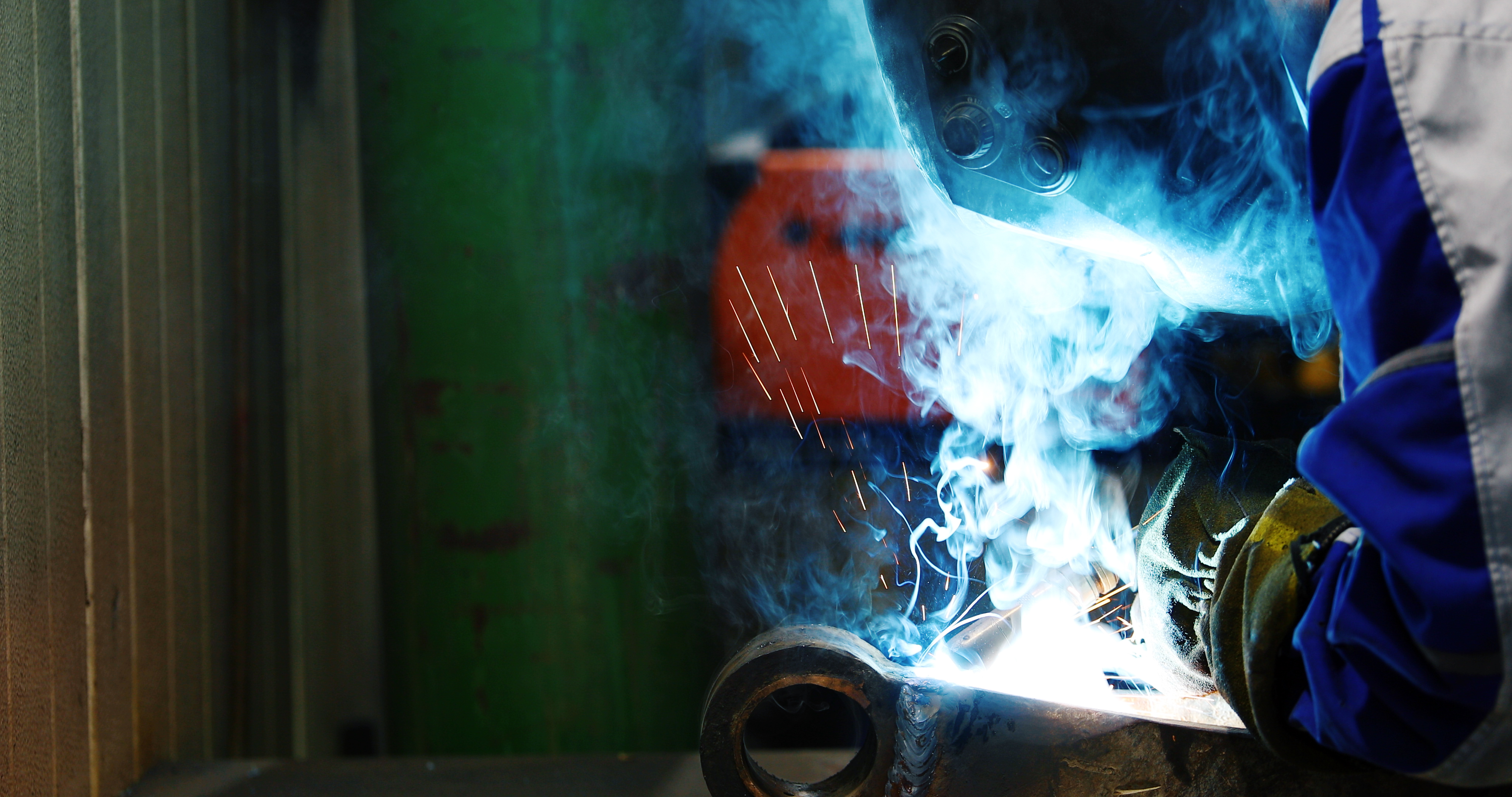
- Welding on stainless steel and high-chromium alloys
- Spray painting and abrasive blasting of chromate primers and paints
- Iron and steel mills, foundries, and molten metal handling
- Aircraft and aircraft parts manufacturing
- Printing, tanning, leather handling, catalyst production, and chemical mixing
- Waste handling downstream of any of the above
The standard has three written scope exclusions, and two of them are worth money to the right facility.
Is there an exposure level below which the Cr(VI) standard does not apply at all?
Yes. 1910.1026(a)(4) exempts operations where the employer holds objective data showing the material or process cannot release hexavalent chromium at or above 0.5 µg/m³ as an 8-hour TWA under any expected condition of use. That is one-tenth of the PEL. The supporting data has to be documented and retained under 1910.1026(m)(3).
That is a real off-ramp. Prove it once, document it, and stop running a monitoring program you do not owe.
Does OSHA’s hexavalent chromium standard apply to portland cement and concrete work?
No. 29 CFR 1910.1026(a)(3) and the parallel scope in the construction standard expressly exclude exposures to portland cement from the Cr(VI) standard. Chromium in cement is handled under hazard communication and general PPE duties instead. An earlier version of this post listed cement work as covered. It is not.
OSHA Inspection Case Study: Three Citations, Three Subsections
A metal finishing client of iSi was already working toward full compliance. iSi ran the quarterly monitoring and the employee notices; the company handled the rest. An employee complaint brought OSHA onsite, and the facility was already on the NEP target list.
The inspection produced three violations, two of them grouped. Here is where each one actually lands in the regulation.
Violation 1, change room separation. Cited under 1910.1026(i)(2). The company had a locker area behind three paint booths, but nothing marked where the booth area ended and the clean area began, and protective clothing shared lockers with street clothes. The regulation requires change rooms with separate storage that prevents cross-contamination. Mixed lockers fail that test on sight.
Violation 2, washing facility access. Cited under 1910.1026(i)(3)(i). The available sink was far enough from the work area that OSHA determined contamination could travel outside the regulated area. The regulation’s test is “readily accessible” washing facilities meeting 29 CFR 1910.141, which is a location test rather than an existence test. Note also (i)(3)(ii), which requires employees to wash hands and face at the end of the work shift, not only before eating.
Violations 1 and 2 were grouped and cited at the serious level for $8,192.
Violation 3, break area contamination. Cited under 1910.1026(i)(4)(i). OSHA has no numeric surface limit for hexavalent chromium. What the regulation requires is that eating and drinking areas be maintained as free as practicable of Cr(VI). Wipe samples in the break room came back low but clearly detectable, and that was enough to support the citation. Serious violation, $5,461.
An earlier version of this post reported that wipe result in µg/m³, an air-concentration unit that cannot describe a wipe. Surface loading is reported in µg/100 cm² or µg/ft². The number is not republished here, because a wipe result without its correct unit and sampled area tells a reader nothing.
The company took an Expedited Informal Settlement Agreement and closed the case above $8,000.
Need quarterly hexavalent chromium monitoring, program buildout, or a regulated-area walkthrough before OSHA arrives? iSi runs the sampling, writes the program, and audits the physical layout. See our industrial hygiene services →
What Those Penalty Numbers Mean in 2026
The original writeup called the $13,653 total “OSHA’s minimum fine amount for any Serious violation.” That is backwards. $13,653 was a statutory maximum for a single serious violation, and the two amounts are gravity fractions of it: $8,192 is 60 percent and $5,461 is 40 percent. Those fractions date the case to an earlier penalty year, well before 2026.
Here is the current table:
| Violation type | 2026 minimum | 2026 maximum |
|---|---|---|
| Serious | $1,085 | $16,550 |
| Other-than-serious | $0 | $16,550 |
| Willful | $11,823 | $165,514 |
| Repeat | $4,256 | $165,514 |
| Failure to abate | $16,550 per day, generally up to 30 days |
Gravity-based penalty tiers run $7,093 for low gravity, $9,457 to $14,187 for moderate, and $16,550 for high.
Score the same two citations at the two nearest current tiers, moderate plus low, and you get $9,457 plus $7,093, or $16,550 before any reduction. Now run the other end. A shop with 25 employees, a clean five-year history, and immediate abatement stacks reductions that can bring the same pair down toward OSHA’s derived serious minimum of $1,085 each, roughly $2,170 for the two. That is a spread of more than seven to one on identical findings, decided by employer size, inspection history, and abatement speed.
Did OSHA raise its maximum penalties for 2026?
No. OSHA’s May 21, 2026 memorandum confirms there is no inflation-based increase for 2026, because OMB Memorandum M-26-11 cancelled the adjustment after BLS could not produce the required October 2025 CPI-U during the government shutdown. The 2025 amounts carry forward. Maximums stay at $16,550 and $165,514.
Can a small manufacturer get hexavalent chromium penalties reduced in 2026?
Yes, and by more than before. Effective July 14, 2025, OSHA widened the 70 percent size reduction to employers with 1 to 25 employees, extended the 80 percent serious-willful reduction to 20 or fewer employees, raised the history reduction from 10 percent to 20 percent, and added a new 15 percent reduction for immediate hazard correction plus 20 percent for a clean five-year record.
Read those two answers together. Penalties did not rise this year, and the reductions available to a small metal finisher got materially deeper.
The Enforcement Picture, Honestly
Is OSHA’s hexavalent chromium National Emphasis Program still active in 2026?
Yes. CPL 02-02-076, effective February 23, 2010, is still listed on OSHA’s current NEP directives page as of August 2026, with administrative updates in 2015 and 2017. It carries no published expiration date. It is now one of the two oldest active NEPs, alongside lead.
NEP status is easy to get wrong here. The directive is old enough that assuming it lapsed is a reasonable guess, and it is the wrong guess.
What sits alongside it is a smaller enforcement arm. The DOL FY2026 Congressional Budget Justification puts OSHA Federal Enforcement at 1,124 FTE, down from 1,292, a cut of 168 positions or 13.0 percent. Agency-wide the request drops from 1,810 FTE to 1,587, and Susan Harwood training grants go to zero.
Fewer inspectors does not mean fewer rules. The standard, the NEP, and your liability are unchanged, and a complaint still brings someone to your door. Treat this as expected-value risk management rather than an inspection surge.
OSHA’s public Cr(VI) dataset is a cumulative 2006 to 2022 inspection-sampling profile rather than an annual citation series, so no year-over-year trend is claimed here.
Does the Hexavalent Chromium Standard Apply to a Shop With Fewer Than 10 Employees?
Yes, and the National Emphasis Program says so explicitly. CPL 02-02-076 states that establishments with fewer than 10 workers shall be included in this NEP. 1910.1026 has no small-employer exemption. The only size relief is on the penalty side, through OSHA’s gravity-based reduction factors described above.
OSHA’s own count of how many employers sit inside these standards is public. The Paperwork Reduction Act renewal for information collection 1218-0252, published 2026-03-05, puts the figure at 83,780 respondents generating 1,052,617 responses a year, carrying 506,685 annual burden hours and $54,470,426 in other costs. Set that against the staffing side: the DOL FY2026 Congressional Budget Justification puts OSHA Federal Enforcement at 1,124 FTE, down from 1,292. More facilities inside the standard, fewer inspectors available to visit them. That lowers the probability of an inspection and changes nothing about the underlying liability, which is the honest framing for a plant manager deciding where to spend a compliance budget.
Will OSHA Accept Our Own Hexavalent Chromium Sampling Data During an Inspection?
Not on its own. CPL 02-02-076 directs compliance officers not to rely solely on employer sampling data when deciding whether to monitor, and states that NEP inspections where workers are exposed to Cr(VI) are expected to include personal exposure monitoring. For abatement verification of a cited overexposure, employer data alone is not permitted.
The directive’s targeting machinery is worth understanding for a different reason. Area Offices build master lists from commercial business listings against SIC and NAICS codes, randomize them, and work them in inspection cycles. OSHA’s own pilot data shows a meaningful share of randomly selected electroplating establishments did no chromium plating at all, so a general industry listing is not a precision instrument, and anyone selling a Cr(VI) program on imminent inspection probability is overstating the case. Complaints are the different animal: the directive treats complaints and referrals alleging overexposure, elevated biomarkers, or symptoms as priority items handled by inspection.
When the monitoring provision itself gets cited, it gets cited hard. Lane Plating Works Inc. of Dallas was cited $110,200 after a complaint inspection under this NEP: two willful violations at $56,000 for failing to use controls to reduce Cr(VI) exposure and for failing to monitor the chemical periodically, plus 19 serious violations at $54,200. The periodic monitoring failure was charged at the willful level, which is the level that reaches $165,514 per violation in 2026.
How often does OSHA actually find Cr(VI) over the PEL in manufacturing?
Across OSHA’s personal sampling data from 2006 to 2022, 2,397 manufacturing inspections included Cr(VI) sampling, 1,470 of them (61.3 percent) confirmed airborne Cr(VI), and 261 (10.9 percent) exceeded the PEL. In electroplating, plating, polishing and anodizing the over-PEL rate rises to 12.1 percent. In construction it reaches 20.0 percent.
Six of ten sampled manufacturing facilities have detectable hexavalent chromium in the air, and about one in nine is over the limit. Detection is normal; overexposure is the exception. The likely outcome of sampling is a documented pass, which is what you hand the inspector.
For a named case with a real number, Cleveland Brothers Inc. in Camp Hill, Pennsylvania was cited $280,874 across one willful, 18 serious, and two other-than-serious violations after a complaint-initiated inspection.
The Rules, General Industry: 29 CFR 1910.1026
PEL: 5 µg/m³, 8-hour TWA Action level: 2.5 µg/m³, 8-hour TWA
Exposure Determination and Monitoring
Most plants that run a chrome bath, weld stainless, or spray a chromated primer know the two numbers in 29 CFR 1910.1026: the 5 µg/m³ PEL and the 2.5 µg/m³ action level. Fewer know that paragraph (d) contains four separate doors into an air sampling obligation, and that only two of them run on a calendar. The one that catches facilities is the third door, and it opens the week you change something.
How Often Is Periodic Hexavalent Chromium Monitoring Required?
Every six months when the 8-hour TWA is at or above the 2.5 µg/m³ action level, per (d)(2)(iii). Every three months when it exceeds the 5 µg/m³ PEL, per (d)(2)(iv). These are minimum frequencies. Change-triggered monitoring at (d)(2)(vi), covered below, runs on top of them, not instead of them.
The practical consequence of stacking the two is that a facility above the PEL and in the middle of a controls project can owe more than four determinations in a year. The three-month clock keeps running while the engineering work proceeds, and each control change is itself a (d)(2)(vi) trigger.
How Long Do We Have to Tell Employees Their Hexavalent Chromium Results?
Within 15 work days after making the exposure determination, per (d)(4)(i). Construction is tighter at five work days under 1926.1126(d)(4)(i). Where any result exceeds the PEL, the written notice must also describe the corrective action being taken to reduce exposure to or below the limit. Rotating job assignments to hold exposures under the PEL is prohibited under (f)(2).
Note what the window attaches to. It runs from making the determination, not from the date the lab report arrives, and work days are not business days. A holiday inside the window will not extend it the way people assume.
When Can a Facility Legally Stop Hexavalent Chromium Monitoring?
Two paths. 1910.1026(d)(2)(ii) permits discontinuation when initial monitoring is below the 2.5 µg/m³ action level, for the employees that sampling represents. (d)(2)(v) permits it when a periodic result below the action level is confirmed by a second sample taken at least seven days later. Both reset under (d)(2)(vi).
That last clause is the part worth writing into the program document. Discontinuation is conditional on the process staying the same. The moment a qualifying change happens, the additional monitoring obligation fires again regardless of how clean the file was before it, and the employees covered by the old determination are no longer covered by anything. A facility that discontinued monitoring on a clean result and then rebuilt its ventilation or changed its process is back inside paragraph (d).
Note also what (d)(2)(ii) does and does not cover. It discontinues monitoring for the employees that the sampling represented. It does not discontinue it for a job classification, work area, or shift that the sampling design never included.
We Are Adding a New Plating Line. Does OSHA Require Hexavalent Chromium Air Sampling Before We Start It?
1910.1026(d)(1) requires an initial exposure determination for each employee exposed to Cr(VI), and (d)(2)(vi) requires additional monitoring on any change in production process or equipment that may result in new or additional exposures. A new line is both. Sample the new configuration under normal production conditions.
The sequence matters more than the paragraph number. A new or modified process has no exposure history, so there is nothing to fall back on. You cannot carry a result forward from the line it replaced, because the determination has to characterize the exposure the employee is actually getting. Run the sampling once the process is operating at a production rate you would call representative, with the ventilation configured the way it will stay, and with the operator doing the full task set including loading, unloading, and rinse.
What iSi sees in the field is the timing failure rather than the sampling failure. A plant commissions a line, runs it through a shakedown period, intends to sample “once it settles,” and the file still shows nothing months later. Meanwhile the operator has been in that exposure the entire time, and there is no document anywhere establishing what it was.
How Soon After a Process Change Must Cr(VI) Monitoring Be Done?
1910.1026(d)(2)(vi) sets no numeric deadline. It requires additional monitoring when the change occurs, which in practice means as soon as the changed process runs under representative conditions. The only clock in paragraph (d) is the 15 work day notification window at (d)(4)(i), and it starts when you make the determination.
The absence of a number is the problem, not a relief. A six-month or three-month cadence is easy to defend because the date is on a calendar. An obligation that fires on an event and has no stated deadline gets judged after the fact, against what a reasonable employer would have done. If a change happened in February and the sampling happened in November, the gap is the finding.
This is why the change trigger belongs in management of change rather than the industrial hygiene schedule. The IH calendar will produce the six-month and three-month samples on its own. It will never produce the sample that a filler-metal substitution required, because nobody told the calendar.
What Counts as a Change That Triggers Additional Cr(VI) Monitoring?
1910.1026(d)(2)(vi) names six categories: production process, raw materials, equipment, personnel, work practices, and control methods. A seventh trigger is independent of change, any time the employer has reason to believe new or additional exposures have occurred. A filler metal substitution and a ventilation repair both qualify.
Read against a real plant, the six categories cover more than they look like they do:
- Production process. A new bath chemistry, a change from decorative to hard chrome, a move from brush plating to tank immersion, a new rack or barrel configuration, a higher duty cycle on the same line.
- Raw materials. A switch from carbon to stainless base metal. A different electrode or filler classification. A primer reformulation from the coating supplier, which is a change you did not make and may not be told about.
- Equipment. A replacement booth fan, a new lip exhaust, a different HVLP gun, a rebuilt rectifier that runs the line harder than the old one.
- Personnel. A new operator on an existing task. Work practice varies by person, and the standard treats that as capable of producing new exposures.
- Work practices. Moving from wet to dry cleanup. Dropping a pre-rinse step. Changing part dwell time over the tank.
- Control methods. Anything that touches ventilation, fume suppressant dosing, or enclosure. A repair counts. So does a fume suppressant that the supplier reformulated.
The seventh trigger is the one that reaches situations nobody classified as a change. An employee reports symptoms. A biological monitoring result comes back elevated. A visible plume appears where there was none. Each of those is reason to believe new or additional exposures have occurred, and each one starts the obligation on its own.
Can We Use Objective Data Instead of Air Sampling for Hexavalent Chromium?
Yes. 1910.1026(d)(3) permits the 8-hour TWA to be determined from any combination of air monitoring data, historical monitoring data, or objective data sufficient to accurately characterize employee exposure. The employer carries the sufficiency burden and retains the records under (m)(2) and (m)(3).
That is a real option and it is underused. A facility with several years of consistent personal sampling on a stable line does not need to keep generating new data to prove the same thing. A facility holding supplier objective data showing a material cannot release Cr(VI) at or above 0.5 µg/m³ as an 8-hour TWA under any expected condition of use is outside the standard’s scope entirely under 1910.1026(a)(4), with the supporting data retained under (m)(3).
When Is the Performance-Oriented Option Not Defensible in Place of Sampling?
When the data does not match the process you run today. The (d)(3) standard is data “sufficient to accurately characterize” exposure, so historical data from a different bath chemistry, alloy, ventilation configuration, or production rate fails on its face. CPL 02-02-076, OSHA’s hexavalent chromium National Emphasis Program directive, also bars employer data alone for abatement verification.
Four conditions break a (d)(3) reliance, and they are worth checking against your own file before an inspector does:
- Process drift. The data describes the line as it was built. The line has since been rebuilt, rebalanced, or run harder.
- Material substitution. The historical samples were taken on a different alloy, filler classification, or coating formulation.
- Control change. Ventilation was modified or repaired after the data was generated, in either direction.
- Population change. The data represents a job classification that no longer matches how work is divided on the floor.
Then there is the enforcement-side limit, which is the part most compliance programs miss. The National Emphasis Program directive instructs compliance officers not to rely solely on employer sampling data when deciding whether to conduct their own monitoring, and states that NEP inspections where workers are exposed to Cr(VI) are expected to include personal exposure monitoring. For follow-up verification of a cited overexposure, the directive is explicit that use of employer-generated monitoring data alone is not permitted.
So (d)(3) can satisfy your determination obligation and still not end the conversation. Objective data keeps you compliant. It does not keep OSHA’s pump off your operator.
Which analytical method should a lab use for Cr(VI) air samples, and what accuracy does OSHA require?
OSHA Method ID-215 and NIOSH 7605 are the laboratory ion-chromatography methods, and NIOSH 7703 is the field-portable equivalent. Whichever is used, 1910.1026(d)(5) requires the method to be accurate within plus or minus 25 percent at a 95 percent confidence level for airborne concentrations at or above the action level.
Lab selection is a compliance decision. A result you cannot defend on accuracy cannot be used to discontinue monitoring.
Regulated Areas
Establish regulated areas where exposures are or can reasonably be expected to be above the PEL:
- Demarcate the area from the rest of the workplace, per (e)(2)
- Limit access to authorized personnel, per (e)(3)
- No eating, drinking, smoking, chewing, or cosmetics inside, and no consumables carried in, per (i)(5)
Note the citation split. Boundary and access rules live in paragraph (e), while the eating and consumables prohibition lives in the hygiene paragraph (i)(5). A citation for a sandwich in the plating room will not say (e).
What Exposure Level Triggers a Regulated Area for Hexavalent Chromium?
Exposure that is, or can reasonably be expected to be, in excess of the 5 µg/m³ PEL, per (e)(1). The “reasonably be expected” language means a regulated area can be owed before a single sample comes back. Demarcation sits at (e)(2), access control at (e)(3), and the consumables prohibition at (i)(5).
Read that trigger carefully, because it is forward-looking. A new hard chrome line, an indoor stainless welding cell with no local exhaust, or chromate paint removal inside a building are all situations where overexposure can reasonably be expected on the engineering facts alone. Waiting for lab confirmation before demarcating is the wrong sequence, and it is a sequence that shows up in citations. Demarcate on the expectation, then let the sampling tell you whether the area stays.
Engineering Controls and PPE
Engineering and work-practice controls come first. Where they cannot bring exposure to the PEL, reduce as far as feasible and use respiratory protection for the remainder.
Is the 25 µg/m³ aerospace figure an alternate PEL for the aircraft industry?
No. 1910.1026(f)(1)(ii) applies narrowly to painting of aircraft or large aircraft parts in the aerospace industry, requiring engineering and work-practice controls down to 25 µg/m³ and respirators to reach the 5 µg/m³ PEL from there. The separate fewer-than-30-day exemption at (f)(1)(iii) is a different provision that applies to any process.
Earlier versions of this post merged the two. The 25 µg/m³ figure is not a relaxed limit for aircraft manufacturing generally.
Protective Clothing and Equipment
- Contaminated PPE, waste, and debris removed at the end of the shift or task
- Placed in sealed, impermeable bags or containers, labeled per hazard communication
- PPE does not leave the workplace except for laundering, and the launderer must be informed in writing of the potentially harmful effects and of the requirement that Cr(VI) not become airborne
- No shaking, blowing, or brushing down to remove dust
- Waste needs a hazardous waste determination, since chromium content can make debris hazardous
Hygiene Areas
- Change rooms with separate storage preventing cross-contamination between contaminated clothing and street clothes, per (i)(2)
- Washing facilities that are readily accessible and meet 29 CFR 1910.141, per (i)(3)(i)
- Employees wash hands and face at the end of the work shift, per (i)(3)(ii), and before eating, drinking, smoking, chewing, applying cosmetics, or using the restroom
- Eating and drinking areas kept as free as practicable of Cr(VI), per (i)(4)(i), with contaminated clothing and equipment kept out
Housekeeping
- Keep surfaces as free as practicable of Cr(VI) accumulation
- Clean by HEPA-filter vacuuming or other methods that minimize the likelihood of exposure, per (j)(2)(i)
- Dry shoveling, sweeping, and brushing only where HEPA vacuuming or other effective methods have been tried and found not effective
Does OSHA prohibit compressed air for cleaning up hexavalent chromium?
Not absolutely. 1910.1026(j)(2)(iii) allows compressed air in two situations: used together with a ventilation system designed to capture the resulting dust cloud, or where no alternative method is feasible. HEPA vacuuming remains the default, and dry methods are a fallback, but a flat “compressed air is banned” statement misreads the rule.
Medical Surveillance
At no cost to the employee, provide medical surveillance for employees:
- Exposed at or above the action level for 30 or more days a year, per (k)(1)(i)(A), with the initial exam within 30 days of assignment and annually after
- Experiencing signs or symptoms of Cr(VI) exposure
- Exposed in an emergency
- Whenever a PLHCP recommends an additional examination, per (k)(2)(iii)
- At termination, if exposed within the past six months
The two off-by-one errors in the original version of this post both narrowed the trigger. “At or above” pulls in the employee sitting exactly at 2.5 µg/m³, and “30 or more days” pulls in the employee at exactly 30. Inspectors check those boundaries against your exposure records.
HazCom and Training
Include hexavalent chromium in the hazard communication program: labels, safety data sheets, and training. Under (l)(1)(ii), the classification must address at least cancer, eye irritation, and skin sensitization. Training covers the standard and the medical surveillance provisions.
Recordkeeping
Air monitoring records with names, job classifications, dates, locations, methods, results, and PPE worn. Historical monitoring records under (m)(2) and objective data records under (m)(3) if you rely on either. Medical surveillance and training records.
Has OSHA Changed the Hexavalent Chromium Monitoring Rules Recently?
No. The monitoring and notification provisions were last substantively amended by a direct final rule at 75 FR 12681, effective June 15, 2010. The only 2026 Federal Register action touching 1910.1026 is the Paperwork Reduction Act renewal of collection 1218-0252, published 2026-03-05, which changed burden estimates and nothing else.
That 2010 amendment is worth knowing because it went the direction people do not expect. The Third Circuit remanded the notification provision after finding OSHA had failed to explain departing from its proposed standard and its past practice in other standards. The resulting rule broadened (d)(4)(i) from notifying employees of results above the PEL to notifying them of all exposure determinations. Litigation against this standard has moved it in both directions. Appendix A to 1910.1026 still reproduces the October 2006 settlement in which opting-in surface finishing companies secured engineering-controls deadlines and narrowed respirator enforcement.
Where the current deregulatory cycle lands on Cr(VI) is a fair question, and the answer right now is nowhere. Across 2025 and 2026, OSHA has proposed revising a long list of substance-specific health standards, including asbestos, lead, cadmium, benzene, coke oven emissions, inorganic arsenic, formaldehyde, and ethylene oxide. Most would relax substance-specific respirator requirements or strip provisions duplicative of 1910.134. Hexavalent chromium does not appear on that rulemaking list at all. One pending item does reach Cr(VI) sideways: a proposal would remove some medical evaluation requirements in the respiratory protection standard for certain respirator types, and 1910.1026(g) routes respirator selection and use to 1910.134. A final rule on that proposal is pending.
Most Common Hexavalent Chromium Exposures in General Industry
| Operation | Typical Source |
|---|---|
| Electroplating | Hard chrome, decorative chrome, and anodizing baths. Loading and unloading parts, rinsing, replenishing with chromate solution or powder |
| Welding | Stainless welding, and confined-space or indoor welding on stainless and carbon steel. Fume from base metal, coatings, electrodes, and chromium filler metals |
| Painting and blasting | Spray painting with strontium or zinc chromate primers, abrasive blasting of chromate paint, sanding and grinding chrome-covered material. Spent grit carries the waste |
| Foundries and steel mills | Furnace and crane operations, molten metal pouring, tapping, surface conditioning, hot rolling, torch cutting and gouging |
Each of these operations has a different capture problem and a different sampling strategy. Stainless welding fume is the one most often undersampled, because the exposure follows the arc and the operator rather than the room. Our writeup on source capture for multi-operator welding covers the local exhaust side of that, and our piece on when a stainless changeover triggers new Cr(VI) sampling covers the monitoring-trigger side. Paint booth residue is its own regulatory track under 1910.107, which we cover in paint booth cleaning requirements. Plating and anodizing shops carry a parallel EPA air obligation alongside the OSHA exposure duty, covered in chromium electroplating and anodizing under Subpart N and Subpart 6W.
Construction and Shipyards
Construction work is covered by 29 CFR 1926.1126. Same 5 µg/m³ PEL, same 2.5 µg/m³ action level, same portland cement exclusion. The notification window is shorter: within 5 work days of receiving monitoring results, per 1926.1126(d)(4)(i), against 15 work days in general industry. The construction standard is organized differently, so do not assume a paragraph letter carries across. Read 1926.1126 on its own terms.
Shipyard employment has its own standard, 29 CFR 1915.1026, named alongside the other two in the NEP directive’s standard list. Marine coating removal and stainless welding in shipyards fall there.
Construction exposures cluster in chromate paint and primer removal on bridges, water towers, and industrial structures, including cleanup of spent blast grit, and in welding and thermal cutting on stainless and carbon steel, including brazing and boilermaker work.
Compliant and Safe Are Two Different Findings
Is the OSHA PEL a health-protective limit, or just the legal limit?
The 5 µg/m³ PEL is a legal limit that OSHA set on technological and economic feasibility grounds, not a finding that 5 µg/m³ carries no risk. ACGIH’s occupational hygiene benchmark for water-soluble hexavalent chromium sits well below OSHA’s legal limit. A facility can be fully compliant and still be running exposures a hygienist would want lowered.
A useful monitoring report answers two questions: where you stand against the PEL, which decides citation exposure, and where you stand against the hygiene benchmark, which decides worker health and long-term liability.
Do Kansas, Missouri, Oklahoma, Nebraska, Texas, or Colorado have their own hexavalent chromium rules?
No. All six are federal OSHA jurisdictions with no approved State Plan, so 29 CFR 1910.1026 applies directly to private employers with no state variant to reconcile. There is a jurisdictional gap worth knowing: state and local government workers in these states are not covered by federal OSHA, so a municipal shop doing plating, welding, or bridge paint removal falls outside this standard’s enforcement entirely.
Frequently Asked Questions
Q: What is the permissible exposure limit for hexavalent chromium under OSHA?
The PEL is 5 µg/m³ as an 8-hour TWA. The action level of 2.5 µg/m³ triggers periodic monitoring and medical surveillance obligations under 29 CFR 1910.1026 (general industry), 29 CFR 1926.1126 (construction), and 29 CFR 1915.1026 (shipyards).
Q: What are the most common sources of hexavalent chromium exposure in manufacturing?
Electroplating baths for hard and decorative chrome, stainless steel welding, spray painting with chromate primers, abrasive blasting to remove chromate coatings, and foundry and molten metal operations. Each has a different engineering control strategy. One respirator program does not fit all of them.
Q: What must employers include in their hexavalent chromium compliance program?
Initial and periodic exposure monitoring with a written exposure control approach, regulated areas with demarcation and access control, engineering and work-practice controls before respirators, protective clothing handling, change rooms and readily accessible washing facilities, housekeeping, medical surveillance, hazard communication classification and training, and recordkeeping.
Q: What are the consequences of non-compliance?
OSHA enforces under the National Emphasis Program. In 2026 a serious violation runs from $1,085 to $16,550 depending on gravity, employer size, history, and abatement speed, and willful or repeat violations reach $165,514. Complaint-triggered inspections routinely produce citations that stack across multiple hygiene subsections.
Q: How do the general industry and construction rules differ?
The clearest operational difference is the notification window: 5 work days under 1926.1126 against 15 work days under 1910.1026. The PEL, action level, and monitoring triggers match. Beyond that, the construction standard is structured differently, so program documents written against 1910.1026 paragraph letters do not transfer cleanly to a construction site.
Q: Is the waste from hexavalent chromium operations hazardous under RCRA?
Often yes. Debris, spent grit, contaminated PPE, and rinsate commonly carry enough chromium to trigger EPA waste code D007, which applies at a toxicity characteristic level of 5.0 mg/L by TCLP under 40 CFR 261.24. A waste determination is required for each stream, and OSHA compliance on the worker exposure side does not address the EPA side.
Sources
- 29 CFR 1910.1026, Chromium (VI), general industry
- 29 CFR 1926.1126, Chromium (VI), construction
- OSHA memorandum, 2026 Annual Adjustments to OSHA Civil Penalties (2026-05-21)
- DOL/OSHA National News Release, penalty guideline update (2025-07-14)
- OSHA Directives, National Emphasis Program index
- CPL 02-02-076, NEP Hexavalent Chromium
- OSHA Hexavalent Chromium Industry Profile, by sector
- OSHA Hexavalent Chromium Industry Profile, by subcategory
- OSHA State Plans
- DOL/OSHA news release, Cleveland Brothers Inc., $280,874 (2020-02-04)
- DOL FY2026 Congressional Budget Justification, OSHA
- 40 CFR 261.24, Toxicity characteristic
- 29 CFR 1910.1026, eCFR current text
- 29 CFR 1903.15, OSHA civil penalty amounts
- CPL 02-02-076, National Emphasis Program for Hexavalent Chromium, full directive PDF
- FR Doc. 2026-04364, ICR 1218-0252 renewal, Hexavalent Chromium Standards for General Industry (2026-03-05)
- 1910.1026 Appendix A, Third Circuit settlement agreement
- OSHA notice confirming the direct final rule effective June 15, 2010 (75 FR 12681)
- DOL/OSHA news release 15-0042-DAL, Lane Plating Works Inc., $110,200 (2015-02-03)
- OSHA Deregulatory Rulemaking
Items 1 through 12 verified 2026-08-31. Items 13 through 20 verified 2026-10-13.
If you are standing up a new plating, coating, or welding process, the decision in front of you is narrower than the standard makes it look. You need a determination that characterizes the process as it will actually run, a defensible answer on whether historical or objective data covers it, and a regulated-area call made on the engineering facts before the lab report arrives. iSi has run Cr(VI) and coating compliance programs for manufacturers for two decades, and the work is the same every time: personal sampling that meets the plus-or-minus-25-percent accuracy requirement at (d)(5), a written determination that names which employees each sample represents, and a change trigger wired into management of change so the next process modification produces a sample instead of a gap.
See our industrial hygiene services or get a scoped proposal.